
When the World’s Crises Start Driving One Another. Near final draft still going through red team accuracy verification process 10.15.26.
The 15-factor polycrisis: interacting scenarios, planning horizons and the decisions that preserve our capacity to recover.
October 15, 2026 · Version 1.0 · Executive planning overview, 2026–2050 and beyond. Approximately 25 years means 2026–2051; the tables retain the source pages’ 2050 horizon. Based only on six specified Universe Institute and Job One for Humanity pages.
Executive summary: protect the systems that make recovery possible
A corporation can survive a lost shipment and still fail when food, energy, finance, staffing and transport are disrupted together. A government can endure a disaster and struggle when the same event damages its revenue, care system, infrastructure and public trust. A household can repair a building yet lose the income, insurance or services needed to keep living there. These are constructed planning examples of a shared problem: several crises can compete for the same capacity to recover.
The six source pages describe 15 interacting global crisis factors. Climate change is one factor and an important amplifier. Resource depletion, pollution, ecosystem loss, population change, migration, conflict, financial fragility, weak government, authoritarian responses, disease, inequality, AI-enabled manipulation, infrastructure and cyber risk, and trade fragmentation can also initiate or amplify disruption. The direction of influence is not always from climate outward. [S1] [S6]
The central severe scenario is a decline in recovery capacity. Repeated shocks draw on food reserves, repair crews, medical supplies, insurance, public budgets, functioning ecosystems and trusted institutions. If those resources become less dependable, the next shock can cause more damage. Some pathways return to their own causes: shortages can encourage restrictions that deepen shortages; financial losses can reduce protection against further losses; ecological damage can weaken the systems that sustain production.
The main planning periods are now through 2035, 2035–2050, and the long tail beyond 2050. They organize decisions, not a countdown to certain global collapse. Many component pressures already exist. War, the next pandemic, a systemic banking failure and the collapse of a nation have no reliable universal arrival dates in these sources. [S4] [S5]
This guide provides one integrated scenario, 15 factor-based scenario families, four alternative starting points, regional applications and a response framework. The practical task is to fix what we can, identify shared dependencies, and protect essential functions before disruption consumes the options for doing so. An executive reading route is this summary, the complete factor table, planning horizons, integrated scenario and conclusion.
All 15 factors belong in the same assessment
The numbering follows the specified polycrisis page. It identifies categories; it does not rank their probability, urgency or first arrival. Several factors contain very different local situations and time horizons. The detailed scenario families below explain both the outward transmission and the return path. [S1]
| Factor | What changes | Role in a compound scenario |
|---|---|---|
| 1. Population pressure and uneven demographic growth | Population and demand | Changes demand, exposure and the workforce available to maintain services. |
| 2. Overshoot, overconsumption and critical resource depletion | Resources and overshoot | Reduces the dependable material and ecological base on which other systems rely. |
| 3. Pollution of air, water, soil and the food chain | Pollution | Adds chronic harm and can turn an acute disaster into a long cleanup and health burden. |
| 4. Biodiversity loss and ecological breakdown | Biodiversity and ecosystems | Weakens natural functions that support food, water, carbon storage and recovery. |
| 5. Migration, displacement and constrained mobility | Migration and displacement | Transmits needs between locations and can separate people from livelihoods and support networks. |
| 6. Crime, conflict, terrorism and war | Conflict and war | Can destroy the institutions and infrastructure needed to contain every other crisis. |
| 7. Economic fragility and financial instability | Finance and the economy | Spreads losses through household, corporate, lender, insurer and public balance sheets. |
| 8. Political instability and government failure | Government capacity | Determines whether collective protection, fair allocation and recovery continue under pressure. |
| 9. Authoritarianism, executive overreach and harder nationalism | Authoritarian responses | Can change rights, information flows and cooperation while societies manage emergencies. |
| 10. Disease outbreaks, pandemics and antimicrobial resistance | Disease and care | Consumes staff, supplies, income and response capacity across many sectors. |
| 11. Inequality, poverty and social fracture | Inequality and poverty | Determines who can absorb losses and who loses options after a shock. |
| 12. AI-enabled manipulation, surveillance and mass psychological distortion | AI and information disorder | Can alter how people interpret risk, allocate resources and respond to legitimate guidance. |
| 13. Accelerating climate change | Climate change | Applies changing physical pressure to resources, ecosystems, infrastructure and human health. |
| 14. Critical infrastructure fragility and cyber-system disruption | Infrastructure and cyber | Connects physical and digital failures across essential services. |
| 15. Geoeconomic fragmentation, trade weaponization and supply-chain division | Trade fragmentation | Changes whether distant resources, substitutes, equipment and finance remain accessible. |
The groups are neither independent risks nor separate loss accounts. A worker’s lost wages may appear under health, economic disruption and inequality; they remain one underlying loss transmitted through several systems. Equally, an independent outbreak or conflict can worsen a climate emergency without having been caused by climate change.
 The 15 factors can transmit pressures across physical, economic, social and institutional systems. Dashed connections are selected conditional scenario links, not measured interaction weights or a joint probability model.
The feedback dynamics: how one problem changes another
The Climageddon Feedback Loop (CFL) is Job One’s systems-risk framework. It brings together tipping points, reinforcing feedbacks, nonlinear reactions, delays and interactions across systems. Its complete integrated cascade remains a hypothesis. The underlying categories of interaction are well-established areas of research; the exact strength and sequencing of this 15-factor network are not calibrated by the source pages. [S6]
| Dynamic | What to look for | Planning example constructed here |
|---|---|---|
| A common stress | Several systems depend on the same stressed resource or service. | Heat affects workers, care demand and electricity at once. |
| A cascade | An effect moves from one system into another. | A transport interruption becomes a food or medical-supply problem. |
| A reinforcing return path | The consequence worsens the original pressure or vulnerability. | Repair costs displace maintenance, increasing damage in a later event. |
| A threshold or tipping-like transition | A service, institution or ecosystem changes behavior after a boundary is crossed. | A city cannot maintain water service or finance essential repairs. This operational threshold is not automatically a physical tipping element. |
| A nonlinear loss | A small additional pressure produces a much larger consequence. | A spare route is lost while the main route remains closed. |
| A delay or hidden commitment | Present decisions create consequences that unfold later. | Long-lived infrastructure maintains exposure while slow ice or ocean changes continue. |
| A stabilizing response | An intervention reduces pressure or restores capacity. | Reliable relief, prevention, restoration and cooperation interrupt transmission. |
Imagine a bowl of spaghetti whose strands are food, water, energy, health, finance and governance. Tugging one strand can move several others. Several people tugging at once can change the shape of the whole bowl. The executive task is to trace the connections, not to pretend that every strand is identical. A spreadsheet with 15 separate tabs is useful; it does not guarantee the world has agreed to stay inside those tabs.
Three distinctions prevent misleading forecasts. Present evidence for one component does not prove a future nationwide collapse. A reinforcing loop need not grow forever: it can saturate, reverse or be interrupted. A physical threshold, the commitment to change, completed transformation and social consequences can have different dates.
In the illustrations, numbered nodes identify factors. Arrows indicate selected causal pathways or constructed scenario links. Dashed paths identify conditional social or institutional transmission. No numerical edge weights or event probabilities are implied. Lines are selected to explain a mechanism, rather than asserting that every factor directly causes every other factor.
Relative timeframes: three clocks must be kept separate
The source pages primarily offer overlapping planning periods. They do not provide a defensible year-by-year sequence for all 15 crises. A fast service failure can occur while slower demographic, ecological or climate pressures are still accumulating. The duration of recovery may be longer than the next interval available between disruptions. [S1] [S4] [S5]
| Clock | Examples | What the date means |
|---|---|---|
| Event and transmission clock | A power or communications failure; contaminated water; disrupted shipping; emergency information failure. | An operational sequence can develop during an event. Its speed does not date the onset of the entire polycrisis. |
| Accumulation and decision clock | Repeated losses; debt; aging and urban concentration; infrastructure backlogs; inequality; institutional legitimacy. | Evaluate decisions through 2035 and 2050, while checking present exposure. |
| Commitment and recovery clock | Lost old soil carbon; ocean and ice response; ecosystem or cultural loss; long reconstruction. | Effects can persist beyond 2050, including centuries or millennia for some Earth-system responses. |
| Planning horizon | What the sources support | Scenario emphasis |
|---|---|---|
| Now–2030 | Many physical, resource, service, health and social pressures already exist. | Map current dependencies and test simultaneous loss of a primary service and its backup. Keep outbreak, financial and security contingencies active. |
| 2030–2035 | The source pages describe continuing food, water, migration, infrastructure and fiscal pressures; some dated studies fall in this period. | Test recurring production losses with constrained trade, household purchasing power and assistance. Do not treat 2030 as migration’s first arrival. |
| 2035–2050 | A continuing exposure and investment horizon, with possible greater compounding under further warming and weak protection. | Assess long-lived assets, receiving communities, workforce and care capacity, ecological functions and repeated incomplete recovery. |
| After 2050 | Decision legacies and slow physical responses continue. | Separate reopening a service from restoring household wealth, public solvency, community continuity or an Earth-system state. |
| No reliable common date | The next pandemic, world war, broad authoritarian transition, banking collapse, national failure or integrated global cascade. | Keep severe branches conditional and monitor precursors. Undated does not mean distant or negligible. |
How to interpret “likely.” The strongest basis for immediate planning is existing exposure and recognized pathways of transmission. Escalating losses under repeated shocks are a conditional planning case. War, severe repression, global collapse and the most extreme methane branch have less predictable outcomes and timing. This is an evidence distinction, not a new ranking of their probabilities. The source’s judgmental percentages are not multiplied or converted into a joint forecast.
 Planning relevance across now–2035, 2035–2050 and after 2050. These are overlapping assessment horizons, not dates of first arrival, severity scores or collapse deadlines.
One integrated scenario: when the reserves and services needed for recovery weaken
This is a constructed scenario, not a prediction of one inevitable global sequence. Each phase is conditional. It can unfold in a region, a network of businesses or interconnected communities. The same broad pattern can be initiated by a war, outbreak, financial shock or cyber disruption.
Phase 1: several systems begin drawing on the same reserves
Imagine a food-producing and industrial region already managing water and resource pressure (2), pollution (3) and ecological decline (4). Heat, drought, flood or fire (13) damages production while demand and the workforce change (1). Power, transport or water-service disruption (14) reduces output and the ability to obtain substitutes.
The first visible problem may be familiar: higher bills, lost shifts, a missed delivery, a drinking-water advisory or a school closure. What changes the risk is that several affected services depend on the same constrained workers, route, water basin or budget. Relief and inventories can still contain the losses if they remain adequate.
Phase 2: the loss becomes a financial and social problem
Trade restrictions or disrupted international routes (15) make replacement supplies more costly or less accessible. Financial strain (7) reaches businesses, households, insurers and public budgets. Households with fewer resources (11) face a harder choice between food, electricity, care and housing. Some move; others cannot (5).
Receiving places need additional housing, schools, work and medical care. Meanwhile, smoke, heat, contamination or an unrelated outbreak increases health demand (10). The crisis now includes both production and distribution, both food availability and affordability, both damaged property and the capacity to maintain a viable life there.
Phase 3: response capacity and trusted coordination are tested
Government institutions (8) must allocate scarce resources, restore services and maintain confidence. Misleading narratives, scams or AI-enabled manipulation (12) complicate the response. Leaders may choose fair coordination and credible information, or pursue exclusionary and coercive responses (9). Where rivalry, grievances and weak protection are already severe, conflict or organized predation (6) can intensify the problem.
Political breakdown and violence are contingent branches. Disasters can also produce mutual aid and constructive reform. The scenario becomes more dangerous when the chosen response reduces the trust, access, cooperation or resources needed to contain the next disruption.
Phase 4: consequences return to the systems that produced them
Conflict and fragmented trade can further obstruct supplies. Debt and lost revenue can reduce infrastructure maintenance. Household impoverishment can reduce protection. Poorly designed adaptation can transfer exposure or lock it in. Resource and ecological degradation can continue while restoration is deferred. Climate action can lose money and cooperation, while natural climate feedbacks continue independently.
The operational turning point is repeated incomplete recovery. Essential functions are restored less reliably; backlogs and losses accumulate; the same next shock causes more harm. A company may lose continuity, a community may lose viability, or a state may lose essential capacity without every subsystem collapsing at once.
A different ending remains possible
Early protection, reliable services, fair support, functioning ecosystems and cooperation can reduce the demands on those reserves. Prevention can preserve response capacity; preserved response capacity can sustain further prevention. This is the stabilizing branch to test alongside the severe one. It is a proposed decision framework, not a guarantee of success.
 A constructed shortage scenario: constrained production, trade and household purchasing power can interact with financial pressure and deferred protection. Political outcomes depend on circumstances and choices.
The 15 scenario families below use the same factor numbering as the source. Each begins with a different factor, traces a return path and identifies an interruption point. They overlap; they are not independent forecasts to add together.
1. Population pressure and uneven demographic growth
Potential interaction. A fast-growing city needs more housing, water, food, jobs and sanitation. If resource stress (2), climate damage (13) and unreliable infrastructure (14) reduce supply, rents, household costs and inequality (11) can rise. Displacement (5) can add urgent needs in receiving places. In other countries, aging and a shrinking workforce strain care, public finance and maintenance through a different demographic pathway.
The reinforcing return path. When household and public finances weaken (7), investment in services can fall behind demand. The next disruption then affects more people with less protection. Population, consumption, geographic concentration and institutional capacity need separate attention.
What could change abruptly? The city can no longer expand or maintain essential services as quickly as demand changes. This is a proposed operational threshold, not a universal population limit.
Timeframe. Assess now through 2050. Demographic and infrastructure commitments can extend beyond 2050; a service emergency can occur much sooner.
Interruption point. Plan receiving capacity and workforce needs together with water, housing, health and infrastructure. Avoid assigning responsibility for resource consumption simply by counting people. [S1] [S4]
2. Overshoot, overconsumption and critical resource depletion
Potential interaction. Water shortages, degraded soils, stressed fisheries or constrained fertilizer inputs reduce dependable production. Trade fragmentation (15) makes substitutes harder to obtain. Financial pressure (7) and poverty (11) then intensify the consequences of the same physical shortage.
The reinforcing return path. Constructed branch: governments and businesses prioritize immediate output over restoration. Further extraction and damage weaken ecosystems (4) and resource renewal, reinforcing the shortage. This branch depends on choices; scarcity can also motivate efficiency and cooperation.
What could change abruptly? Available supplies and substitutes no longer sustain essential production at affordable cost. The relevant boundary is local or sectoral, not one global resource-exhaustion year.
Timeframe. Present exposure through 2026–2035 and 2035–2050. The source particularly places worsening soil, water and food-input pressure in 2030–2050.
Interruption point. Protect renewal and ecosystem condition alongside supply continuity. Test replacement inputs against the same water, energy, transport and trade constraints. [S1] [S2] [S4]
3. Pollution of air, water, soil and the food chain
Potential interaction. Heat, smoke, flooding or thaw can redistribute contaminants. Industrial releases, sewage, toxic metals, PFAS, plastics and other pollution pressures can affect water, food and health. Ecological damage (4), health demand (10), lost work and household costs (11) can coincide.
The reinforcing return path. Constructed branch: higher care and cleanup costs strain budgets (7, 8), delaying maintenance and remediation. A later flood, fire or infrastructure failure (14) then mobilizes additional contamination.
What could change abruptly? Treatment, containment or cleanup capacity is exceeded. A service can become unusable before the entire physical resource disappears.
Timeframe. Present exposure; acute releases can occur during events, while chronic contamination and cleanup may persist for years or decades. Assess through 2050 and beyond.
Interruption point. Map contamination and industrial sites alongside water, fire, flood and thaw exposure. Protect containment, water treatment and access to care. [S1] [S3] [S4] [S5]
4. Biodiversity loss and ecological breakdown
Potential interaction. Pollination, soil condition, fisheries, habitats and natural hazard buffering can deteriorate under exploitation, pollution (3) and climate stress (13). Food and livelihood losses then reach resource systems (2), finance (7) and inequality (11).
The reinforcing return path. Constructed branch: economic pressure encourages further extraction or land degradation, weakening the remaining ecological buffer. Forest fire and stressed soils can also release carbon or reduce storage, connecting ecological loss back to climate pressure.
What could change abruptly? A damaged ecosystem fails to provide a function on which a community or business depends. Individual ecosystem transitions differ in reversibility, timing and confidence.
Timeframe. Observed losses and present exposure; assess compounding through the 2030s and mid-century. Extinction and some ecosystem changes have much longer or irreversible consequences.
Interruption point. Treat ecosystems as functioning infrastructure. Combine protection and restoration with reduced pressure on the people whose livelihoods depend on them. [S1] [S2] [S3] [S5]
5. Migration, displacement and constrained mobility
Potential interaction. War (6), livelihood losses, climate hazards (13), unaffordable recovery (7) and failing services (14) can encourage or force movement. Receiving places then face adjustments in housing, work, water, schools and health (1, 10). Other people remain exposed because they cannot readily move.
The reinforcing return path. Constructed branch: exclusion, housing scarcity or poorly supported relocation deepen poverty (11). Political manipulation (12) and nationalist responses (9) can reduce cooperation and funding, leaving both displaced and receiving communities less able to manage later shocks.
What could change abruptly? A community loses the service and livelihood network that makes remaining viable, or a receiving system cannot provide essential support. Migration itself is not the failure threshold.
Timeframe. Movement and displacement already occur. The source horizons extend through 2035 and 2050; cultural, educational and community consequences can last generations.
Interruption point. Support voluntary, planned adaptation and the people who remain. Preserve care, schooling, livelihoods and cultural continuity, with receiving communities involved. [S1] [S3] [S4]
6. Crime, conflict, terrorism and war
Potential interaction. Existing political grievances and rivalry can interact with resource pressure (2), inequality (11), weak government (8) and manipulated information (12). A conflict can then damage infrastructure (14), interrupt trade (15), displace people (5) and increase health emergencies (10).
The reinforcing return path. Constructed branch: disrupted food, energy, public revenue and relief deepen insecurity and grievance, making violence harder to end. Security spending and geopolitical competition can also divert resources from adaptation and emissions reduction (13).
What could change abruptly? Essential routes, public services or humanitarian access become persistently unavailable. A wider war is a severe contingent branch, not an inevitable next stage of a drought or food-price rise.
Timeframe. Existing conflicts and spillover risks matter now. Assess contingencies throughout 2026–2050; reconstruction and trust can take decades to restore.
Interruption point. Preserve essential-service and humanitarian coordination, reduce avoidable resource tensions, and assess conflict exposure in supply and recovery plans. [S1] [S4] [S6]
7. Economic fragility and financial instability
Potential interaction. Production interruptions, commodity shocks, insurance withdrawal, property losses and repair obligations can interact. Trade barriers (15), damaged infrastructure (14), reduced work and higher health costs (10) can worsen the strain.
The reinforcing return path. Constructed branch: losses reduce the money available for maintenance, social protection and resilience. Lower protection permits larger losses in another event. Public debt and household debt can therefore reinforce physical vulnerability.
What could change abruptly? Critical functions can no longer be financed or insured on sustainable terms. This can occur locally without a global banking collapse; a systemic financial crisis remains a conditional extension.
Timeframe. Present exposure, repricing and renewal decisions; repeated losses matter through 2035, 2050 and later. No reliable worldwide climate-driven banking-crisis date is provided.
Interruption point. Test cash flow, uninsured losses, debt, revenue and essential maintenance together. Keep accounting of the original loss separate from its transmission through other balance sheets. [S1] [S4] [S6]
8. Political instability and government failure
Potential interaction. Disaster costs, fiscal strain (7), service failures (14), illness (10) and displacement (5) increase demands on public institutions. Perceived unfairness (11) and unreliable information (12) can make cooperation more difficult.
The reinforcing return path. Constructed branch: repeated visible failures erode trust, reducing the capacity to coordinate the next response. Emergency spending crowds out maintenance and prevention, increasing future demands. A government can remain in office while losing the ability to deliver essential public goods.
What could change abruptly? Authorities cannot coordinate essential services, credible guidance or fair resource allocation at the scale required. This is an institutional threshold, not proof of full state collapse.
Timeframe. Present capacity pressures and conditional deterioration throughout 2026–2050. Institutional rebuilding and restored legitimacy can take much longer than physical repairs.
Interruption point. Protect coordination, honest reporting, equitable service delivery and preventive budgets. Assess national and local agencies as an interdependent response system. [S1] [S4] [S6]
9. Authoritarianism, executive overreach and harder nationalism
Potential interaction. Fear, unresolved losses, inequality (11), displacement (5) and manipulated narratives (12) can increase support for coercive or exclusionary responses. Governments may expand surveillance or emergency powers; trade and border restrictions can affect supplies and recovery (15).
The reinforcing return path. Constructed branch: scapegoating and suppressed or unreliable information reduce constructive participation and trust (8). Poorly targeted protection then leaves grievances unresolved, sustaining demand for further coercion.
What could change abruptly? Temporary emergency measures become durable unaccountable controls that impair fair protection and correction of mistakes. A lawful emergency declaration alone does not establish this transition.
Timeframe. Contingent risk throughout both 2026–2035 and 2035–2050. Political outcomes are not scheduled by global temperature.
Interruption point. Maintain accountability, credible communication, fair treatment and review of emergency measures. Cooperation and legitimate protection can interrupt this branch. [S1] [S4]
10. Disease outbreaks, pandemics and antimicrobial resistance
Potential interaction. Heat, smoke, contaminated water, ecological change (4) and interrupted services (14) can increase health burdens or alter some disease risks. Outbreaks and antimicrobial resistance are additional stresses with their own causes. Aging (1), poverty (11) and damaged medical supply chains (15) affect the capacity to respond.
The reinforcing return path. Constructed branch: staff illness and overloaded care reduce service capacity, delaying treatment and ordinary prevention. Household and public financial losses (7) weaken recovery, leaving the next outbreak or heat emergency harder to manage.
What could change abruptly? Demand exceeds accessible care, staffing, treatment or medical supplies. This service threshold differs from the emergence of a new pathogen.
Timeframe. Present care and disease burdens; possible acute surges throughout 2026–2050. No date for the next pandemic follows from these six pages.
Interruption point. Preserve ordinary care and surge capacity together with sanitation, surveillance, staff protection and dependable medical logistics. [S1] [S3] [S4] [S5]
11. Inequality, poverty and social fracture
Potential interaction. Lost wages, illness (10), school interruption, rising food or housing costs and uninsured losses (7) can coincide. People with fewer resources have less access to cooling, safe housing, treatment or relocation (5).
The reinforcing return path. Constructed branch: one shock reduces income and assets; reduced protection increases the next shock’s impact. Learning loss and prolonged illness can carry the disadvantage into later life, while grievances can interact with political instability (8), coercive responses (9) or conflict (6).
What could change abruptly? Households or communities can no longer maintain essentials or recover without enduring loss of livelihood and shelter. Their threshold may be crossed well before a national indicator shows crisis.
Timeframe. Present vulnerability; cumulative consequences through 2035 and 2050, with potentially lifelong and intergenerational effects.
Interruption point. Make protection accessible before households exhaust their options. Evaluate who receives adaptation benefits and who inherits costs or new exposure. [S1] [S4]
12. AI-enabled manipulation, surveillance and mass psychological distortion
Potential interaction. Fear and confusion during shortages, disasters or conflict create opportunities for scams, impersonation, misleading claims and blame narratives. AI-enabled manipulation or surveillance can interact with government weakness (8), coercive responses (9), cyber threats (14) and labor-market disruption (7, 11).
The reinforcing return path. Constructed branch: poor decisions and mistrust obstruct coordinated response; visible response failures provide further material for manipulation. Communities may become less able to distinguish accurate warnings from fraud precisely when reliable information matters most.
What could change abruptly? Trusted guidance cannot reliably reach people or command enough confidence for essential coordination. This is a scenario boundary, not a measured global truth-collapse date.
Timeframe. Current exposure and possible expansion through 2026–2050; emergency information failures can act much faster than demographic or climate change.
Interruption point. Maintain trusted, accessible communication and verification of essential instructions. Judge performance by whether people can act on dependable guidance. [S1] [S4] [S6]
13. Accelerating climate change
Potential interaction. Heat and humidity, water extremes, fire, snow and ice loss, ocean change and coastal hazards affect production, care, assets and movement. Northern amplification, permafrost carbon and weakened land storage can reinforce warming; circulation changes can redistribute regional conditions.
The reinforcing return path. The return path is both physical and social: added natural carbon or lower reflectivity can amplify warming, while war (6), financial strain (7), weak institutions (8) and fragmented trade (15) can obstruct mitigation and adaptation. The full integrated loop is a systems-risk hypothesis.
What could change abruptly? Physical thresholds differ by subsystem. The consequences of crossing one may unfold over decades to millennia. A precautionary CFL planning zone is not an established universal master tipping point.
Timeframe. Many component processes operate now; assess 2026–2040 and 2041–2060 climate horizons alongside 2026–2035 and 2035–2050 human-system horizons. Slow commitments extend beyond 2100.
Interruption point. Reduce greenhouse-gas emissions, protect natural buffers and build service resilience. Preserve the institutions needed to keep those efforts effective under other crises. [S1] [S2] [S3] [S5] [S6]
14. Critical infrastructure fragility and cyber-system disruption
Potential interaction. Heat, flood, fire, storms, coastal change or thaw can damage electricity, water, transport and communications. Cyberattack can interrupt connected services through a different initiating mechanism. Health (10), production (7), supply (15) and public coordination (8) depend on these networks.
The reinforcing return path. Constructed branch: repeated disruption reduces revenue and repair capacity, delaying maintenance and cyber protection. Another failure then occurs in a network with less redundancy and a larger backlog.
What could change abruptly? A shared dependency fails and disables several services or their backups. Owning a backup is insufficient if it shares the failure pathway of the main system.
Timeframe. Present exposure; failures can propagate during an event. Reinvestment and design choices made now shape reliability through 2050 and later.
Interruption point. Test power, water, communications, access, payment and staffing dependencies together. Make alternate arrangements independent of the same critical point of failure. [S1] [S3] [S4] [S6]
15. Geoeconomic fragmentation, trade weaponization and supply-chain division
Potential interaction. Export restrictions, sanctions, tariffs, resource nationalism and conflict (6) can compound climate-related production and transport losses (13, 14). Import-dependent households, businesses and governments face food, fuel, fertilizer or equipment constraints (2, 7, 11).
The reinforcing return path. Constructed branch: shortages motivate hoarding or further restrictions, worsening shortages elsewhere and encouraging retaliation. Reduced cooperation impairs recovery and climate investment, feeding pressures back into other systems.
What could change abruptly? Substitute supplies exist but cannot be accessed quickly or affordably under the prevailing political and logistical conditions. This is distinct from the world physically running out of the resource.
Timeframe. Present fragmentation and conditional supply shocks through 2026–2050. Reorganizing networks and long-lived industrial commitments can shape later exposure.
Interruption point. Evaluate diversification against shared routes, inputs and policy restrictions. Preserve practical cooperation on essential supplies and recovery. [S1] [S4] [S6]
Four alternative starting points: the whole scenario need not begin with climate
| Constructed exercise | Transmission and return path | What to test |
|---|---|---|
| A. Production and affordability first | Resource or ecological stress plus climate damage → food and input constraints → trade and financial strain → poverty and displacement → less capacity to protect production. | Simultaneous regional production loss, constrained imports and households losing purchasing power. |
| B. Conflict and trade first | War or rivalry → energy, shipping, budget and infrastructure disruption → food and health pressure → displacement and institutional strain → further insecurity. | Recovery and essential supplies during impaired international cooperation. |
| C. Infrastructure or finance first | Cyber or physical service failure, or a financial shock → lost production and care access → revenue and household losses → deferred maintenance and protection → greater service vulnerability. | A shared dependency defeating the main system and the proposed backup. |
| D. Health and information first | An outbreak during ordinary heat or other service pressure → staff and medical-supply shortages → economic and fiscal loss → misleading guidance and weakened trust → delayed recovery or prevention. | Care, staffing, trusted communication and basic services under concurrent demands. |
All four exercises are relevant now and across the 2035 and 2050 planning horizons. The sources do not justify ranking one exact sequence as the most probable worldwide. Local exposure, reserves, service dependencies, institutions and response choices determine which exercise deserves the closest attention.
A global organization should also test events in different locations that require the same replacement supplier, emergency equipment, credit, insurer or public assistance. Geographical separation does not necessarily remove a shared dependency. This is an operational inference from the sources’ network-risk framework.
 Different physical and cyber shocks can converge on shared services, affecting care, livelihoods and government response. Reduced protection and repair capacity can increase future service vulnerability.
Climate and northern systems connect fast human crises to slow commitments
The northern-latitude and methane pages explain why distant physical changes belong in a global business or government assessment. Snow and sea-ice retreat can reduce reflectivity. Forest, soil and wetland changes affect carbon storage and release. Thaw can undermine infrastructure or expose contaminants. Warming and freshwater changes can affect ocean circulation. A local northern change can therefore have both local service effects and wider climatic consequences. [S2] [S3]
Further connections include methane-related ground-level ozone that harms health and crops, thaw-related mercury and other contaminants entering water and food systems, and warm or poorly mixed waters interacting with pollution to affect oxygen and harmful algal blooms. These pathways can combine with lost income, stressed care and disrupted food supply rather than remaining separate environmental issues. [S1] [S3] [S5]
| Subsystem combination | Potential connection to the other factors | Timing and confidence limits |
|---|---|---|
| Atmosphere, water vapor, clouds and hydrology | Heat and humidity, changing precipitation, water stress, storms and fire weather affect labor, care, food, electricity and transport. | Many component hazards already occur. Regional outcomes differ; the entire climate system is not one exponential curve. |
| Snow, sea ice, glaciers and land ice | Reflectivity changes can amplify warming; changing runoff affects water and energy; sea-level exposure affects assets, insurance and relocation. | A first practically ice-free Arctic September is a before-2050 projected milestone, not complete summer or winter ice loss. Glacier and ice-sheet responses have different clocks. |
| Land permafrost, fire and carbon storage | Thaw and microbial decay can release CO₂ and methane; fire can remove insulation; ground failure can damage roads, buildings and industrial containment. | Land thaw and local damage already matter. Abrupt thaw can expose carbon quickly while the full carbon response continues for much longer. |
| Shallow shelf systems and deep methane hydrates | Subsea warming and gas pathways can affect methane release; processing of methane in seawater can affect local chemistry and oxygen. | Air temperature is not seabed temperature. Deep responses are generally slow; much deep-water methane is processed before reaching the air. |
| Ocean heat, acidification, oxygen, layering and ecology | Marine heat and chemistry can combine with reef or fishery deterioration, affecting food, livelihoods and coastal communities. | Mechanisms differ and also interact with non-climate pollution and exploitation. No single date describes global marine collapse. |
| North Atlantic circulation | Weakening or a disruptive circulation change can alter regional weather and water conditions, affecting agriculture, energy and trade. | Labrador–Irminger convection and the wider AMOC are distinct. Collapse timing is unresolved. Local cooling can coexist with continued global warming. |
The source pages place several estimated tipping thresholds around 1.5–2°C of global warming and describe a precautionary CFL planning zone around 1.8–2°C. Estimated thresholds have wide uncertainty and are not event deadlines. The sources’ +20% and +30% temperature adjustments are Institute planning assumptions, not IPCC probabilities or corrections that can be applied to every social outcome. [S2] [S6]
Numerical handling for this edition. The previously supplied latitude tables contained multiplier inconsistencies. This article does not reproduce those adjusted band values, choose unverified replacements, or convert global temperatures into dates for war, migration, disease or institutional failure. It also does not add the methane page’s long-term warming synthesis on top of those adjusted curves; overlap and timing would need to be resolved first.
Severe branches retained without turning them into the central forecast
| Contingency | What is retained | What cannot be concluded |
|---|---|---|
| A rapid large methane pulse | The methane page describes a 2013 exercise involving 50 billion tonnes of methane over ten years and a 15–35-year advance of 2°C within that exercise. | The supplied page describes such a rapid pulse as very unlikely this century. Its time advance cannot simply be subtracted from another temperature scenario. |
| Yedoma loss, persistent unfrozen ground and self-heating soil | The source describes deeper thaw, year-round unfrozen pockets, lake feedbacks and a theoretical self-heating “compost bomb.” | A theoretical mechanism or a large reservoir does not establish a near-term global release or a probability of integrated collapse. |
| Hydrate-related slope failure or tsunami | A rare local submarine failure can have abrupt consequences where the geological setting permits it. | No worldwide or mid-century tsunami calendar is supplied. |
| Microbes exposed by thaw | The methane page discusses localized disease exposure and laboratory revival of ancient viruses that infect amoebae. | Those observations do not establish a human pandemic from permafrost or a dated global outbreak. |
| Ice-unloading effects on faults and volcanoes | The primary page retains regional mechanisms linking ice removal with crustal or volcanic systems. | It does not establish a worldwide surge of major earthquakes or a dated supervolcano event. |
| Full circulation collapse or a novel tipping cascade | High-consequence changes merit conditional exercises and monitoring. | Neither a best-estimate threshold beyond 2100 nor an uncertain early warning supplies a guarantee of safety or an inevitable early collapse. |
These branches matter because very large consequences can deserve preparation even with uncertain likelihood. They do not justify neglecting the already-visible pathways through heat, water, services, food, health and finance.
Regional applications: similar dynamics, different starting conditions
The specified polycrisis page includes 15 geographical groupings in addition to its 15 crisis categories. These are retained below to help readers locate combinations relevant to their operations and relationships. The periods are the source author’s conditional judgments; they are not independently calibrated forecasts or deadlines for leaving a country. [S1]
| Geographical grouping | Source danger periods | Interaction to examine |
|---|---|---|
| Sudan, South Sudan and Chad corridor | 2026–2032; 2033–2040 | Conflict, hunger, displacement and response capacity. |
| Central Sahel and northern Nigeria spillover | 2026–2033; 2034–2042 | Insecurity, food, climate shocks and demographic demand. |
| Great Lakes, DRC and Central African Republic | 2026–2034; 2035–2045 | Conflict, hunger, disease and institutional fragility. |
| Yemen and the Red Sea arc | 2026–2033; 2034–2042 | Water, food imports, conflict and shipping. |
| Afghanistan–Pakistan | 2026–2032; 2033–2040 | Water, readiness, fiscal pressure and security spillover. |
| Haiti and fragile Caribbean settings | 2026–2031; 2032–2038 | Violence, hunger, sanitation, storms and infrastructure. |
| Bangladesh and the Bay of Bengal delta | 2028–2035; 2036–2045 | Heat, floods, salinity, urban concentration and livelihoods. |
| Non-Gulf Middle East and North Africa | 2026–2034; 2035–2045 | Water, import dependence, employment and government legitimacy. |
| Pacific atolls and exposed small island states | 2030–2040; 2040–2050 | Coasts, debt, essential imports and relocation capacity. |
| Ukraine and the eastern European frontline | 2026–2032; 2033–2040 | War, energy, infrastructure, budgets and reconstruction. |
| India | 2028–2035; 2036–2045 | Heat, water, pollution, food, urban services and inequality. |
| China | 2030–2038; 2039–2050 | Aging workforce, water, infrastructure and trade confrontation. |
| United States | 2028–2036; 2037–2045 | Climate extremes, insurance, cyber exposure and political trust. |
| Japan, South Korea, Italy, Greece and Spain | 2030–2040; 2040–2050 | Aging, care, pensions, fiscal pressure, imports and climate costs. |
| Egypt, Turkey and Mexico | 2028–2036; 2037–2045 | Water, migration, strategic trade connections and politics. |
Several groupings overlap, and they should not be added as independent exposures. Some places face severe humanitarian risk; major economies can transmit shocks widely through their international roles. The ranking of a country is not a substitute for examining a particular community, supplier, asset or service network.
The source also assigns narrower potential “tipping” windows to regions, but does not supply a common reproducible model for them. This guide uses the broader periods and the associated mechanisms. A national institutional inflection, a physical climate threshold and the completion of a transition are different claims.
Coverage check: the climate consequences remain connected to the whole
All 19 primary and 17 secondary categories from the selected consequence pages are mapped here. They are detailed pathways within the 15-factor framework, rather than 36 additional independent crises. The numbers in the right column refer to the scenario families above. [S4] [S5]
| Primary key | Consequence category | Relevant factors |
|---|---|---|
| P1 | Heat accumulation and extremes | 1, 7, 10, 11, 13, 14 |
| P2 | Dangerous heat and humidity | 1, 10, 11, 13, 14 |
| P3 | Intense rain, floods and wet–dry swings | 2, 3, 7, 13, 14 |
| P4 | Drought, soil drying, desertification and dust | 2, 3, 4, 10, 13 |
| P5 | Storm rainfall, intensity and other hazards | 5, 7, 13, 14, 15 |
| P6 | Seasonal and atmospheric circulation changes | 2, 4, 7, 13, 14 |
| P7 | Fire weather, wildfire and smoke | 3, 4, 5, 10, 13, 14 |
| P8 | Snow, glacier, sea-ice and ice-shelf loss | 2, 5, 7, 13, 14 |
| P9 | Reduced reflectivity / albedo | 4, 13 |
| P10 | Sea level, erosion, flooding and salinity | 2, 5, 7, 13, 14 |
| P11 | Ocean heat, acidification, oxygen and layering | 2, 3, 4, 13 |
| P12 | Reefs and marine-life changes | 2, 4, 5, 7, 13 |
| P13 | Weaker land storage and carbon release | 3, 4, 13, 14 |
| P14 | Species, pests, ranges and ecological timing | 2, 4, 10, 13 |
| P15 | Direct injury, illness and pollution exposure | 3, 10, 11, 13 |
| P16 | Crop, livestock and crop-quality damage | 2, 7, 10, 11, 13 |
| P17 | Ground thaw, unstable slopes and debris flows | 3, 5, 7, 13, 14 |
| P18 | Atlantic and other large-scale circulation | 2, 4, 7, 13, 15 |
| P19 | Ice-unloading geological responses | 13, 14; contingency |
| Secondary key | Consequence category | Relevant factors |
|---|---|---|
| D1 | Work, commuting and schooling | 1, 7, 11, 14 |
| D2 | Food operations and delivery | 2, 4, 7, 14, 15 |
| D3 | Food prices, shortages and hunger | 2, 7, 10, 11, 15 |
| D4 | Water allocation and service stress | 1, 2, 7, 8, 14 |
| D5 | Care overload, disease and mental health | 5, 7, 10, 11, 14 |
| D6 | Infrastructure and service interruption | 7, 8, 10, 14 |
| D7 | Supply instability and commodity shocks | 2, 7, 14, 15 |
| D8 | Insurance, reinsurance and mortgage pressure | 5, 7, 8, 11 |
| D9 | Property, stranded assets and retreat | 5, 7, 8, 11 |
| D10 | Household costs, debt and homelessness | 5, 7, 10, 11 |
| D11 | Inflation, budgets and financial strain | 7, 8, 11, 15 |
| D12 | Migration and constrained mobility | 1, 5, 8, 9, 11 |
| D13 | Crime, policing and emergency powers | 6, 8, 9, 11 |
| D14 | Unrest, democratic erosion and extremism | 6, 8, 9, 11, 12 |
| D15 | Conflict, litigation and regional failure risk | 6, 7, 8, 9, 15 |
| D16 | Culture, identity and local knowledge | 4, 5, 8, 11 |
| D17 | Maladaptation and long-term lock-in | 2, 4, 5, 7, 8, 11, 14 |
Keep easily missed pathways in view: schooling and long-term earnings; cultural continuity and place-based knowledge; mental health; those unable to relocate; liability and accountability; and adaptation that transfers risk. A damaged building, interrupted schooling and lost community relationships have different recovery requirements.
Climate-liability litigation may impose costs or improve accountability and protection. Disasters can encourage cooperation and mutual aid. Migration can be successful adaptation. Protective investments can work well when design, access and maintenance match the conditions. These stabilizing possibilities are part of the same scenario assessment.
Decision points: prevent disruption from consuming the capacity to respond
The following framework is proposed here for executives, public officials, communities and households. It is a way to apply the source mechanisms; it does not supply local engineering standards, investment advice or a universal relocation recommendation.
| Priority | Actionable question | Proposed trigger for review |
|---|---|---|
| Protect essential functions | Which water, food, energy, care, communications, access and payment functions must continue, and what do they share? | One failure can remove several critical functions or defeat the backup. |
| Preserve recovery capacity | Can repair, staffing, reserves and financing restore essential functions before another consequential disruption? | Backlogs persist, repeated assistance is insufficient, or restoration repeatedly takes longer than the available interval. |
| Test access as well as physical supply | Can households or businesses afford and obtain what exists elsewhere? | Essential substitutes are blocked by purchasing power, routes, policy restrictions or shared suppliers. |
| Protect natural and social buffers | What functions do ecosystems, health, learning, public trust and community networks provide? | Physical output appears restored while those underlying functions continue deteriorating. |
| Review long-lived commitments | Does an infrastructure, housing or production decision remain viable over its service life? | Keeping it operational requires conditions outside its assumptions or transfers large exposure to others. |
| Keep information usable | Can people identify and act on credible instructions during an emergency? | Fraud, contradictory guidance or distrust prevents essential coordination. |
| Maintain fair protection | Who can use warnings, care, housing and relocation support, and who cannot? | A protection measure leaves a vulnerable group with reduced options or greater cost. |
| Preserve prevention under pressure | Will urgent repairs, security or debt payments crowd out maintenance, restoration and emissions reduction? | The response improves today’s appearance while increasing dependence or exposure tomorrow. |
A household can use a shorter version: which essentials depend on the same income, route or service; what happens if several fail together; and which decisions preserve options? A community should include those with limited mobility, spare income or access to care. A large organization should connect its footprint with workforce, suppliers, receiving places and public services.
Use the precautionary principle with explicit evidence labels. Prepare for credible severe branches before every uncertainty is resolved. Distinguish observed processes, supported risks, source-author estimates and constructed scenarios. Uncertainty about timing does not establish absence of risk, and it does not turn the earliest conceivable event into the most likely one.
Monitor cross-system signals as well as individual hazards: successive food and energy cost pressure; repeated care overload; insurance or financing difficulty; maintenance backlogs; delayed recovery; degraded water or ecosystems; displaced people without dependable services; and failing trusted communications. These are proposed scenario indicators, not calibrated universal early-warning alarms.
Review contrary evidence. Stronger institutions, reliable trade, effective adaptation, healthier ecosystems and improving recovery should reduce the assessed severity of a branch. Repeated overprediction or weak return connections should also lead to revision. Reward prevention, cooperation and accurate reporting so that organizations learn before losses force the lesson.
 Event transmission, social recovery and physical commitments operate on different clocks. Restoring one service does not restore all the functions needed for a community or institution to remain viable.
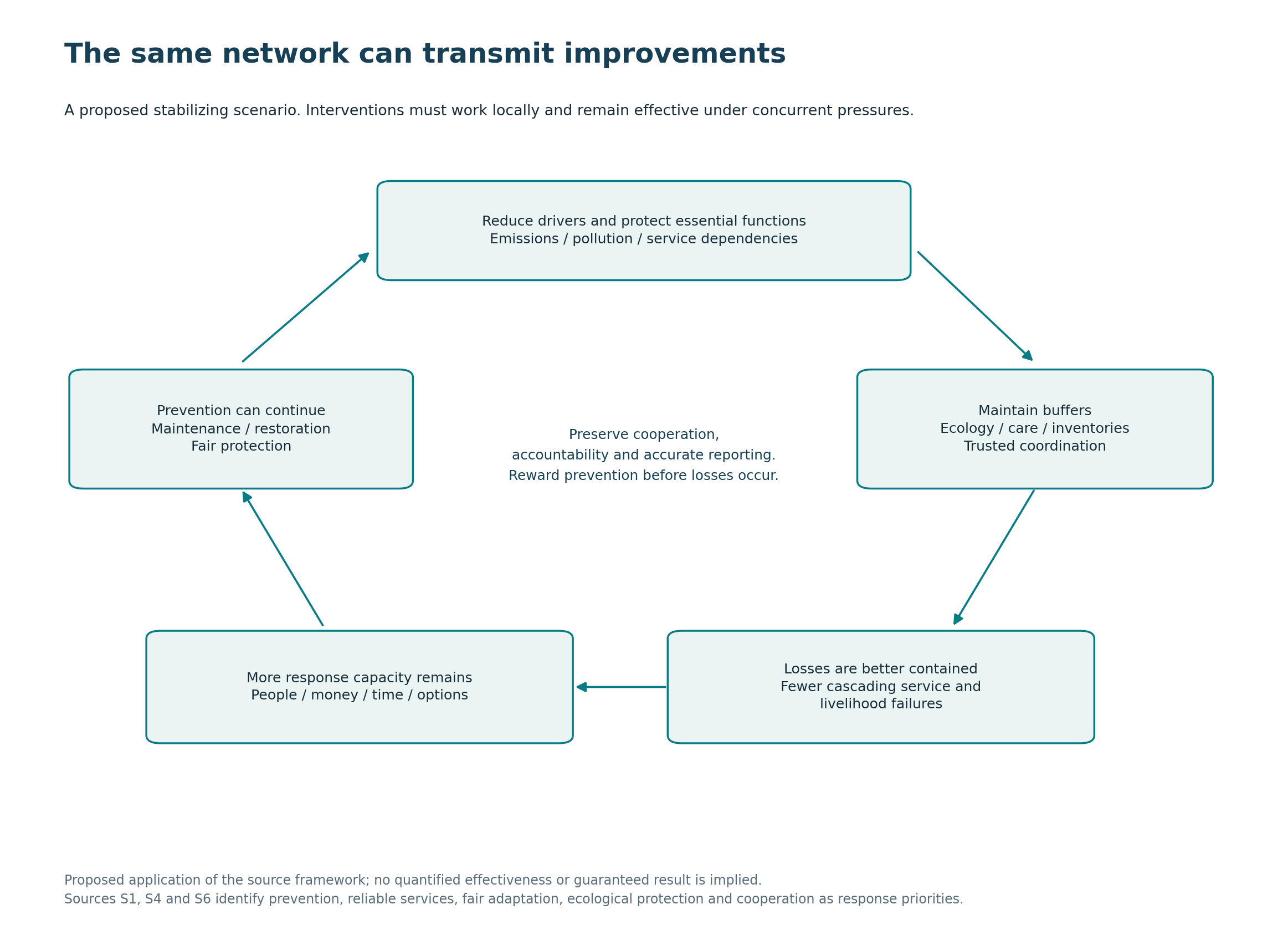 A proposed stabilizing branch: reducing drivers and maintaining buffers can contain losses, preserve response capacity and sustain further prevention. Effectiveness must be established in local conditions.
Conclusion: global efforts have not yet matched the scale of interacting risk
The six sources describe responses that remain too fragmented, uneven or insufficient for the combined pressures they identify. They repeatedly point to strained fiscal capacity, weak prevention, vulnerable infrastructure, inequality, depleted ecological buffers and impediments to cooperation. The broad conclusion of this synthesis is that current global efforts do not yet provide a demonstrated, dependable capacity to manage all 15 factors as an interacting system. This is a source-limited judgment, not a new quantitative audit of every international institution. [S1] [S6]
Climate illustrates part of the gap: the CFL source reports emissions near record levels and a current-policy warming assessment of approximately 2.8°C this century. That figure is reported as the source page’s assessment, without independently updating the underlying report. The wider problem includes conflicts, barriers to essential supplies, public-health weaknesses, information manipulation and economic incentives that can undermine prevention even while societies are coping with existing damage.
Inadequate management can itself become a reinforcing factor. Underprotection permits losses; losses consume public and private reserves; depleted reserves delay protection and recovery; the next shock reaches a weaker system. Some societies may respond with constructive cooperation and reform. Others could enter repeated emergency, declining essential services, escalating grievance or coercive responses. Severe institutional and security branches remain contingent, but their consequences warrant serious preparation.
Some losses can be repaired quickly. Others cannot. Repeated financial, educational, health and community damage can extend across decades or generations. Old carbon stores and major ecosystem changes can have century-scale consequences. Ocean, hydrate and ice-sheet responses can extend for centuries to millennia. Extinction and some cultural losses may be irreversible. Replacing a road does not restore all the systems that made the community viable.
The risk is therefore greater than the simultaneous presence of 15 difficult problems. It is the possibility that their interactions weaken the capacity to solve any of them, while some physical and social commitments become harder to reverse. Tipping points, feedbacks and nonlinear responses can then turn added pressure into disproportionately larger consequences.
The strongest practical response is to reduce the drivers while protecting the ability to recover. Maintain dependable essential services, restore ecological and social buffers, reduce greenhouse-gas emissions and pollution, protect health and livelihoods, preserve credible institutions, and sustain cooperation across borders. Doing these together can interrupt more than one destructive pathway at a time. The next 25 years matter because the decisions made during them shape both the next emergency and the options available to future generations.
Frequently asked questions
Is this a prediction that all 15 factors will collapse together?
No. It is a portfolio of conditional interactions. Many underlying pressures already exist, while the largest political, security and integrated-collapse outcomes remain uncertain.
Which scenario is most likely?
The sources do not supply a calibrated comparison of complete sequences. Start with current local exposure, critical dependencies and recognized transmission pathways; keep severe contingencies separate.
Why do so many timeframes overlap?
Most core processes are not waiting for a unique arrival year. The periods describe exposure, decisions, possible compounding and persistence. Different places can encounter the same combination at different times.
Does climate change cause every other crisis?
No. War, pandemics, pollution, inequality and financial or political shocks have their own causes. Their coincidence with climate pressure can still make response and recovery more difficult.
Can national failure or a business failure occur before a major physical tipping point?
Yes as a scenario possibility: financial, service or institutional thresholds differ from Earth-system thresholds. This guide does not supply their probability or a universal date.
Are migrants or disasters inherently a cause of disorder?
No. Political choices, support, rights, livelihoods and public capacity shape outcomes. Migration, mutual aid and fair adaptation can improve resilience.
Can the 20% and 30% adjustments move all crisis dates forward?
No. They are temperature assumptions in the source framework. They do not define a proportional change in the dates of disease, war, financial failure or political transition.
Does positive feedback mean endless acceleration?
No. Positive means reinforcing, not beneficial. A loop can saturate, weaken, reverse or be counteracted; physical and social stabilizers must remain in the assessment.
Is a catastrophic methane burst the main scenario?
No. The supplied methane page labels a huge rapid hydrate pulse very unlikely this century. Land thaw, infrastructure exposure and long-lived carbon feedbacks remain important without assuming that pulse.
What would weaken a severe scenario?
Evidence of weak return paths, improving recovery, effective protection, independent backups, restored ecological functions or successful cooperation should lower its assessed severity.
Were outside scientific studies checked for this article?
No. The task was restricted to six pages. Two were available through the complete text supplied earlier by the user; underlying references were not followed.
Glossary
- AI
- Artificial intelligence.
- DRC
- Democratic Republic of the Congo.
- PFAS
- Per- and polyfluoroalkyl substances, the chemical group named in the pollution source.
- AMOC
- Atlantic Meridional Overturning Circulation, a major Atlantic ocean-circulation system.
- Antimicrobial resistance
- Reduced effectiveness of medicines against the microorganisms they are intended to treat.
- Buffer
- A reserve or protective function that helps absorb a shock: inventories, finance, ecosystems, health or social support, for example.
- Cascade / compound risk
- A disruption transmitted across systems / multiple pressures acting together.
- CFL
- Climageddon Feedback Loop, Job One’s systems-risk framework for interacting thresholds, feedbacks, nonlinear responses and cascades.
- CO₂ / CH₄ / N₂O
- Carbon dioxide / methane / nitrous oxide.
- Commitment
- A change or decision whose consequences may continue unfolding long after it begins.
- DMAP
- Dialectical Metasystemic Analysis and Problem-solving, used here to examine changing relationships among systems.
- Feedback
- An effect that returns to influence its cause or underlying vulnerability. Reinforcing amplifies; stabilizing opposes.
- Hysteresis
- A different path back: reducing the original pressure may not immediately restore the previous state.
- IPCC / SSP
- Intergovernmental Panel on Climate Change / Shared Socioeconomic Pathway, a climate scenario framework.
- Maladaptation
- A response that increases, transfers or locks in risk.
- Nonlinear response
- A change not proportional to the initiating pressure.
- Overshoot
- Using resources or ecological functions faster than they can be renewed or maintained.
- Permafrost / thermokarst / talik
- Persistently frozen ground / terrain change from thawing ground ice / a persistently unfrozen pocket or layer.
- Polycrisis
- Multiple major crises interacting in ways that complicate and can amplify their combined consequences.
- Scenario / forecast
- A conditional account of possible developments / an estimate of what is expected under specified assumptions.
- Shared dependency
- A service, resource, route or institution on which several otherwise separate activities rely.
- Tipping point
- A threshold beyond which a system can move toward a substantially different state through reinforcing processes.
- Yedoma
- Ice-rich, carbon-rich frozen sediments in parts of Siberia and Alaska.
Sources, bibliography and method notes
Only the six requested pages supplied factual material. The 15-factor framework and broad planning windows come from those pages. The integrated narrative, factor-based return paths, local threshold examples, review triggers and diagram selections are explicitly constructed synthesis. They are not new observational results or a calibrated simulation.
Exact requested URL, read through an indexed copy displaying “Last updated: 4.7.26.” Framework, crisis mechanisms and regional scenario windows.
[S2] How Much Faster the North Latitudes Warm
Previously supplied complete text of the requested page. Northern amplification, cryosphere, water, carbon and circulation mechanisms. Live retrieval remained unavailable.
[S3] The Methane Time Bomb, Melting Permafrost & Our Future
Previously supplied complete text, October 15, 2026, version 1.1. Land and subsea carbon, thaw-related infrastructure and pollution, timescales and contingencies. Live retrieval remained unavailable.
[S4] The Secondary Wave of Climate Change Consequences
October 14, 2026; 17 human-system consequence categories, timing qualifications and institutional responses.
[S5] The Climate Clock Is Already Running: 19 Primary Consequences and Their Timeframes
October 14, 2026; physical, ecological and direct-health inventory, including undated and conditional branches.
[S6] The Climageddon Feedback Loop
Updated October 15, 2026; feedback, thresholds, nonlinear response, cross-system interaction, evidence levels and response principles.
Four evidence levels. Observed or established refers to the source’s documented processes. Supported risk or emerging identifies mechanisms with uncertainty. Institute/DMAP synthesis identifies source-author estimates or integration. Constructed scenario identifies the conditional combinations assembled here; extreme contingencies receive additional qualification. A complete sequence does not inherit the certainty of its best-established component.
Scope and numerical controls. The source framework’s percentages are not treated as calibrated joint probabilities. Disputed adjusted latitude values and long-term feedback totals are not reproduced as corrected forecasts. Broad regional windows remain attributed source judgments. A first ice-free September, an ice-sheet commitment, a long-run sea-level response and a local financial threshold are not interchangeable milestones.
Coverage and readability. The article represents all 15 polycrisis factors, all 19 primary and all 17 secondary climate-consequence categories, including rare or undated branches and stabilizing responses. Layout uses a full-width left-aligned wrapper, separated panels, short labeled paragraphs, readable contrast, working navigation targets and horizontally scrollable tables. Separate illustrations have captions, alternative text and a placement guide. Readability and dyslexia checks emphasize clear labels, repeated structure and no essential meaning conveyed by color alone.
Publication credit. Prepared for the Universe Institute / Job One for Humanity polycrisis project. Source pages retain their respective authorship and credits. This guide does not claim that the full 15-factor cascade has been demonstrated as a single event.
Showing 1 reaction