
Climate change can no longer best described as a slow or gradual uniform rise in temperature. The evidence shows a more dangerous pattern: several core indicators are increasing at faster rates, many consequences are becoming more frequent, severe, long-lasting, or widespread, and multiple systems are interacting in ways causing abrupt human disruption.

Climate Change Is Accelerating: A Short Public Summary
Bottom line: Climate change is not simply getting worse in one smooth straight line. Several fundamental parts of the climate system are now changing faster, while many consequences are becoming more frequent, severe, prolonged, widespread, or harder to manage. Some indicators show clear acceleration. Others show a higher recent rate, a nonlinear response, or strong worsening without proven acceleration.
The original white paper upon which this climate change consequence summary was based examined dozens of climate indicators and consequences, including temperature, Earth’s energy imbalance, ocean heat, sea level, glaciers, ice sheets, marine heatwaves, drought, groundwater, wildfire, tropical cyclones, dust, human health, labor productivity, disease risk, and more. This original white paper includes 25 compelling illustrations and charts that show exactly what's accelerating in the climate change system and its subsystems. We strongly recommend that after reading this quick summary, you go back to the original white paper and scan through the illustrations showing the various levels of acceleration of climate change consequences
The goal was not to prove that every climate problem is accelerating. It was to ask a harder question: Where does the evidence actually show faster change, where does it show nonlinear worsening, and where is the evidence still mixed?
1. What “Accelerating” Actually Means
The word acceleration is easy to misuse. In everyday speech, people often use it to mean “getting worse.” In science, that is not precise enough.
The white paper separates climate changes into several categories:
- Demonstrated temporal acceleration: the rate itself is increasing over time.
- Higher recent rate: a recent period is changing faster than an earlier period.
- Nonlinear response: a small additional amount of warming can produce a disproportionately larger consequence.
- Worsening without proven acceleration: a problem is becoming more severe, frequent, long-lasting, or widespread, but the evidence does not prove that its rate of change is itself accelerating.
- Mixed or uncertain: evidence differs by region, timescale, measurement, or study.

2. Where the Evidence for Faster Change Is Strongest
Earth’s energy imbalance
Earth is currently absorbing more energy from the Sun than it sends back to space. This is called Earth’s energy imbalance. It is one of the most important measurements in climate science because it tells us whether the planet is still gaining heat overall.
Recent assessments show that this imbalance has increased substantially over recent decades. That means the climate system is accumulating heat faster than before.
Ocean heat
Most of the excess heat caused by greenhouse gases does not remain in the atmosphere. Roughly 90 percent enters the ocean. Ocean heat content has continued to rise, and recent years have repeatedly set records.
This matters because the ocean is both a heat reservoir and a buffer. It slows surface warming by absorbing heat, but that stored energy contributes to marine heatwaves, sea-level rise, coral stress, oxygen loss, and changes in ocean circulation.
Sea-level rise
Global sea level is not only rising. The rate of rise is now significantly faster than it was early in the satellite era. Sea level rises because warmer water expands and because glaciers and ice sheets lose mass.
Even modest acceleration in sea level can produce much larger increases in coastal flooding because tides and storms begin from a higher starting point.
Glaciers and ice sheets
Mountain glaciers are losing ice at very high rates. Greenland and Antarctica are also losing large amounts of ice. In several cases, recent loss rates are substantially higher than in earlier periods.
These losses matter far beyond the polar regions because they raise sea level and can influence ocean circulation and regional climate.
Marine heatwaves
Marine heatwaves are periods when ocean temperatures remain unusually high for days, weeks, or months. Their frequency, duration, and total number of heatwave days have increased strongly.
These events can damage coral reefs, shift fish populations, disrupt food webs, and harm fisheries and coastal economies.
3. Is Global Temperature Itself Accelerating?
The answer is more complicated than a simple yes or no.
Human-caused warming has clearly continued. One recent assessment estimated human-induced warming at roughly 0.27°C per decade during 2016–2025.
Some statistical analyses find even higher recent warming rates after adjusting for short-term natural influences such as volcanic activity, El Niño, and solar variation. However, those higher adjusted rates are still being debated because recent warming may reflect a combination of greenhouse forcing, natural variability, reduced aerosol cooling, cloud and albedo changes, and other factors.
This is why the final paper does not claim that one recent temperature surge proves a permanently accelerating warming rate. The evidence for faster warming is important, but the physical reasons and long-term persistence are still being studied.
4. Why Climate Consequences Can Grow Faster Than Temperature
A small additional rise in global temperature does not always produce a small additional impact.
For example:
- A few more inches of sea-level rise can turn rare coastal flooding into regular flooding.
- Additional heat can push crops, workers, power systems, or human bodies across dangerous thresholds.
- Hotter droughts can increase wildfire risk and reduce water supplies at the same time.
- Warmer oceans can intensify coral bleaching and marine ecosystem stress.
- Several moderate hazards can occur together and create a much larger crisis.
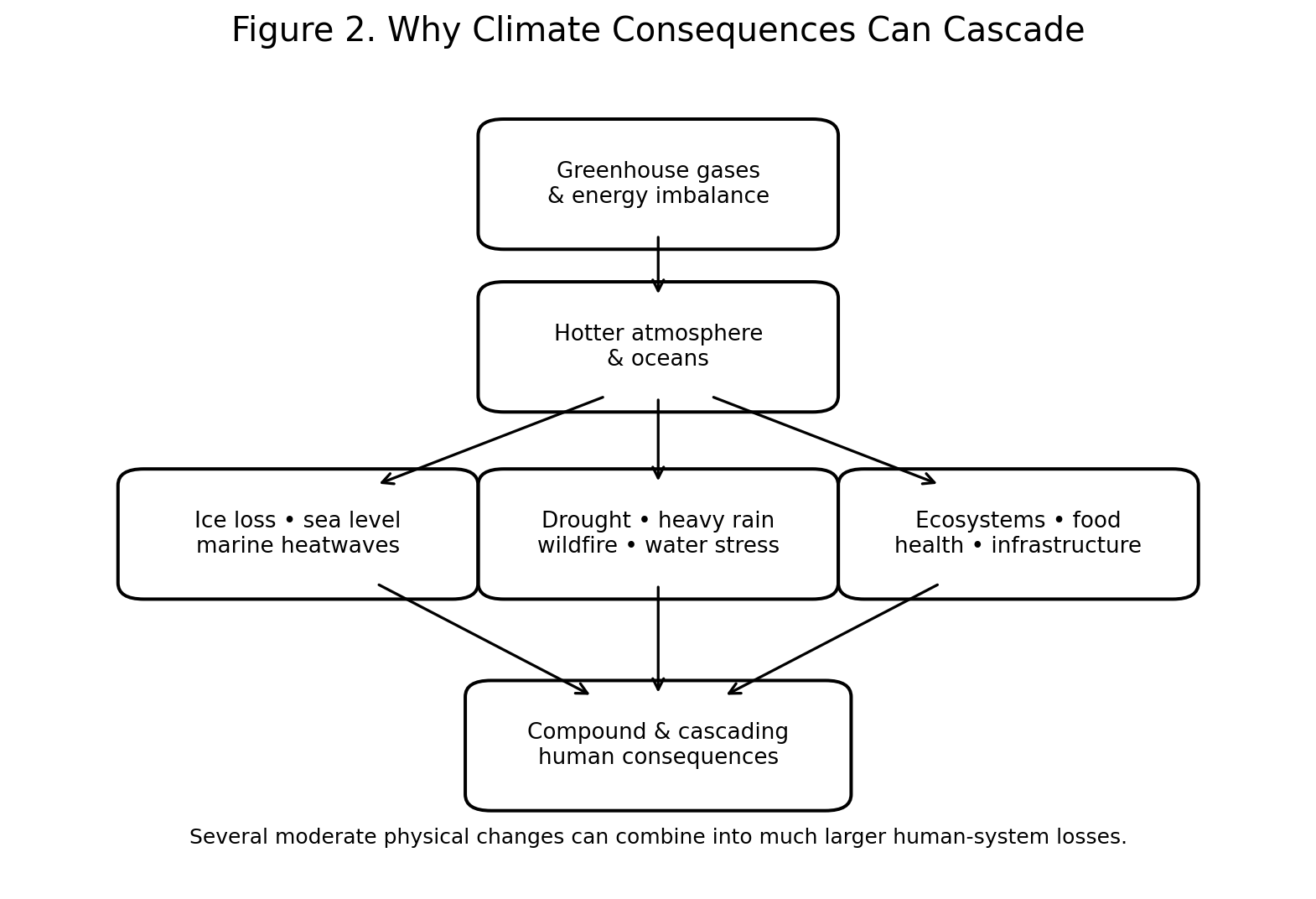
This is called compound and cascading risk. It is one of the most important reasons society can experience damage that grows faster than the physical climate variable that started the chain.
5. What the White Paper Does Not Claim
The report deliberately rejected several easy but weak claims.
- It does not claim that every climate indicator is accelerating.
- It does not claim that the whole climate system follows one exponential curve.
- It does not claim that every wildfire, hurricane, drought, flood, or dust trend is globally accelerating.
- It does not claim that every tipping point is imminent or irreversible.
- It does not claim that one recent hot year alone proves a permanent new warming rate.
Several indicators remain mixed or strongly regional. For example, total global tropical-cyclone counts do not show a simple upward trend. Wildfire trends depend heavily on which region and which measure is used. Drought evidence is complicated by different definitions and methods. Dust trends can move in opposite directions in different places.
This caution strengthens the main conclusion because the evidence for acceleration does not depend on pretending every climate metric behaves the same way.
6. Why Recent Warming May Be Speeding Up
Scientists are studying several possible contributors to the recent increase in warming and Earth’s energy imbalance.
These include:
- continued greenhouse-gas accumulation;
- reduced sulfate-aerosol pollution, which removes some temporary cooling;
- changes in clouds and planetary reflectivity, or albedo;
- ocean variability and heat transfer;
- changes in land and ocean carbon sinks;
- natural short-term variability layered on top of long-term human-caused warming.
These explanations are not mutually exclusive. Several can operate at the same time.
The most important point is that uncertainty about the exact mixture of causes does not erase the observations. Earth is continuing to gain heat, oceans are warming, sea level is rising faster, and ice is being lost.
7. Human Consequences Are Also Increasing
Climate change is already increasing risks to health, work, food, water, infrastructure, insurance, and economic systems.
Heat-related deaths have increased. Workers are losing more labor hours to dangerous heat. Climatic conditions suitable for diseases such as dengue have expanded in many regions. High-tide flooding is becoming much more common in many coastal areas. Insurance losses and adaptation costs are also increasing.
These human effects are influenced by more than climate alone. Population growth, poverty, urban design, health care, infrastructure, land use, and government capacity all matter. That is why the report distinguishes climate hazard from human vulnerability and exposure.
8. The Main Conclusion
The strongest conclusion is not that every climate change consequence is growing exponentially. It is that several fundamental and important components of the climate system are now changing at faster rates, while many consequences are becoming more frequent, severe, prolonged, or geographically extensive.
That distinction is important. It means climate risk can rise quickly even when the underlying temperature curve still looks relatively smooth.
It also means adaptation becomes harder over time. Infrastructure designed for yesterday’s extremes may fail more often. Insurance can become unaffordable or unavailable. Food and water systems can face simultaneous stresses. Communities may be forced to spend more money responding to repeated disasters and less money preventing the next one.
The practical message is straightforward: waiting for every uncertainty to disappear increases risk.
The science already shows enough faster change and nonlinear worsening to justify stronger emissions cuts, faster adaptation, and better preparation for compound climate events.
Now that you have finished this quick summary, we strongly recommend that after reading this quick summary, you go back to this original white paper and quickly scan through the illustrations showing the various levels of acceleration of the various climate change consequences. It is powerful. It may even change a few climate deniers minds about the accelerating reality of climate change.
FAQ
Is climate change definitely accelerating everywhere?
Some indicators show clear acceleration, some show higher recent rates, some show nonlinear worsening, and some remain mixed.
What is the clearest evidence of acceleration?
Earth’s energy imbalance, sea-level rise, ocean heat, glacier loss, ice-sheet loss, and marine heatwaves are among the strongest examples.
Why can impacts rise faster than temperature?
Because real-world systems have thresholds. A small additional increase in heat, sea level, drought, or rainfall can push ecosystems, infrastructure, or human systems past limits.
Does uncertainty mean we should wait?
No. Uncertainty cuts both ways. Actual outcomes can be better or worse than central estimates. High-consequence uncertainty is a reason for risk management, not inaction.
Is global warming becoming exponential?
There is no evidence that the entire climate system follows one simple exponential curve. Some consequences can grow very rapidly over limited periods, especially after thresholds are crossed. But, some climate system consequences have already crossed into level levels of exponential growth.
Glossary
Acceleration: an increase in the rate of change over time.
Albedo: how much sunlight a surface reflects.
Carbon sink: a natural or human system that absorbs more carbon than it releases.
Compound risk: two or more hazards or vulnerabilities that occur together and amplify damage.
Earth energy imbalance: the difference between energy Earth absorbs and energy it sends back to space.
Marine heatwave: an unusually warm period in the ocean lasting days, weeks, or longer.
Nonlinear: a relationship in which the effect does not increase in simple proportion to the cause.
Tipping point: a threshold after which a system may shift toward a substantially different state.
AI Prompts to Test This Summary
Prompt 1: “Using current peer-reviewed climate research, identify the strongest evidence that climate change is accelerating and the strongest evidence that some indicators are not accelerating. Separate direct observations from projections.”
Prompt 2: “Check the claim that sea-level rise, ocean heat, glacier loss, ice-sheet loss, and marine heatwaves are changing faster than in earlier decades. Find the best primary sources and report any major disagreements.”
Prompt 3: “Red-team the claim that climate consequences can worsen faster than global temperature because of thresholds, compound hazards, and cascading human-system risks. Find both supporting and contradicting evidence.”
Selected Sources
- Intergovernmental Panel on Climate Change (IPCC), Sixth Assessment Report: https://www.ipcc.ch/report/ar6/
- World Meteorological Organization, State of the Global Climate: https://wmo.int/publication-series/state-of-global-climate
- Indicators of Global Climate Change: https://essd.copernicus.org/
- NASA Global Climate Change and Earth Energy Budget resources: https://science.nasa.gov/climate-change/
- Global Carbon Budget: https://globalcarbonbudget.org/
- For the full Climate Change Is Accelerating, Version 1.2 white paper, click here.
Based on the white paper: Climate Change Is Accelerating, Version 1.2, Universe Institute, 2026.
To help do something about the climate change and global warming emergency, click here.
Sign up for our free Global Warming Blog by clicking here. (In your email, you will receive critical news, research, and the warning signs for the next global warming disaster.)
To share this blog post: Go to the Share button to the left below.
Showing 1 reaction