
Irreversible global warming and climate change are the most critical concepts to understand regarding your future. You have likely seen news about more severe, frequent, and larger-scale weather driven by climate change, such as powerful hurricanes and devastating wildfires in Northern California, across the West Coast, Europe, and Asia. Unfortunately, what you are witnessing is the early phase of irreversible global warming and climate change.
This matters because the future is no longer a clean choice between "everything is fine" and "game over. The real issue is how much warming, disruption, migration, financial loss, ecological damage, and political instability we still have time to avoid. That is still a very big deal.
- Overview
- Definition
- The two phases
- What this means for your future
- What would it take to end this state
- Why we got here
- Why carbon ppm matters
- There is no easy fix, only ways to survive and reduce harm
- The “miracle technology” problem
- Longer historical carbon perspective
- What you can do now
- FAQ
- Glossary
- References and bibliography
Overview
We estimate that 99.999% of humanity has little or no idea that we are already in irreversible global warming, or what dangers it may hold for their future, their children, and the generations that follow.
No one wants to hear bad news about climate change. Fair enough. But sometimes the only path to useful good news is to stop sugarcoating the bad news first. This page does exactly that. The encouraging part is that there is still time to reduce additional damage if governments, institutions, communities, and individuals act fast enough and honestly enough.
- Why many climate dangers may be 20–40% worse than commonly presented
- The Climageddon Feedback Loop
- Primary and secondary climate change consequences
- Climate change solutions, adaptation, resilience, and preparation
What is the definition of irreversible global warming and climate change?
Irreversible global warming and climate change are states in which global warming temperatures have reached a level that will continue to rise on their own unless humanity or Mother Nature intervenes and fixes the problem. The last thing we want to do is let Mother Nature fix irreversible global warming because it will be a very painful, destructive process.
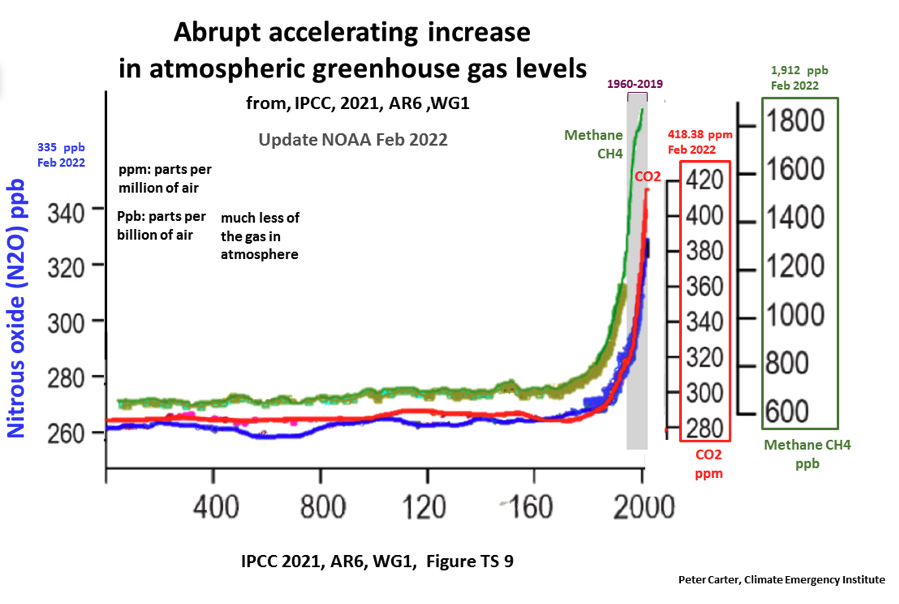
This irreversibility occurs because the past atmospheric heating momentum from greenhouse gases such as carbon, methane, and nitrous oxide is so large that it has reached levels that, on their own, can trigger additional reactions within the climate system and its sub-systems, including new tipping points, feedback loops, and non-linear reactions.
For example, our current 1.5°C+ temperature increase, driven by the momentum of past greenhouse gases already accumulated in the atmosphere, can help produce a 2°C world. A 2°C world can help produce a 3°C world, and a 3°C world can help produce a 4°C world, and so on, unless something powerful like Mother Nature or us interrupts that process. That is the essence of why this page uses the term irreversible global warming.
The only two things that will stop the current irreversible global warming that humanity has created for itself
Humanity through government enforcement immediately and radically cuts in global fossil fuel use to the required levels so that no additional fossil-fuel pollution is going into the atmosphere, while humanity simultaneously also removes, over time or by mechanical means, the vast amount (2,650 gigtons) of greenhouse gas now in the atmosphere and brings atmospheric carbon levels back down toward the pre-industrial safe range of carbon 270 to 350 ppm.
Mother Nature and time do the work after a massive human die-off and emissions collapse. In this second path, so much of humanity dies off because of the accelerating primary and secondary consequences of global warming and climate change that additional fossil fuel emissions plunge, after which Mother Nature's natural processes operating over centuries to thousands of years gradually reduce atmospheric greenhouse gases. Click here to see how Mother Nature will painfully fix climate change if our givernments and politicians continue to fail us.
We have known for a long time that humanity has been in a state of irreversible global warming. As this page frames it, James Hansen warned that if we crossed the 386 ppm carbon threshold, we would enter an irreversible period of global warming. Humanity now sits at about 429 ppm of atmospheric carbon dioxide, which is a rather unsubtle clue that our species has not been taking the memo seriously.
Key things to remember
Irreversible global warming and climate change are created by and strengthened by:
- rising greenhouse gases in the atmosphere, especially carbon, methane, and nitrous oxide,
- rising temperatures,
- the crossing of additional climate tipping points, and
- the triggering of multiple self-reinforcing positive feedback loops within the climate and its sub-systems.
Acting together and synergistically, these forces can push the global climate toward a new, higher-temperature state that remains effectively irreversible on human timescales, which means from centuries to thousands of years.
If you want the systems-level explanation for why these factors keep forcing temperatures upward, read the Climageddon Feedback Loop.
Why this matters so much
The state of irreversible global warming creates two humanity-endangering consequences:
- Earth’s average global temperature continues to increase, progressively destabilizing the relatively stable climate that helped humanity flourish over the last 10,000 years.
- Many of the worst primary and secondary climate consequences persist for decades to centuries.
The really bad news is that the natural time frame for removing the many gigatons of carbon already added to the atmosphere is now centuries to thousands of years. That means future generations may be forced to live for a very long time inside the consequences of our fossil-fuel addiction, and they will not be writing us thank-you notes.

The two phases of irreversible global warming and climate change
Think of irreversible global warming and climate change in two distinct phases. Each stage carries additional, more severe consequences that can last longer and cause greater global damage.
Phase 1
The world entered the first phase of irreversible global warming when atmospheric carbon levels crossed the 386 ppm threshold. Once that threshold was crossed, humanity became committed to a roughly 1.5°C increase in average global temperature relative to pre-industrial levels. For reference, 350 ppm is presented here as the upper boundary of a safe and stable climate range.
Before the Industrial Revolution, the average atmospheric carbon dioxide concentration was approximately 270 ppm. Our current 1.5°C+ temperature increase, driven by the momentum of past greenhouse gas emissions already accumulated in the atmosphere, can lead to a 2°C increase, and a 2°- 2.7 °C increase can lead to a 3°C increase. Some forecasts suggest we could reach 2°C by the 2030s.
Phase 2
Once humanity crosses the 450 ppm threshold and continues moving irreversibly toward 500 ppm, 600 ppm, 700 ppm, and beyond, this page argues that humanity will face a future that can fairly be called hell on Earth.
At that point, we would be committed to an increase of roughly 3°C to 5°C or more in average global temperature over pre-industrial levels for much of humanity. As this final phase deepens, newer non-IPCC forecasts are cited here as implying much higher late-century risks than the public is usually told about.
Put bluntly: if 4°C is hell on Earth, then 5°C or 6°C is likely beyond what most human systems can endure, because the primary and secondary consequences of climate change would reach levels that few societies, corporations, or nations could sustain. For a deeper dive into time tables, tipping points, and consequences, see the four extinction-accelerating climate tipping points and phases of irreversible global warming.
What does the current state of irreversible global warming mean for your future?
Due to extensive new climate research findings, the 20–40% underestimation problem, rising average temperatures, and the crossing of numerous bellwether tipping points, this organization now states that global warming has entered a state of transitional irreversibility.
That is grim news, but it still needs context. We believe it is possible to respond in a balanced, rational, and hope-filled way. Start with realistic climate hope and climate recovery benefits.
Even though rising global warming has now entered irreversibility and many of its primary and secondary consequences may last for decades to centuries, this page argues that humanity still has a meaningful window, roughly 2026 to 2035 if we are lucky, to prepare, adapt, build resilience, migrate where appropriate, and reduce losses as much as possible.
If you are not well prepared locally, mass migration driven by climate disruption, economic stress, and political destabilization is likely to intensify in many parts of the world over the next 5 to 15 years.
It is useful to think about our current condition as a slow-moving, planet-crippling asteroid that is still some years away but already on course. It is not here this afternoon, but it is moving toward us, and pretending otherwise is not a strategy. Preparation is.
The good news is that smart, rapid preparation and adaptation can still reduce suffering, financial losses, and deaths. People who face reality earlier generally do better than people who treat denial as a lifestyle brand.
What do we have to do to end the current state of irreversible global warming and climate change?
Our current state of irreversible global warming does not have to be permanent. But getting out of it would require very difficult and immediate changes. In the view presented here, the central requirement is simple: humanity must make very radical, immediate reductions in global fossil fuel use.
Many other proposed solutions, if they do not include immediate and radical fossil fuel reduction, are too little, too late, and carry a high probability of a catastrophic outcome. Governments have failed to act adequately for decades despite repeated warnings.
This page also argues that while governments are unlikely to act in time to spare us from many of the worst consequences, natural correction processes may still prevent total extinction. To see that argument, read why total extinction and widespread global collapse are highly improbable due to climate change-related consequences.
Why have we reached our current irreversible state of global warming and climate change?
According to the analysis on this site, phases 1 and 2 of irreversible global warming have occurred because:
-
- For decades, nations, political systems, and politicians have been compromised by the wealth and multibillion-dollar disinformation and misinformation campaigns of the global fossil fuel cartel.
- The UN’s Intergovernmental Panel on Climate Change has made major modeling and framing errors described in this site’s underestimation and reduction-failure analysis.
- Governments have failed to act effectively despite more than 60 years of warnings from climate scientists, verified research, and repeated international conferences.
- The minimum time needed to fully convert global fossil fuel energy systems to green energy systems is still enormous, roughly 35 to 50 years, as framed on this site.
- Humanity has crossed many known and unknown global warming tipping points, and that process itself increases the likelihood of crossing still more tipping points at ever-faster rates.
For the larger systems failure analysis, see 30+ problems impeding effective climate change resolution.
Understanding fossil-fuel carbon (CO2) pollution in our atmosphere is essential
Viewing atmospheric carbon ppm measurements is one of the clearest ways to understand current and future trends in global warming. By the laws of physics, if carbon keeps rising in the atmosphere, heat will keep rising too. Despite cheerful headlines and PR fog, this page argues we are not making sufficient progress in reducing atmospheric carbon.
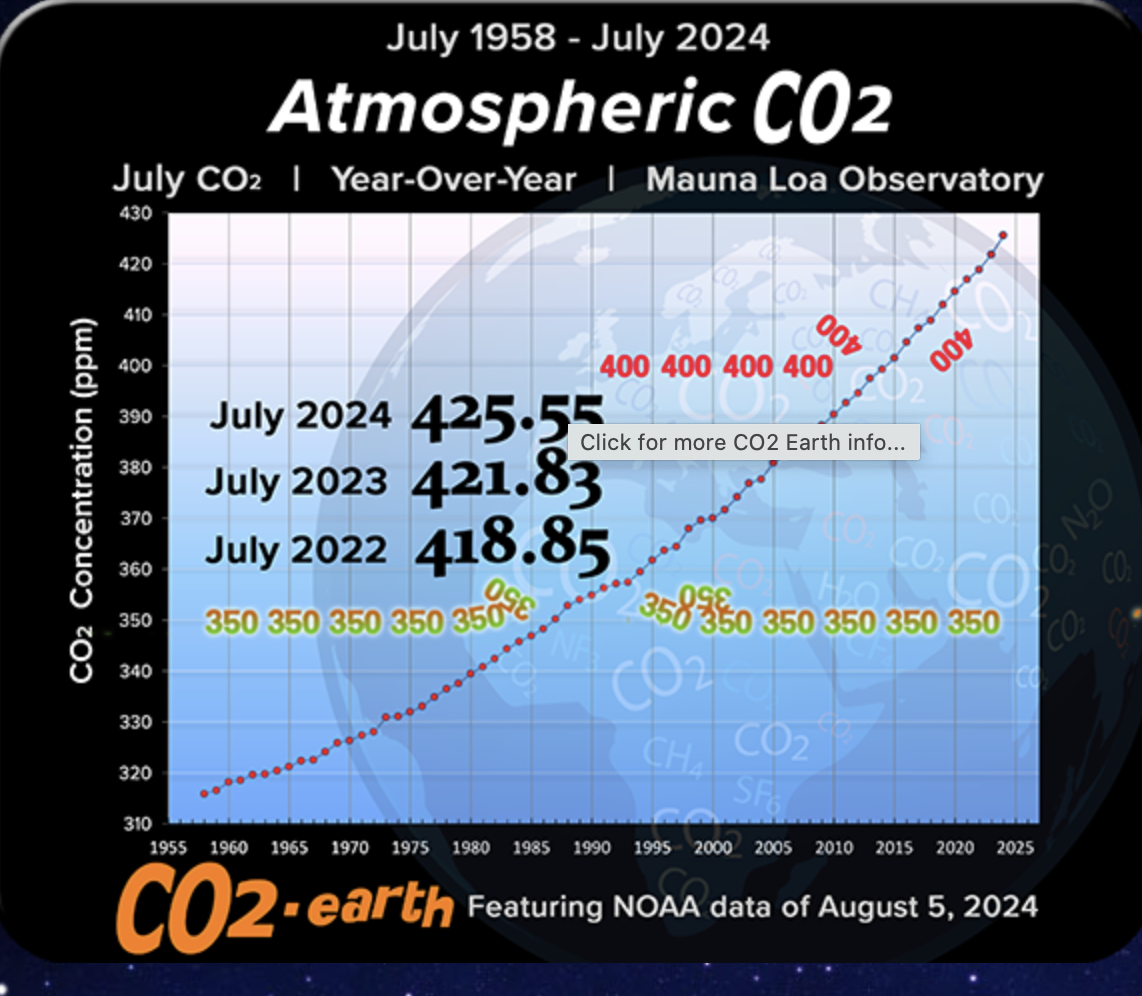
It is already terrible, and it is going to get much worse
There are minor monthly variations in carbon ppm levels, as well as cyclical weather variations driven by El Niño and La Niña. But the dominant long-term pattern over the last 70 years is unmistakable: carbon ppm has been rising, and rapidly.
At current carbon levels, this page argues that the stability of the West Antarctic ice sheet has already been breached and is now in an irreversible state of decline. See NASA’s discussion of West Antarctic glacier decline and this site’s own related analysis of critical tipping points.
At the 450 ppm carbon threshold, which this page frames as perhaps 6 to 8 years away or less, humanity is likely to cross more of the 11 critical global warming tipping points across the climate system and its sub-systems, and to do so at an even faster rate.
Once we cross the 500 ppm carbon threshold, all Earth's ice and glaciers will melt, and the oceans will rise by about 70 meters (230 feet). The full melt would take many decades and likely much longer, but that does not make the direction of travel comforting.
At current annual carbon-emission rates, this page argues that humanity could reach the 500 ppm threshold in roughly two dozen years or less. The initial temperature range associated with triggering irreversible global warming is presented here as around 1.5°C of average global warming, which the page treats as already effectively surpassed once all baked-in factors are considered.
There is no way to neatly “fix” our situation, only ways to survive it and reduce the damage
To understand why this page says we are already committed to irreversible global warming, it helps to understand the idea of committed or baked-in warming. The claim here is that roughly 1.5°C to 2.7°C of average global temperature increase has already been reached or is soon to be reached, and that it will not quickly disappear even with major action.
Worse yet, when we cross the 2°C range, it will become increasingly difficult to prevent movement toward 3°C, 4°C, and 5°C. At roughly 3°C, only the strongest current governments may remain stable.
This is due in significant part to:
-
- the existing momentum of past carbon ppm already in the atmosphere,
- the new carbon ppm per year humanity is still likely to keep adding for decades,
- already existing ocean warming,
- unknown crossed or soon-to-be-crossed tipping points and feedback loops, and
- overly optimistic modeling assumptions based on future large-scale greenhouse gas removal technology.
False promises for a nonexistent “miracle technology” that cannot save us in time
This page argues that many IPCC-compatible pathways and Paris-aligned scenarios rely in part on heavy future carbon dioxide removal, even though the necessary scale, reliability, timing, costs, and side effects remain highly uncertain.
The mathematical, scientific, and mechanical feasibility of scaling up carbon capture technologies to the required level has been challenged by respected climate researchers such as Kevin Anderson. The page’s conclusion is blunt: carbon capture will not reverse the current irreversible global warming emergency in time, no matter how many techno-optimists keep trying to sell the public a last-minute rescue fantasy.
For more on that issue, see: Why carbon capture won’t save us in time, and the IPCC’s climate sensitivity error analysis.
The dangers of delusional groupthink on our survival
Instead of telling humanity that we must immediately and radically cut back on fossil fuel use, the page argues that too much of the public climate conversation has functioned like this:
Don’t worry. You won’t have to give up much. You won’t need to make immediate, painful changes. Some future miracle technology will show up after 2050 and magically vacuum the greenhouse gases out of the atmosphere.
This page rejects that framing as dangerous groupthink. It argues that betting civilization on a technology that does not yet exist at scale is not prudent forecasting. It is fantasy with spreadsheets.
For a deeper look at the site’s broader case on this, see underestimation errors and related failures to reduce global fossil fuel use.
Would you like to see the rise of human-caused carbon ppm from a longer historical perspective?
The graph below shows the dramatic increase in atmospheric carbon dioxide over a far longer historical time scale. In the zoomed-in modern era, the fossil-fuel age stands out with all the subtlety of a house fire in a library.
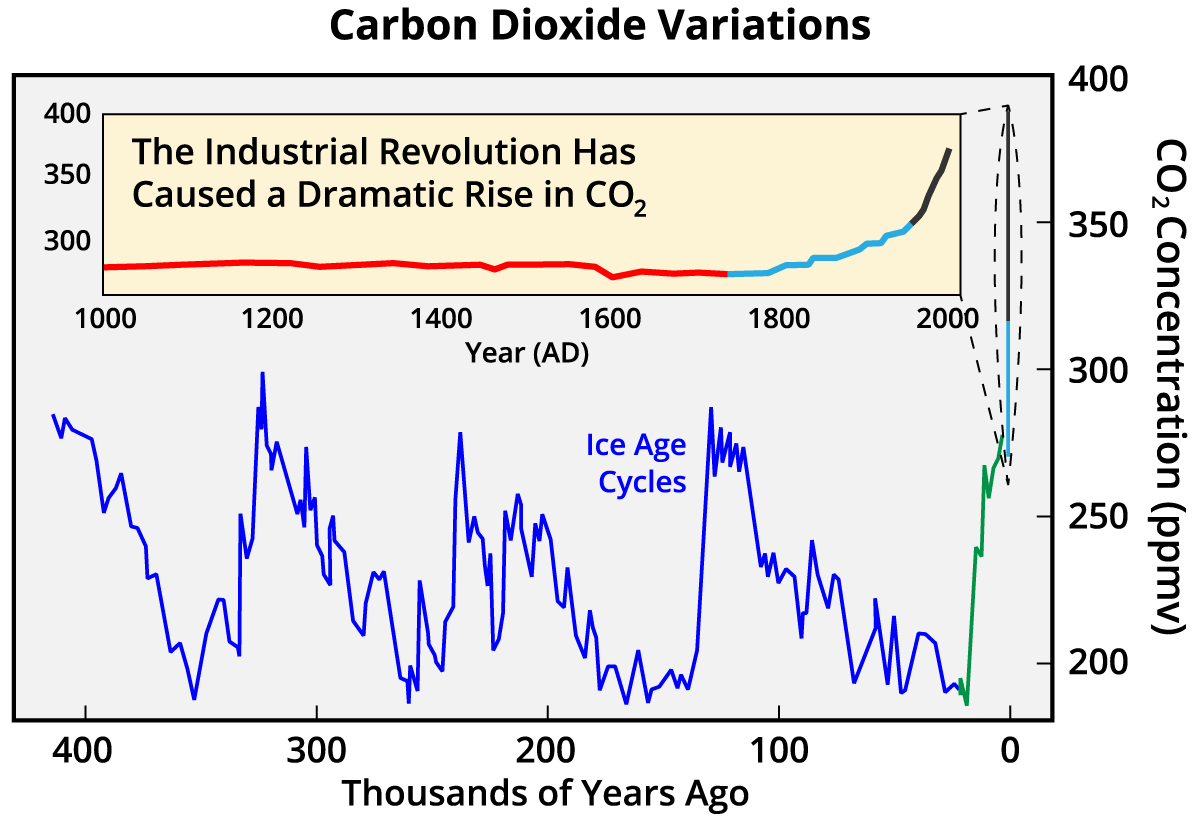
Over hundreds of thousands of years, atmospheric carbon stayed within a much lower cyclical range. The page argues that humanity has now moved out of that long-standing range and into a wholly different level of atmospheric carbon risk and threat exposure.
For hundreds of thousands of years, the atmosphere remained below what this page treats as the safe level for civilization, roughly 275 ppm. Since the fossil-fuel era began, atmospheric carbon has surged above 425 ppm and average global temperatures have risen to levels unseen for millions of years.
What you can do to protect yourself, your family, and your business
The resources below are the practical continuation of this article. They expand the central threat analysis and point to planning, resilience, adaptation, and action steps:
Read about the surprising benefits and realistic hope that can emerge when humanity responds wisely.
See the members’ area for the newest and most detailed climate consequence forecasts and time frames.
Study the Climageddon Feedback Loop to understand how warming can amplify itself. It is critical to understand the Climageddon Feedback Loop description because it is the main reason why average global temperatures will rise far faster than the predictions you are being given. Unfortunately, it is difficult to visualize the hundreds of complex interactions occurring at these levels within the climate system and its subsystems. This page's many illustrations of the Climageddon Feedback Loop will help you visualize this and understand how, once this feedback loop hits its own internal tipping point, climate change consequences, including rising heat, will happen so fast that it will be unadaptable for the many individuals, corporations, and nations currently using IPCC forecasts that are about 20 to 40% underestimated. At this point all you have to remember is that the Climageddon Feedback Loop will be a fundamental and dominant reason that humanity will experience rises in average global temperature far faster and far beyond what we are being told by our governments or the IPCC.
Review the four most critical extinction-driving climate tipping points.
See how carbon capture assumptions distort realistic fossil fuel reduction planning.
Read the latest IPCC climate sensitivity error discussion.
Explore 30+ reasons governments are unlikely to act in time without extraordinary change.
Review the documentation on the role of the fossil fuel cartel in delaying effective climate action.
Read the broader hope-and-rebirth perspective after you have absorbed the difficult parts.
Please do not mistake the severity of this page for hopelessness. The site’s position is that there is still real value in clear thinking, preparation, resilience, adaptation, and meaningful action. Hope without realism is fluff. Realism without action is surrender. You need neither.
FAQ
What is irreversible global warming?
It is a state in which warming has reached a level that continues to rise on its own because of past emissions, rising greenhouse gases, tipping points, and self-reinforcing feedback loops, unless humanity or nature makes a radical intervention.
Why does this page say we are already in irreversible global warming?
Because the page argues that humanity has already crossed key carbon thresholds, triggered or approached multiple tipping points, and accumulated enough atmospheric heat momentum that continued warming is now partly locked in.
What are the two phases described on this page?
Phase 1 is associated here with crossing the 386 ppm threshold and being committed to roughly 1.5°C warming or more. Phase 2 is associated with crossing 450 ppm and moving toward 500 ppm, 600 ppm, and beyond, where the page argues consequences become radically more severe.
Can irreversible global warming still be reduced?
According to this page, yes, but only through radical and immediate fossil fuel reductions, plus long-term removal of greenhouse gases already in the atmosphere. The page rejects half-measures and delayed action as inadequate.
Why does carbon ppm matter so much?
Because atmospheric carbon concentration is one of the clearest indicators of the amount of heat-trapping gas in the atmosphere and therefore a major signal of present and future warming risk.
What should I read next?
Start with the Climageddon Feedback Loop, the primary and secondary consequences page, and the practical planning resources on climate change solutions, resilience, and preparation.
Glossary
- ppm
- Parts per million. In this context, it refers to the concentration of carbon dioxide in the atmosphere.
- Committed warming
- Future warming that is already effectively locked in because of past greenhouse gas emissions and existing climate system momentum.
- Tipping point
- A threshold where a climate system or sub-system shifts into a new state, often in a way that is difficult or impossible to reverse quickly.
- Feedback loop
- A process that amplifies or dampens change. On this page, the focus is on self-reinforcing feedback loops that intensify warming.
- NETs
- Negative Emissions Technologies. These are methods proposed to remove carbon dioxide from the atmosphere.
- Carbon capture
- A set of technologies intended to capture carbon dioxide from emissions streams or directly from the air. This page argues that such technologies are far too uncertain and unscalable to serve as civilization’s main rescue plan.
Key internal references used or linked on this page
-
UN, IPCC Climate Change Underestimation Problem: Why the Real-World Danger May Be 20–40% Worse
- What is the Climageddon Feedback Loop?
- Primary and Secondary Climate Change Consequences
- The 4 Extinction-Accelerating Climate Change Tipping Points and Phases of Irreversible Global Warming
- By 2050, is mass human extinction and widespread global collapse likely?
- Who Caused Climate Change, Who Helped Delay Action, and Why Many Public Forecasts Run “Too Calm”
- Underestimation Errors and Other Problems in Climate Change Analysis Are Significant Causes of the Failure to Reduce Global Fossil Fuel Use
- Climate Change Solutions: Practical and Effective Preparation, Adaptation, Resilience-Building, and Actions to Fix Climate Change
- Eleven Critical Climate Change and Global Warming Tipping Points
- Why Carbon Capture Won’t Save Us in Time From Global Warming Mass Extinction
- Why Carbon Capture Technology Won’t Save Us in Time From a Massive Global Climate Change Catastrophe
- The IPCC’s Big Climate Sensitivity Error
- 30+ Problems Impeding Climate Change Resolution
- Real Climate Change Hope and Climate Recovery Creates Many Benefits
- Evolutionary Benefits, Hope, and Perspectives on Humanity’s 13 Global Crises
- The Definition of Irreversible Global Warming and Climate Change
References and bibliography
This selected bibliography is organized by the main claims and positions discussed on this page. It emphasizes major scientific assessments, peer-reviewed studies, and official monitoring sources that support the document's core arguments about greenhouse gas buildup, irreversible impacts, tipping risks, overshoot, carbon removal limits, and the continuing importance of rapid fossil-fuel reductions.
1) Foundational assessments and current climate status
-
- IPCC. Climate Change 2023: AR6 Synthesis Report (2023). The most comprehensive recent assessment of climate science, impacts, adaptation, and mitigation. Useful as the top-level source for claims about human-caused warming, escalating risks, carbon budgets, and the need for rapid emissions cuts.
- IPCC Working Group I. Climate Change 2021: The Physical Science Basis (2021). Core source for the physical science of warming, greenhouse gases, feedbacks, attribution, and long-lived system changes.
- World Meteorological Organization. State of the Global Climate 2024 (2025). Confirms record greenhouse gas concentrations, record heat, and that sea-level rise and ocean warming are irreversible for hundreds of years.
- NOAA Global Monitoring Laboratory. Trends in Atmospheric Carbon Dioxide. Official continuously updated atmospheric CO2 record, including Mauna Loa monthly averages.
2) Irreversibility, long time lags, and changes that continue for centuries
-
- IPCC. Climate Change 2021: Summary for All (2021). Explains in plain language that deep ocean warming, ice-sheet melt, and sea-level rise are slow to respond and can remain irreversible for centuries to millennia.
- IPCC. Climate change widespread, rapid, and intensifying (2021 press release). Summarizes headline AR6 findings, including that many changes already set in motion, such as continued sea-level rise, are irreversible over hundreds to thousands of years.
- IPCC Working Group II. Summary for Policymakers Headline Statements (2022). Supports claims that some climate impacts are already irreversible as systems are pushed beyond their ability to adapt.
- World Meteorological Organization. State of the Global Climate 2024 (2025). Reinforces the long-duration nature of ocean warming and sea-level rise.
3) Tipping points, feedback loops, and non-linear climate risks
-
- Armstrong McKay, D. I. et al. Exceeding 1.5°C global warming could trigger multiple climate tipping points. Science (2022). Landmark reassessment finding that several tipping points may be triggered in the Paris range of 1.5 to <2°C warming, with more likely at 2 to 3°C.
- Möller, T. et al. Achieving net zero greenhouse gas emissions critical to limit climate tipping risks. Nature Communications (2024). Shows that every additional increment of overshoot raises tipping risks and that earlier net zero is essential to minimize them.
- IPCC. AR6 Synthesis Report Headline Statements (2023). States that overshoot entails adverse impacts, some irreversible, and additional risks for human and natural systems that grow with the magnitude and duration of overshoot.
- IPCC Working Group I, Chapter 5. Global Carbon and Other Biogeochemical Cycles and Feedbacks (2021). Useful for claims involving carbon-cycle feedbacks, including permafrost-related feedbacks and limits to natural carbon uptake.
- Biskaborn, B. K. et al. Permafrost is warming at a global scale. Nature Communications (2019). Supports arguments that thawing permafrost can amplify warming and create additional feedback risks.
4) Climate sensitivity, warming in the pipeline, and why underestimation remains a concern
-
- Hansen, J. E. et al. Global warming in the pipeline. Oxford Open Climate Change (2023). Argues for higher climate sensitivity and highlights warming already “in the pipeline,” including the role of aerosol masking and the risk of faster warming than many mainstream expectations assumed.
- Sherwood, S. C. et al. An Assessment of Earth's Climate Sensitivity Using Multiple Lines of Evidence. Reviews of Geophysics (2020). Major review concluding that low-end climate sensitivity values are difficult to reconcile with multiple lines of evidence.
- IPCC Working Group I, Chapter 7. The Earth's Energy Budget, Climate Feedbacks, and Climate Sensitivity (2021). Authoritative assessment of feedbacks and sensitivity ranges used in mainstream modeling.
- Lamboll, R. D. et al. Assessing the size and uncertainty of remaining carbon budgets. Nature Climate Change (2023). Supports claims that remaining carbon budgets are small and sensitive to assumptions, including zero-emissions commitment and feedback uncertainties.
5) Why atmospheric CO2 concentration matters, and why 350 ppm remains influential
-
- Hansen, J. et al. Target Atmospheric CO2: Where Should Humanity Aim? NASA GISS summary (2008). The classic source behind the 350 ppm framing, arguing that atmospheric CO2 had already entered a dangerous zone and that an initial target of 350 ppm was warranted.
- Hansen, J. et al. Target Atmospheric CO2: Where Should Humanity Aim? (2008 full text). Provides the fuller scientific argument behind the 350 ppm target and the warning that prolonged overshoot risks irreversible outcomes.
- NOAA Global Monitoring Laboratory. Trends in Atmospheric Carbon Dioxide. Use this for current CO2 values when updating the page so the number stays current instead of fossilizing like a bad website footer.
6) Net zero, fossil-fuel cuts, and why what humanity does next still matters
-
- IPCC. AR6 Synthesis Report Headline Statements (2023). States that limiting human-caused warming requires net zero CO2 emissions, and that cumulative emissions and reductions this decade largely determine whether warming can be limited to 1.5°C or 2°C.
- Smith, C. J. et al. Current fossil fuel infrastructure does not yet commit us to 1.5°C warming. Nature Communications (2019). Important counterweight to fatalism: even existing infrastructure did not make 1.5°C geophysically impossible, which supports the page's argument that rapid action still matters.
- Fankhauser, S. et al. The meaning of net zero and how to get it right. Nature Climate Change (2022). Useful for explaining why “net zero” only has integrity if it prioritizes deep emissions cuts rather than offset theater.
7) Carbon dioxide removal and the limits of “miracle technology” narratives
-
- IPCC Working Group III. Carbon Dioxide Removal factsheet (2022). Supports the argument that CDR may be necessary in some amount, but its scale, timing, feasibility, costs, and sustainability constraints matter enormously.
- Smith, S. M. et al. The State of Carbon Dioxide Removal 2024 (2nd ed.). A broad scientific assessment of where CDR actually stands, including the gap between modeled future reliance and current real-world deployment.
- National Academies of Sciences, Engineering, and Medicine. Negative Emissions Technologies and Reliable Sequestration (2019). Useful for claims that removal is technically relevant but bounded by cost, land, permanence, monitoring, and scale constraints.
- Bindl, M. et al. Risks of relying on uncertain carbon dioxide removal in mitigation planning. Nature Communications (2025). Supports skepticism toward plans that assume large future CDR and therefore delay near-term fossil-fuel phaseout.
- Meckling, J. et al. A policy roadmap for negative emissions using direct air capture. Nature Communications (2021). Useful for balanced framing: DAC may help in hard cases, but it is not currently cheap, simple, or anywhere near large enough to rescue continued fossil-fuel expansion.
Note: This bibliography is not meant to imply that every cited source agrees with every sentence on this page. It is meant to document the strongest relevant scientific literature and official assessments supporting the page's main positions: that greenhouse gas accumulation is still rising, some climate changes are already effectively irreversible on human timescales, overshoot and tipping risks grow with additional warming, large-scale carbon removal is improbable, and rapid fossil-fuel reduction still matters enormously.
Showing 1 reaction