
Last Updated: 8.24.26 Reading time: 8–12 minutes (depending on how often you stop to scream into a pillow.) There is a glossary, bibliography and short FAQ for this page at the bottom of the page.
Quick summary
Our governments have failed to manage climate change over the last 65 years, despite well documenting its many disastrous effects if not correctly managed. Because our governments have failed to act, many severe and catastrophic climate change consequences are now unavoidable.
While we must continue doing everything we can under our control to reduce global fossil fuel use, it is now also time to begin emergency preparations; effective adaptation strategies and migration are necessary for the climate consequences that are already out of our control.
It is also time and necessary to prepare for the next waves of climate change consequences, which will globally increase in severity, frequency, and scale until humanity and our governments reduce global fossil fuel use enough to reverse this current pattern. Unfortunately, because our governments continue to fail to reduce global fossil fuel use to the required level, the severity, frequency, and scale of climate change consequences will not just increase gradually or linearly year by year. Going forward, the severity, frequency, and scale of climate change consequences will accelerate.
Climate change consequences are already increasing dramatically. Not far into the future some of the worst climate change consequences will increase exponentially to catastrophic global levels.
Global warming is not a “future problem.” It’s a right-now systems problem: rising greenhouse gas concentrations, rising heat, rising drought, fire, rain, and flooding extremes, rising costs, rising global conflict pressures, and a rising risk of crossing tipping point and feedback thresholds we won’t be able to uncross. The world is still emitting greenhouse gases at record levels, and most public fossil fuel reduction plans rely on optimistic, unrealistic assumptions that have failed for 65 years to reduce global fossil fuel use. Plan A has not worked. It is also time to consider the Plan B discussed below.
Here are Today's 7 most critical climate change facts to never forget (Number 7 is essential)
Fact 1: Greenhouse gases are at record highs! Global warming has not “paused, slowed, or reversed. It is accelerating!”
CO₂ is near 431 ppm at Mauna Loa (May 2026), rising year over year. Methane and nitrous oxide are also elevated and continue to increase.
Why it matters:
-
-
CO₂ persists for a long time. Much of today’s global warming is the delayed response to yesterday’s emissions.
-
Methane is shorter-lived than CO₂ but about 80 times more potent in the near term, making it a nasty global warming accelerant.
-
Translation: the atmosphere is not negotiating. It’s just doing chemistry.

Despite 60 years of valid scientific warning and 31 international climate conferences, global fossil fuel use is not being reduced.
We’ve already dumped roughly ~2.4 trillion tons of CO₂ into the atmosphere since 1850, and we are adding even more every year.
IPCC AR6 estimates historical cumulative net CO₂ emissions (1850–2019) at about 2400 ± 240 GtCO₂ (≈ 2.4 trillion tons CO₂).
-
-
Warming is strongly linked to cumulative CO₂ (the “carbon budget” logic).
-
Important clarification: This figure pertains only to CO₂. Don’t call it “CO₂ + methane + nitrous oxide tons” unless you’re using a consistent CO₂e method and stating it that way.
Plan A” is gradual cuts in fossil fuel use and a distant net-zero. It has not worked over the last 60 years, and emissions remain high and continue to rise at an even faster rate than ever before.
Why this keeps happening (non-mystical reasons):
-
-
Fossil fuels are still deeply embedded in energy, transport, agriculture, industry, and geopolitics.
-
Institutions prefer slower change because fast change is disruptive (and humans hate disruption unless it’s an app update).
-
Disinformation and political pressure have materially delayed action in multiple countries (as documented in numerous investigations and academic analyses).
-
Bottom line: if the plan requires everything going right, it’s not a plan. It’s a wish. We need a new Plan B!
Fact 2: Many “official” government and UN, IPCC forecasts and fossil fuel reduction plans are far too optimistic for safety planning for you, your family, and your business's future.
This is where we apply the well-founded 20–40% underestimation buffer from Job One for Humanity.
Why do we apply this 20-40% consequence underestimation buffer?
60 years of government failures in reducing fossil fuel use strongly suggest that major public forecasts often understate risk and/or assume unrealistically smooth transitions and reductions, so honest planning should discount rosy current government and media projections by 20–40%.
There’s also mainstream literature showing that economic and policy modeling often underprices fat-tailed risks and serious damages (especially when climate systems become nonlinear, can change suddenly and severely, change exponentially, or involve major financial conflicts of interest over the information presented or the required changes). There is also extensive credible research that financial vested interests in the fossil fuel industry have significantly corrupted climate change public information and the climate change regulation process. Click here for information and documentation on this financial vested-interest interference.
What we do at Job One with this 20 to 40% discount for government and media (and yes, UN, IPCC) predicted climate change consequence severity and timetables
-
-
If a government or media plan says “X by 2050,” we ask: what if it’s effectively X by 2040–2045 or sooner in terms of impacts, tipping points, costs, or urgency?
-
If a scenario assumes some massive future carbon removal, we treat that as highly unlikely, but helpful if it arrives, and not something civilization should bet its future existence on. The IPCC does include carbon dioxide removal in its pathways, but the technical feasibility, scale, and governance risks are real, regularly understated or overhyped.
-
Important: Our 20–40% discount on climate reports reflects a prudent risk posture that is well aligned with the Precautionary Principle. It’s not “the IPCC is wrong by exactly 33.7%.” Reality refuses to be that tidy.
What does this mean to you when you hear government, IPCC, or media forecasts for climate change future temperature, consequence severity, or consequence timetables? Smart climate change planners will always discount government, IPCC, or media forecasts and estimates of the severity and timelines of climate change consequences by 20 to 40% to avoid being caught unprepared. (Click here for all the reasons why the 20-40% underestimation factor is both valid and reasonable.) (Click here for the 7 good reasons why discounting the IPCC, government, and media climate change "facts" by 20-40% is just prudent and smart.)
Fact 3: The 1.5°C average global warming increase that exists now is a warning light. A 2°C increase is a major danger zone. The timing depends on choices, but the direction is not in doubt. We are headed for a world of climate-change suffering and loss if we do not change our ways today.
Analyses of IPCC AR6 pathways commonly show ~2°C around mid-century or sooner in intermediate scenarios, and significantly earlier in high-emissions scenarios. Our calculations indicate that the world will reach an average global temperature increase of 2°C sometime between now and 2035 to 2040.
Why 2°C matters
Most people also do not understand that a 2°C increase in average global temperature is, in itself, extremely detrimental. At about a 2°C increase, millions will die worldwide from starvation caused by the collapse of the world's reef system, and low-yielding and failed crops because of the many primary and secondary consequences of climate change.
At higher temperatures, multiple risks intensify: heat stress, significant crop disruption, water instability, fire weather, coastal flooding, pressure on ecosystem collapse, and conflict multipliers. (Not “guaranteed apocalypse,” but definitely “bad decisions become lethal faster.”
What about “2°C sometime in the 2030s to 2060” as Job One has argued is very possible?
There is a REAL and accelerating fat-tail risk we will reach 2°C above pre-industrial levels long before 2060. (Fat tails occur especially when climate sensitivity is higher and climate change tipping points, feedback loo,ps, and nonlinear reactions bite much harder in what is called the Climageddon Feedback Loop).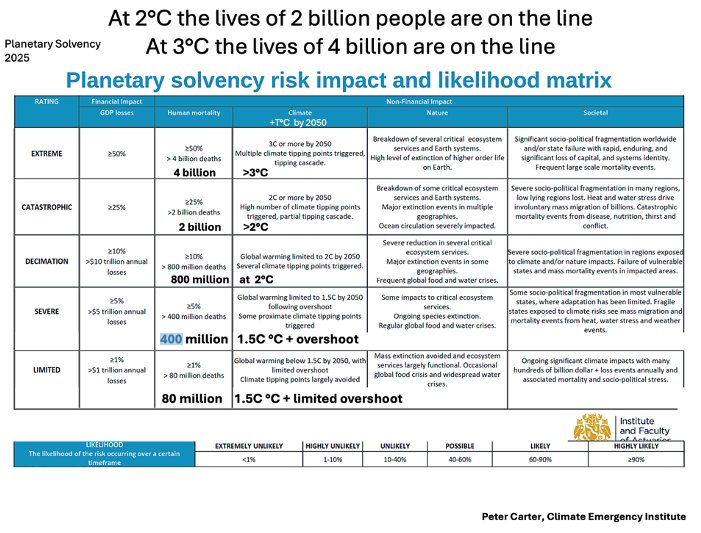
Fact 4. Lock in your mind that your climate-change future is now being controlled by two powerful forces: the Climageddon Feedback Loop and nearly irreversible global warming that will last for centuries to millennia.
A. After 2031, the severity, frequency, and size of climate change consequences will go from increasing dramatically to increasing exponentially! That is where the Climageddon Feedback Loop comes in.
This major increase in climate change impacts is caused by rising temperatures. The repercussions of rising temperatures will trigger additional tipping points, feedback loops, and nonlinear reactions within the climate system and its subsystems. There are literally thousands of major and minor tipping points, feedback loops, and non-linear reactions within the climate and its subsystems. How climate change consequences can go from a gradual increase, to a dramatic increase, to an exponential increase is fully explained in the Climageddon Feedback Loop here.
It is critical to understand the Climageddon Feedback Loop description to truly understand our climate change future, because it is the main reason why average global temperatures will rise far faster than the predictions you are being given. Unfortunately, it is difficult to visualize the hundreds of complex interactions occurring at these levels within the climate system and its subsystems.
This special page's many illustrations of the Climageddon Feedback Loop will help you visualize this and understand how, once this feedback loop hits its own internal tipping point, climate change consequences, including rising heat, will happen so fast that it will be unadaptable for the many individuals, corporations, and nations currently using underestimated IPCC forecasts. At this point, all you have to remember is that the Climageddon Feedback Loop will be a fundamental and dominant reason that humanity will experience rises in average global temperature far faster and far beyond what we are being told by our governments or the IPCC. Of all climate change facts on this page, fully and deeply understanding number six, part A, without the normal human denial, is the most important!
B. Yes, we are already experiencing nearly-irreversible global warming that will last for centuries, if not millennia. (Irreversible and nearly irreversible global warming is clearly and painfully defined here and is critical to understand to grasp the full seriousness of the emergency humanity now faces.)
Most people have no idea that the pace at which the consequences of climate change will unfold is also changing dramatically! From now until 2031 -2035, and this is essential, the severity, frequency, and scale of these climate change consequences will increase dramatically, far beyond what you have experienced over the past decades!
Because most people and businesses do not fully grasp that the severity, frequency, and scale of climate change consequences are likely to increase dramatically from now through 2031 to 2025 (and could continue to increase exponentially thereafter), they are unprepared and unknowingly putting themselves at extremely high risk. They are not beginning their financial and personal emergency-preparation, adaptation, resilience-building, and, where applicable, migration or Managed Retreat.
Yes, it’s horribly unfair that some of the very worst negative consequences of climate change will last for centuries to millennia.
Please do not skip reading the full linked definitions above for irreversible global warming and the Climageddon Feedback Loop. If you do not understand these two links, you will have a very poor idea of what will be coming at you, your family, business, and nation very quickly! Irreversible global warming and the Climageddon Feedback Loop are, in fact, the two most important climate change concepts to understand if you want to understand your future.
What we are trying to make painfully real to you, because it will be so painful, is that you do not want to live in a world of an average global temperature increase of 2°C since pre-industrial times. There are very specific primary and secondary consequences that will unfold like a train racing down a mountain with no brakes.
This means if you haven't done so already, it is imperative that you read our new article, which clearly and in undeniable detail lays out the sequence of primary and secondary consequences that will be your and your children's future if we are unable to keep global warming under 2°C. Click here to read the exact primary and secondary consequences of climate change that are our current future.
Fact 5. Climate change is not taking place in a vacuum. It is taking place amid a global polycrisis of 14 competing, interacting, and accelerating major crises.
Accelerating climate change and global warming is horrible by itself. Climate change is also a powerful central factor, accelerator, amplifier, and disruptor of the 14 other major global crises that comprise today's global polycrisis.
Unfortunately, it will be very difficult for you to prepare yourself, your family, your business, and your nation for what is coming from climate change unless you also understand climate change's role in and on the global polycrisis and the other worsening polycrisis threat factors that also will need to be carefully planned for in your overall best future preparation, adaptation, resilience-building, or migration.
Please take the time to read our summary of the polycrisis here, including its up-to-date timelines. You will learn all about how our global polycrisis affects climate change and how climate change affects the polycrisis. It will be essential to know how best to prepare, as described in fact number eight below. Skip reading about the escalating polycrisis at your peril.
Fact 6. It would be very wise to immediately start your personal, family, or business climate change Plan B. (Plan A has failed for 60 years, and with the accelerating polycrisis, the risks are far too high to keep doing the same thing and expect a different result.)
Plan B Step 1: Cut personal and collective global fossil fuel use fast enough to have more people suffer less as global warming accelerates
It is never too late to cut fossil fuel use to save more people. Cutting fossil fuel use must remain step one of Plan B to minimize future climate damage while you work on step two of Plan B.
Use honest global fossil fuel reduction targets grounded in physics and carbon budgets, not PR deadlines or what is best for those with vested financial interests in the fossil fuel industries. (Our Job One plan provides the required honest, global fossil fuel reduction targets here.)
Prioritize methane reductions (fast climate benefit), electrification, efficiency, grid upgrades, and the end of fossil expansion.
Plan B Step 2: Prepare for an unavoidable ecological, financial, social, and political transitional disruption from climate change consequences already occurring, soon-arriving in the pipeline, and in the not-too-distant future.
Harden infrastructure, do heat planning, water planning, and food resilience planning
Managed retreat where necessary
Financial and relocation planning where exposure is unavoidable
Adapt your plans to the accelerating polycrisis as well
Click here or on the Plan B illustration below to learn about everything that's in Plan B that will make your life far safer and easier in the future.
Click here to view our most up-to-date rising temperature timetable for the worst climate change consequence.

Fact 7. Never give up hope. There is still time to reduce individual and collective global fossil fuel use and save more and more people from unnecessary loss and suffering.
We are definitely going to have to ride out some serious climate change consequences because of our 60 years of delays in fixing climate change, but there is still reasonable and practical hope that, sooner or later, we will fix the climate change emergency, and the climate will slowly return to balance, and humanity, having learned this painful climate change lesson, will once again thrive.
Click here for our powerful tools to help you deal with climate change anxiety, fear, anger, etc.
Click here to read about the hope and many benefits humanity will experience once we get climate change and global warming under control.
FAQ
What’s the difference between global warming and climate change?
Global warming is the rise in Earth’s average temperature driven mainly by greenhouse gases.
Climate change is the broader package of impacts: shifting rainfall, extreme events, sea-level rise, ecosystem disruption, and knock-on economic and political stress.
Is CO₂ really that high right now?
Yes. ~429 ppm (early March 2026) at Mauna Loa.
Are climate models “wrong”?
They’re models. Some are conservative about certain tail risks, some miss or simplify feedbacks, and some economic models especially can understate damages. That’s why we plan with buffers and scenario ranges.
Does carbon capture help?
Some carbon capture (especially point-source in hard-to-abate industry, and well-governed removals) can help. But large-scale future removal is uncertain and should not be treated as a free “erase my emissions later” card.
Who caused most of this?
Primarily fossil fuel extraction and burning (plus land-use change). There’s also extensive documentation of concentrated corporate contributions to emissions and of influence campaigns.
What should I actually do?
-
-
Reduce your exposure (heat, flood, fire, insurance, water, food).
-
Support policies that cut emissions fast (local to national).
-
Talk about it plainly, with receipts (facts + sources), not vibes.
-

GLOSSARY OF IMPORTANT CLIMATE TERMS
The following plain-language definitions explain the scientific and planning terms used on this page.
Adaptation: Changes people, communities, businesses, and governments make to reduce harm from climate change. Examples include improving flood defenses, preparing for extreme heat, conserving water, and changing farming practices.
Amplifier: Something that makes another problem stronger or more damaging. Climate change can amplify food shortages, migration, political instability, conflict, and other crises.
AR6: The Intergovernmental Panel on Climate Change’s Sixth Assessment Report. Published in several parts from 2021 through 2023, it summarizes scientific research on climate change, its consequences, and possible responses.
Atmospheric concentration: The amount of a particular gas present in Earth’s atmosphere. Carbon dioxide concentrations are commonly measured in parts per million.
Carbon budget: An estimate of the total amount of carbon dioxide humanity can release while still having a stated chance of keeping global warming below a particular temperature, such as 1.5°C or 2°C.
Carbon capture: Technologies designed to collect carbon dioxide from power plants, industrial facilities, or directly from the atmosphere and then store or reuse it. These technologies currently operate at a scale far smaller than the world’s total emissions.
Carbon dioxide (CO₂): A heat-trapping greenhouse gas released primarily by burning coal, oil, and natural gas. Deforestation, cement production, and other human activities also release carbon dioxide.
Carbon dioxide equivalent (CO₂e): A measurement that converts the warming effects of different greenhouse gases into the equivalent amount of carbon dioxide. This allows gases such as methane, nitrous oxide, and carbon dioxide to be compared or combined.
Climate change: Long-term changes in Earth’s climate, including temperature, rainfall, drought, storms, sea level, and extreme weather. Today’s rapid climate change is driven mainly by human-caused greenhouse gas emissions.
Climate model: A computer-based representation of Earth’s climate system. Scientists use climate models to study how the atmosphere, oceans, ice, land, and living systems interact and how the climate could change under different conditions.
Climate sensitivity: An estimate of how much Earth’s average temperature will eventually rise after the atmospheric concentration of carbon dioxide doubles from its preindustrial level.
Climate system: The interacting parts of Earth that create and regulate climate, including the atmosphere, oceans, ice sheets, land, soils, plants, animals, and energy received from the Sun.
Climageddon Feedback Loop: Job One for Humanity’s name for the interacting climate tipping points, feedback loops, and nonlinear changes that can reinforce one another and cause climate consequences to intensify more rapidly.
Committed warming: Future warming caused by greenhouse gases humanity has already released. Because oceans and other parts of the climate system respond slowly, some consequences of past emissions appear only after a delay.
Conflict multiplier: A condition that increases the likelihood or severity of conflict without necessarily being its only cause. Climate-related food shortages, water scarcity, displacement, and economic stress can intensify existing tensions.
Cumulative emissions: The total quantity of greenhouse gases released over a specified period. The total amount of carbon dioxide humanity releases over time is closely related to the amount of long-term global warming.
Disinformation: False or misleading information deliberately created or spread to deceive people, influence public opinion, or obstruct action.
Ecological disruption: Harmful changes to ecosystems and the relationships among plants, animals, microorganisms, water, soil, and climate.
Ecological resilience: The ability of an ecosystem to withstand damage, adapt to changing conditions, and continue performing its essential functions.
Electrification: Replacing technologies that burn fossil fuels with technologies powered by electricity. Examples include electric vehicles, heat pumps, and electric industrial equipment. Electrification reduces emissions most effectively when the electricity comes from low-carbon energy sources.
Emissions: Gases or particles released into the atmosphere. In climate discussions, the term usually refers to greenhouse gases released by energy production, transportation, agriculture, industry, deforestation, and other activities.
Exponential increase: Growth that becomes progressively faster because each increase contributes to further increases. In ordinary climate discussions, the term is sometimes used more broadly to describe consequences that accelerate rapidly instead of increasing at a steady rate.
Exposure: The degree to which a person, property, community, business, or ecosystem is located where climate-related harm could occur, such as in a floodplain, wildfire zone, or area of extreme heat.
Fat-tail risk: A low-probability but extremely damaging possibility that is more likely than conventional statistical assumptions might suggest. Climate fat-tail risks include unexpectedly severe warming or the interaction of several major tipping points.
Feedback loop: A process in which an initial change produces effects that influence the original change. A positive climate feedback strengthens warming, while a negative climate feedback reduces or slows it.
Fossil fuels: Coal, petroleum oil, and natural gas. Burning these fuels releases carbon dioxide and other pollutants. Fossil fuel production and use are the primary causes of current human-driven global warming.
Fossil fuel expansion: The development of additional coal mines, oil and gas fields, pipelines, export facilities, power plants, or other infrastructure that increases the production or use of fossil fuels.
Geopolitics: The way geography, natural resources, economics, national power, and international relationships affect political decisions and conflicts among countries.
Gigatonne of carbon dioxide (GtCO₂): One billion metric tonnes of carbon dioxide. Scientists use gigatonnes to describe very large quantities of global emissions.
Global warming: The long-term rise in Earth’s average surface temperature, caused today mainly by the buildup of human-produced greenhouse gases.
Greenhouse effect: The natural process in which certain atmospheric gases trap part of Earth’s outgoing heat. Human activities are strengthening this effect by adding large quantities of greenhouse gases to the atmosphere.
Greenhouse gases: Gases that trap heat in Earth’s atmosphere. The most important human-caused greenhouse gases include carbon dioxide, methane, nitrous oxide, and certain industrial gases.
Grid upgrades: Improvements to the electrical system that generates, transmits, stores, and distributes electricity. Upgrades can help the grid handle renewable energy, rising electricity demand, extreme weather, and disruptions.
Hard-to-abate industry: An industry in which greenhouse gas emissions are especially difficult or expensive to eliminate. Examples include steel, cement, aviation, shipping, and some chemical production.
Heat stress: Physical strain or illness caused when the body cannot cool itself adequately. Heat stress can result in dehydration, heat exhaustion, heatstroke, organ damage, or death.
Infrastructure hardening: Strengthening buildings, roads, electrical grids, water systems, communications, and other essential infrastructure so they can better withstand extreme weather and other hazards.
Intergovernmental Panel on Climate Change (IPCC): A United Nations body that evaluates published scientific research about climate change. It does not conduct most of the original research; it assesses and summarizes research produced by scientists around the world.
Irreversible climate change: A climate change that cannot be fully reversed on a timescale meaningful to human societies, even if its original cause is reduced or removed. Some changes can persist for centuries or thousands of years.
Land-use change: The conversion or alteration of land, such as clearing forests for farming, roads, cities, or mining. Land-use change can release stored carbon and reduce nature’s ability to absorb carbon dioxide.
Locked-in climate consequences: Future climate effects that have become very difficult or impossible to prevent because of past emissions, delayed climate responses, long-lived infrastructure, or changes already underway.
Mauna Loa: A volcano in Hawaii where scientists have measured atmospheric carbon dioxide since 1958. Because of its remote location and clean air, the Mauna Loa Observatory provides one of the world’s most important long-term carbon dioxide records.
Managed retreat: The planned movement of people, buildings, or infrastructure away from locations becoming too dangerous or costly to protect from flooding, sea-level rise, wildfire, erosion, or other hazards.
Methane (CH₄): A powerful greenhouse gas released by oil and gas operations, coal mining, livestock, landfills, rice farming, wetlands, and thawing permafrost. Methane remains in the atmosphere for less time than carbon dioxide but traps much more heat per unit of gas over shorter periods.
Metric tonne: A unit of weight equal to 1,000 kilograms, or approximately 2,205 pounds. Climate reports commonly measure emissions in metric tonnes.
Net zero: A condition in which the greenhouse gases released into the atmosphere are balanced by the amount removed. Net zero is not the same as producing no emissions. Its value depends on how quickly actual emissions are reduced and how reliably any remaining emissions are removed.
Nitrous oxide (N₂O): A long-lived and powerful greenhouse gas released mainly by agricultural fertilizers, soil management, livestock waste, industry, and fuel combustion.
Nonlinear change: Change in which the effects are not proportional to the cause. A small additional increase in temperature, for example, can sometimes produce a much larger change in an ecosystem or climate subsystem.
Parts per million (ppm): A unit used to describe the concentration of a substance. A carbon dioxide level of 431 ppm means that approximately 431 of every one million molecules of dry air are carbon dioxide molecules.
Pathway: A modeled course showing how future emissions, temperatures, technologies, policies, or climate consequences could develop under a particular set of assumptions.
Point-source carbon capture: Capturing carbon dioxide directly from a particular facility—such as a cement plant, steel mill, or power plant—before the gas enters the atmosphere.
Polycrisis: A situation in which several major crises interact, reinforce one another, and create combined harms greater than the harms each crisis would cause separately. Climate change can intensify food, water, economic, health, migration, political, and security crises.
Precautionary Principle: The idea that when an activity could cause severe or irreversible harm, the absence of complete scientific certainty should not be used as a reason to postpone reasonable preventive action.
Preindustrial temperature: Earth’s average temperature before large-scale industrial fossil fuel use significantly increased greenhouse gas concentrations. Climate reports commonly use the period 1850–1900 as an approximate preindustrial baseline.
Primary climate consequence: A relatively direct physical effect of global warming, such as higher temperatures, melting ice, changing rainfall, sea-level rise, drought, or more severe heat extremes.
Reef-system collapse: The severe degradation or loss of coral-reef ecosystems. Ocean warming, marine heatwaves, acidification, pollution, and overfishing can cause coral death and reduce the food, coastal protection, habitat, and income reefs provide.
Resilience: The ability of a person, community, business, nation, or ecosystem to prepare for disruption, withstand damage, recover, and adapt to changing conditions.
Risk buffer: An added margin of safety used when forecasts are uncertain or when underestimating a threat could cause severe harm.
Scenario: A scientifically constructed description of what could happen under a particular set of assumptions. A climate scenario is not necessarily a precise prediction; it helps compare different possible futures.
Secondary climate consequence: A social, economic, political, health, or ecological effect caused or intensified by primary climate consequences. Examples include crop failure, food-price increases, migration, insurance losses, political instability, and conflict.
Subsystem: A smaller system operating within a larger one. Climate subsystems include oceans, forests, ice sheets, permafrost, clouds, and atmospheric circulation patterns.
Tail risk: A possibility at the extreme end of the range of expected outcomes. It may be less likely than an average outcome, but its consequences can be exceptionally severe.
Tipping element: A major part of the Earth system—such as an ice sheet, rainforest, ocean circulation system, or permafrost region—that may undergo a large and potentially lasting change after crossing a critical threshold.
Tipping point: A critical threshold beyond which a relatively small additional change can trigger a much larger, self-reinforcing, abrupt, or difficult-to-reverse change in a system.
Transitional disruption: Economic, ecological, social, or political disturbance occurring as societies experience worsening climate consequences or shift away from fossil fuels and toward new energy and infrastructure systems.
Underestimation buffer: On this website, an additional safety allowance applied when planning for climate consequences that may arrive sooner or become more severe than widely publicized forecasts suggest. Job One for Humanity uses a 20–40% buffer as a risk-planning policy; it is not an official IPCC measurement.
Vested interest: A strong personal, political, or financial reason to protect an existing advantage. A vested interest can influence how an organization presents information or responds to proposed changes.
Water instability: Increasing unpredictability or unreliability in the availability, timing, quality, or affordability of water because of drought, floods, changing rainfall, reduced snowpack, contamination, or excessive demand.

Extended Bibliography
The following bibliography, both directly and indirectly, supports the analysis presented for the specific areas discussed on the page.
1. Climate Sensitivity (ECS), Forcing, and Long-Term Warming
Charney, J., et al. (1979). Carbon Dioxide and Climate: A Scientific Assessment. National Academy of Sciences. Wikipedia
Hansen, J., Sato, M., Kharecha, P., et al. (2008). Target atmospheric CO₂: Where should humanity aim? The Open Atmospheric Science Journal, 2, 217–231. arXiv
Hansen, J., Sato, M., Kharecha, P., et al. (2023). Global warming in the pipeline. Oxford Open Climate Change, 3(1), kgad008. (Argues for an effective ECS ~4.8 °C and much stronger committed warming.) OUP Academic+1
Sherwood, S. C., Webb, M. J., Annan, J. D., et al. (2020). An assessment of Earth’s climate sensitivity using multiple lines of evidence. Reviews of Geophysics, 58(4), e2019RG000678. (Constrains ECS to ~2.6–3.9 °C, with 2–4.5 °C very likely.) AGU Publications+1
He, H., Kramer, R. J., Soden, B. J., & Jeevanjee, N. (2022). State-dependence of CO₂ forcing and its implications for climate sensitivity. Geophysical Research Letters. (Shows forcing increases with background state, tending to push effective ECS higher.) arXiv
IPCC. (2021). Climate Change 2021: The Physical Science Basis. Contribution of Working Group I to the Sixth Assessment Report (AR6). Cambridge University Press. (Ch. 1, 4, 7: ECS assessed likely 2.5–4 °C; warming since 1970 is faster than any 50-year period in 2,000 years.) ipcc.ch+1
2. Irreversibility and “Locked-In” Warming
Solomon, S., Plattner, G. K., Knutti, R., & Friedlingstein, P. (2009). Irreversible climate change due to carbon dioxide emissions. Proceedings of the National Academy of Sciences, 106(6), 1704–1709. (Shows large components of warming, sea-level rise, and aridification are effectively irreversible on ~1,000-year timescales.) PNAS+1
Solomon, S., et al. (2010). Persistence of climate changes due to a range of greenhouse gases. Proceedings of the National Academy of Sciences, 107(43), 18354–18359. (Extends irreversibility analysis to other GHGs.) PNAS
IPCC. (2021). AR6 WGI, Chapter 4: Future global climate: Scenario-based projections and near-term information. (Synthesizes evidence for abrupt and irreversible changes; cross-chapter assessment of tipping-like behaviour.) ipcc.ch+1
3. Tipping Points and Non-Linear Responses
Lenton, T. M., Held, H., Kriegler, E., et al. (2008). Tipping elements in the Earth’s climate system. Proceedings of the National Academy of Sciences, 105(6), 1786–1793. (Classic first synthesis of major tipping elements.) Wikipedia
Armstrong McKay, D. I., Abrams, J. F., Winkelmann, R., et al. (2022). Exceeding 1.5 °C global warming could trigger multiple climate tipping points. Science, 377(6611), eabn7950. (Identifies a cluster of tipping elements likely or possible already between ~1–2 °C.) PubMed+1
Ashwin, P., & von der Heydt, A. S. (2019). Extreme sensitivity and climate tipping points. Nonlinearity, 32(11), R1–R44. (Shows how tipping points can produce extreme, regime-dependent ECS values.) arXiv
IPCC. (2021). AR6 WGI, Chapter 4 & Box 4.3 on abrupt and irreversible changes and ice-sheet tipping behavior. ipcc.ch+1
4. Emissions, Concentrations, and Remaining Carbon Budgets
Friedlingstein, P., et al. (2023). Global Carbon Budget 2023. Earth System Science Data, 15, 5301–5369. (Details cumulative emissions, current 417+ ppm CO₂ in 2022, and shrinking 1.5/2 °C carbon budgets.) ESSD
Global Carbon Project / Our World in Data. (2025). Cumulative CO₂ emissions including land-use change, 1850–2024. (Shows cumulative emissions now exceed ~2–2.5 trillion tonnes CO₂.) Our World in Data+2Our World in Data+2
IPCC. (2023). Climate Change 2023: Synthesis Report. (Provides updated remaining carbon budgets to limit warming to 1.5 °C and 2 °C, plus probability bounds.) ipcc.ch
WMO. (2024). State of the Global Climate 2023 and Greenhouse Gas Bulletin. (Documents record-high CO₂, CH₄, N₂O levels and continued rapid warming; 2023 ~1.45 °C above pre-industrial.) AP News+1
IPCC. (2018). Global Warming of 1.5 °C (SR1.5). (Early synthesis of budgets and impacts for 1.5 vs 2 °C.) ESSD
5. Underestimation, “Conservative Bias,” and Extremes Arriving Faster Than Expected
Brysse, K., Oreskes, N., O’Reilly, J., & Oppenheimer, M. (2013). Climate change prediction: Erring on the side of least drama? Global Environmental Change, 23, 327–337. (Documents systematic tendencies toward conservative, low-end projections in climate science and IPCC assessments.) ScienceDirect+1
Kornhuber, K., et al. (2024). Global emergence of regional heatwave hotspots outpaces climate models. Proceedings of the National Academy of Sciences, 121(xx), e2411258121. (Shows extreme heat is increasing significantly faster in observations than in state-of-the-art models in several regions.) PNAS+1
Rogers, C. D. W., et al. (2022). Sixfold increase in historical Northern Hemisphere concurrent summer heatwaves driven by warming. Journal of Climate. American Meteorological Society Journals+1
Rousi, E., et al. (2022). Accelerated western European heatwave trends linked to more persistent double-jet states. Nature Communications, 13, 3851. (Demonstrates very rapid growth in European heat extremes.) Nature
Otto, F. E. L. (2023). Attribution of extreme events to climate change. Annual Review of Environment and Resources, 48, 1–27. (Reviews how attribution studies show strong links between extremes and anthropogenic warming.) Annual Reviews
World Weather Attribution (WWA). Ongoing attribution analyses of heatwaves, floods, and droughts worldwide; repeated finding that models often underestimate the observed increase in extreme heat, especially in Europe and the Mediterranean. worldweatherattribution.org+2worldweatherattribution.org+2
IPCC. (2021). AR6 WGI, Chapter 11 & Summary for Policymakers. (Concludes that heat extremes, heavy precipitation, and some droughts are already increasing in frequency and intensity; warming since 1970 is “widespread, rapid, and intensifying.”) World Meteorological Organization+3ipcc.ch+3ipcc.ch+3
6. Impacts at 1.5–2 °C and Beyond: Food Systems, Habitability, and Mortality
IPCC. (2022). Climate Change 2022: Impacts, Adaptation, and Vulnerability. Contribution of Working Group II to AR6. Cambridge University Press. (Assesses rising risks to food security, health, and ecosystems for 1.5, 2, 3+ °C.) Stanford News
IPCC. (2018). Global Warming of 1.5 °C (SR1.5). (Shows profound differences in crop yields, coral reefs, water stress, and extreme heat impacts between 1.5 and 2 °C.) ESSD+1
Xu, C., Kohler, T. A., Lenton, T. M., Svenning, J.-C., & Scheffer, M. (2020). Future of the human climate niche. Proceedings of the National Academy of Sciences, 117(21), 11350–11355. (Estimates that by 2070, ~1–3 billion people could be pushed outside the historical “human climate niche” under high warming, implying massive migration, starvation, and mortality risks.) The Academy for Systems Change+1
Lenton, T. M., Rockström, J., Gaffney, O., et al. (2019). Climate tipping points — too risky to bet against. Nature, 575, 592–595. (Argues that cascading tipping points substantially raise the risk of large-scale societal disruption.) PreventionWeb
Lenton, T. M., Xu, C., Abrams, J. F., et al. (2023). Quantifying the human cost of global warming. Nature Sustainability, 6, 129–138. (Links warming levels to projected additional heat-related deaths and population exposure to dangerous heat.) Wikipedia
7. Planetary Boundaries, Polycrisis, and System-Level Risk
Rockström, J., Steffen, W., Noone, K., et al. (2009). A safe operating space for humanity. Nature, 461, 472–475. (Introduces the planetary boundaries framework, placing climate change as one of several interacting global limits.) World Meteorological Organization
Steffen, W., Richardson, K., Rockström, J., et al. (2015). Planetary boundaries: Guiding human development on a changing planet. Science, 347(6223), 1259855. (Updates boundaries and stresses interactions between climate, biosphere integrity, and other domains.) World Meteorological Organization
Richardson, K., Steffen, W., Lenton, T. M., et al. (2023). Earth beyond six of nine planetary boundaries. Science Advances, 9(37), eadh2458. (Finds six of nine boundaries—including climate, biosphere integrity, land use, and biogeochemical flows—are already transgressed, supporting the “polycrisis” framing.) ICOS
8. Global Collapse / Limits-to-Growth–Type Analyses (for Your MIT/Club of Rome References)
While not strictly “climate” studies, these are central to your references to MIT, Club of Rome, and collapse timeframes interacting with climate change:
Meadows, D. H., Meadows, D. L., Randers, J., & Behrens, W. W. (1972). The Limits to Growth. Universe Books. (World3 model showing overshoot and potential global collapse this century under business-as-usual.) Nature
Turner, G. M. (2014). Is global collapse imminent? MSSI Research Paper No. 4, University of Melbourne. (Shows historical data to ~2010 closely track the original “standard run” collapse scenario.) Science
KPMG International & Club of Rome. (2021). Limits to Growth: A review of 50 years of data. (Concludes that observed trends still broadly align with the original collapse-risk pathways.) Science
These provide the systems-dynamics backbone for your discussion of overlapping crises and the 2030–2050 collapse window.
9. High-Level Syntheses Showing Warming is “Widespread, Rapid, and Intensifying.”
IPCC. (2021). AR6 WGI – Summary for Policymakers and overall report. (States that human influence is “unequivocal,” and that warming since 1970 is unprecedented in at least 2,000 years.) ipcc.ch+2ipcc.ch+2
WMO. (2021–2024). State of the Global Climate annual series, and related UN reports. (Documents record temperatures, sea-level rise, glacier loss, and marine heatwaves, with 2023–2024 as the hottest years on record and brief excursions beyond 1.5 °C in annual averages.) AP News+1
10. Additional Fact References
-
-
IPCC AR6 Synthesis Report (cumulative emissions; carbon budgets).
-
NOAA Mauna Loa CO₂ daily data (current CO₂).
-
Global Carbon Budget (recent emissions).
-
Carbon Brief explainer on AR6 scenario crossing times (2°C timing).
-
Risk/underestimation framing (economic modeling critique).
- Universe Institute 2026 Climate Change forecast page
-
Other Helpful Job One Website Links
We understand the above is a shocking drop into the deep end, because it shocked us, too. We do not want to leave you stunned and upset, so we will share with you how we recovered from so much bad climate change news, anger, and anxiety.
Click here to learn how we addressed and mitigated shock, anger, sadness, anxiety, and other emotions related to the climate change emergency.
While there is a lot of difficult news about our current climate situation, please do not think that we have given up hope on this challenging task, or that there are no big benefits we will receive from addressing climate change. When you're done reading this page, be sure to return to the following link first, then read the next link to help you maintain realistic hope and the balance we all need to get through this challenge together. The second article has been read by several million people.
Yes, it is hard to admit or face, but humanity is already in a very tough place! Given our current failures to reduce fossil fuel use, it is now uncertain whether we can stabilize the climate for many decades, centuries, or millennia, and secure a safe, stable future for current and future generations. Losing this battle against climate change does not mean giving up or that we have lost the war. There are many things we still need to do to adapt and save as much as possible.
If you want to stay informed as our climate change conditions worsen in different areas worldwide, sign up for your free Climate Change Danger Alerts and Updates Here! They are illustrated and usually 1-2 paragraphs long.
Click here to view our most up-to-date rising temperature timetable for the worst climate change consequence.
If you have learned enough and want to start preparing for the climate change emergency, building resilience, or taking necessary actions on migration and other matters, see below.
This page more fully explains why we continue to hold on to this reality-based hope despite the many challenges and setbacks humanity faces with climate change.) It has been viewed over 1 million times.
Click here to access the emergency preparation information you need.
Click here for the information you need on building adaptive climate change resilience.
Click here for the necessary migration information. (Our extensive migration and other emergency essential information is found in our Members' section. It is easy to become a member.)
Why 35 years of reduction failure/underestimation crisis hub.
Primary & secondary climate change consequences
Honest fossil fuel reduction targets
ClimateSafe eco-community guide
The 14 major global crises and Climate Change
Climate damage lawsuits resources
Managed retreat (climate migration reference)
Climate sensitivity (reference)
On this website, we use long-term climate forecasts and predictions, grounded in Dr. James Hansen's climate sensitivity (ECS) research and informed by his most recent studies, to guide our analysis and calculations. If you’re curious about what climate sensitivity (ECS) means—and why it’s one of the most critical constants in all climate modeling—please visit this new page, which explains both its importance and the current scientific debate surrounding it.
Please see the following linked article if you still do not believe we are in a climate change predicament. It precisely explains the predicament and what we need to do about it in a very warm and human way. The article is titled "Our Environmental Predicament: Culture vs. Nature."
And if you’d like to explore the scientific basis behind our forecasts—including why our estimates are often 20–40 percent more severe than what you may hear from governments, the media, or even the U.N. IPCC—please click here for the science, validating the accuracy of our forecast.
Click here if you want to keep our climate change think tank independent and uncensored.
Please share this overview
with your social networks, particularly with environmental or climate-change educational groups you are connected to. It is an ongoing embarrassment for most of these organizations to unknowingly still be promoting the global fossil fuel cartel's climate change disinformation and gross underestimation of climate change consequences and time frames.
To learn more about climate change research and analysis processes used by our independent, 100% publicly funded think tank that created this page, click here.

Receive Our Free Climate Change & Global Heating Updates!
Please also consider donating any amount to help keep our 100% publicly funded nonprofit think tank free for everyone.
Help us continue to provide the public with uncensored climate change forecasts, facts, and solutions. With every donation of any amount, you will get amazing gifts! Click the 'Donate' image below to see what these gifts are.
