
Last updated August 24, 2026.
Important clarification. The Climageddon Feedback Loop (CFL) is Job One for Humanity's name for a systems-risk theory and forecasting framework. It is not the name of one formally recognized physical feedback loop in climate science. The CFL draws on established climate science about individual feedbacks, tipping elements, nonlinear responses, compound hazards, and cascading risks, then uses whole-system and DMAP analysis to examine a further possibility: that many of these processes can interact across climate subsystems and human systems in ways that produce faster, more clustered, more difficult-to-predict consequences than isolated or linear analysis would suggest.
This page therefore separates established science, scientifically supported risk, Job One/DMAP hypotheses and planning estimates, and high-risk scenarios. That distinction is essential. A new theory should be tested hard, not protected from criticism.
Prologue: A Climate Pattern Humanity Has Never Experienced Before
The hardest part of understanding the Climageddon Feedback Loop is that humanity may be approaching a type of climate interaction that has never occurred during the period of human civilization.
That does not mean abrupt or cascading Earth-system change has never occurred. Paleoclimate evidence shows that Earth's climate has undergone large and sometimes abrupt transitions. What is historically unusual today is the combination of very rapid human-caused greenhouse-gas forcing, a globally interconnected civilization of more than eight billion people, highly interdependent food-energy-financial systems, extensive coastal development, and multiple climate subsystems being pushed simultaneously.
Human beings naturally understand the future by comparing it with the past. That works reasonably well when the system remains inside familiar boundaries. It becomes much less reliable when a complex adaptive system is being pushed into conditions it has not experienced in the period for which our institutions, infrastructure, economies, and social expectations were designed.
The CFL hypothesis asks a forward-looking question: What happens if multiple climate tipping risks, reinforcing feedbacks, nonlinear reactions, accelerating physical trends, and human-system vulnerabilities begin interacting strongly enough that the combined result becomes qualitatively different from the historical behavior of any one subsystem examined alone?
This is where DMAP matters. Climate science gives us the measurements, mechanisms, models, probabilities, and specialist knowledge. DMAP asks what may emerge from the relationships among those findings, especially relationships that cross disciplinary boundaries or sit in the fat tails of conventional forecasts.
Quick Navigation
- The long-form CFL definition
- Four evidence levels used on this page
- Positive feedback loops and climate amplifiers
- Climate systems and subsystems inside the CFL
- Why DMAP and metasystemic analysis matter
- The three critical interacting forces
- What is scientifically established and what is new in the CFL theory
- What Job One means by runaway global warming
- Tipping points, irreversibility, and hysteresis
- The CFL tipping-cascade risk zone
- Acceleration, nonlinear change, and exponential-like consequences
- Why Job One uses a 20–40% underestimation range
- How physical climate risks cascade through human systems
- Scientific corrections and limits
- What we should do now
- FAQ
- Glossary
- AI prompts to test and challenge the CFL
- Bibliography and research support
1. What Is the Climageddon Feedback Loop?
The short definition is:
The Climageddon Feedback Loop is Job One's systems-risk theory for the possibility that multiple climate tipping points, reinforcing feedbacks, nonlinear reactions, accelerating physical changes, and human-system vulnerabilities can interact across different climate systems and subsystems, recursively amplifying one another and producing compound or cascading consequences that develop faster and become harder to control than simple linear forecasts would suggest.
The longer definition matters even more
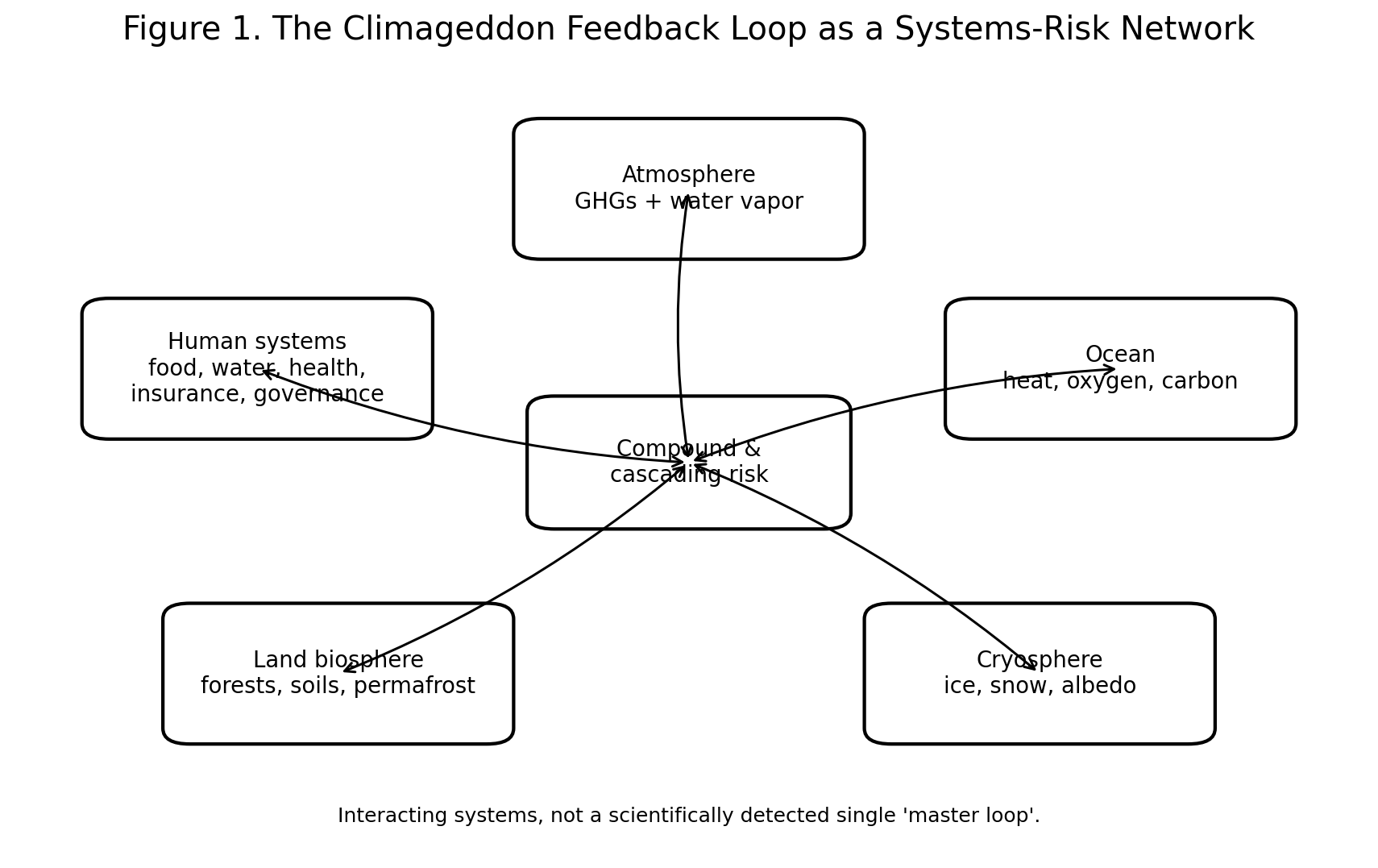
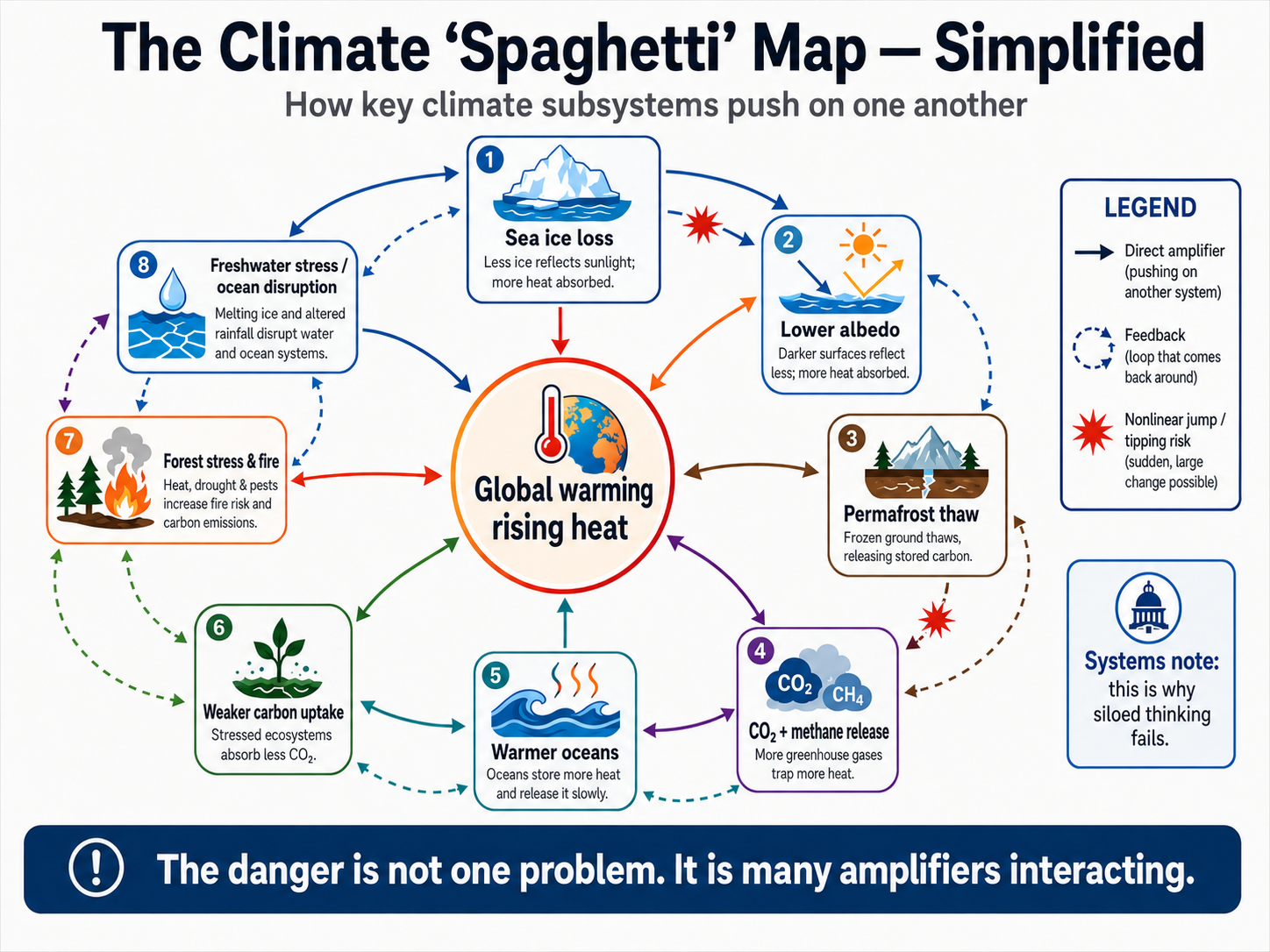
Imagine that rising heat pushes one climate subsystem toward a threshold. That threshold does not have to remain inside that subsystem. Ice loss can reduce albedo and add heat. Added heat can intensify ocean warming and atmospheric moisture. Warmer oceans can alter marine heat, circulation, oxygen, and carbon uptake. Drought and heat can stress forests and soils, weakening carbon storage and increasing fire. Permafrost thaw can release additional carbon dioxide and methane. Those changes can then push other systems closer to their own thresholds.
Now add the part that linear thinking usually misses. A tipping process in one subsystem can change the rate, direction, or stability of a process in a second subsystem. That second subsystem can activate a reinforcing feedback that changes conditions in a third. The third system may respond nonlinearly, producing an effect much larger than expected from the original forcing. That new effect can then feed back into the first or second subsystem, while simultaneously affecting several other systems. Some interactions amplify. Some delay. Some redirect. Some suppress one pathway while strengthening another. Some may create thresholds that do not appear when each subsystem is modeled in isolation.
This is the core of the CFL concept: tipping points, feedback loops, and nonlinear reactions do not have to occur one at a time or stay inside neatly separated climate specialties. They can interact within one subsystem, between two subsystems, and across many subsystems at once. Those interactions can be cumulative, synergistic, recursive, delayed, whipsawing, or cascading. A change in one area can alter the conditions under which another area changes, and the combined result can be larger, faster, or qualitatively different from the sum of the original parts.
That is why the CFL is difficult to visualize. It is not one clean chain of cause and effect. It is closer to a plate of spaghetti thrown into a jet engine: lines crossing lines, loops returning to earlier points, delays hiding consequences until later, thresholds changing the rules, and some connections becoming important only after other conditions are met. The metaphor is intentionally messy because the underlying system is messy.
The most important scientific point is not that every one of these pathways is already proven. It is that modern tipping-point research increasingly agrees that major Earth-system tipping elements interact, that many identified interactions appear destabilizing, and that tipping cascades cannot be ruled out. The 2024 review by Wunderling and colleagues concluded that tipping elements should not be studied only in isolation and that cascades cannot be ruled out on long timescales between about 1.5°C and 2°C of warming, or on shorter timescales above 2°C.
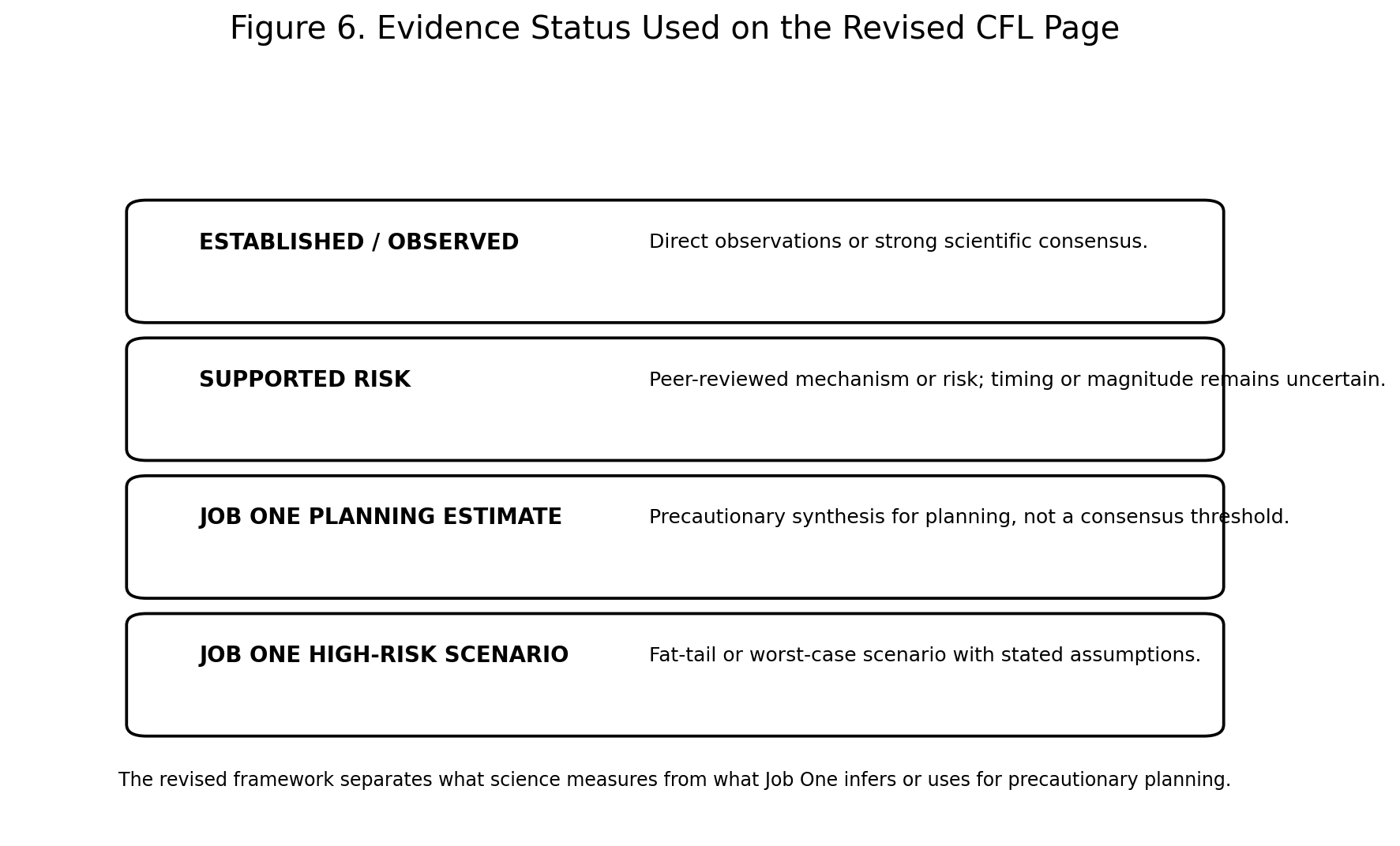
Because this page combines established science with forward-looking systems analysis, each major claim should be understood as belonging to one of four categories:
- Established or observed: directly measured or strongly supported by mainstream climate science.
- Scientifically supported risk: a mechanism or interaction supported by peer-reviewed research, but with uncertainty in timing, magnitude, or pathway strength.
- Job One/DMAP hypothesis or planning estimate: a transparent systems-level inference or precautionary estimate that goes beyond formal consensus and should be tested against future evidence.
- Job One high-risk scenario: a fat-tail or worst-case scenario used for risk management when consequences are very large even though probability and timing remain uncertain.
3. Positive and Stabilizing Feedback Loops
A reinforcing or positive feedback amplifies change. A stabilizing or negative feedback opposes change. Climate contains both.
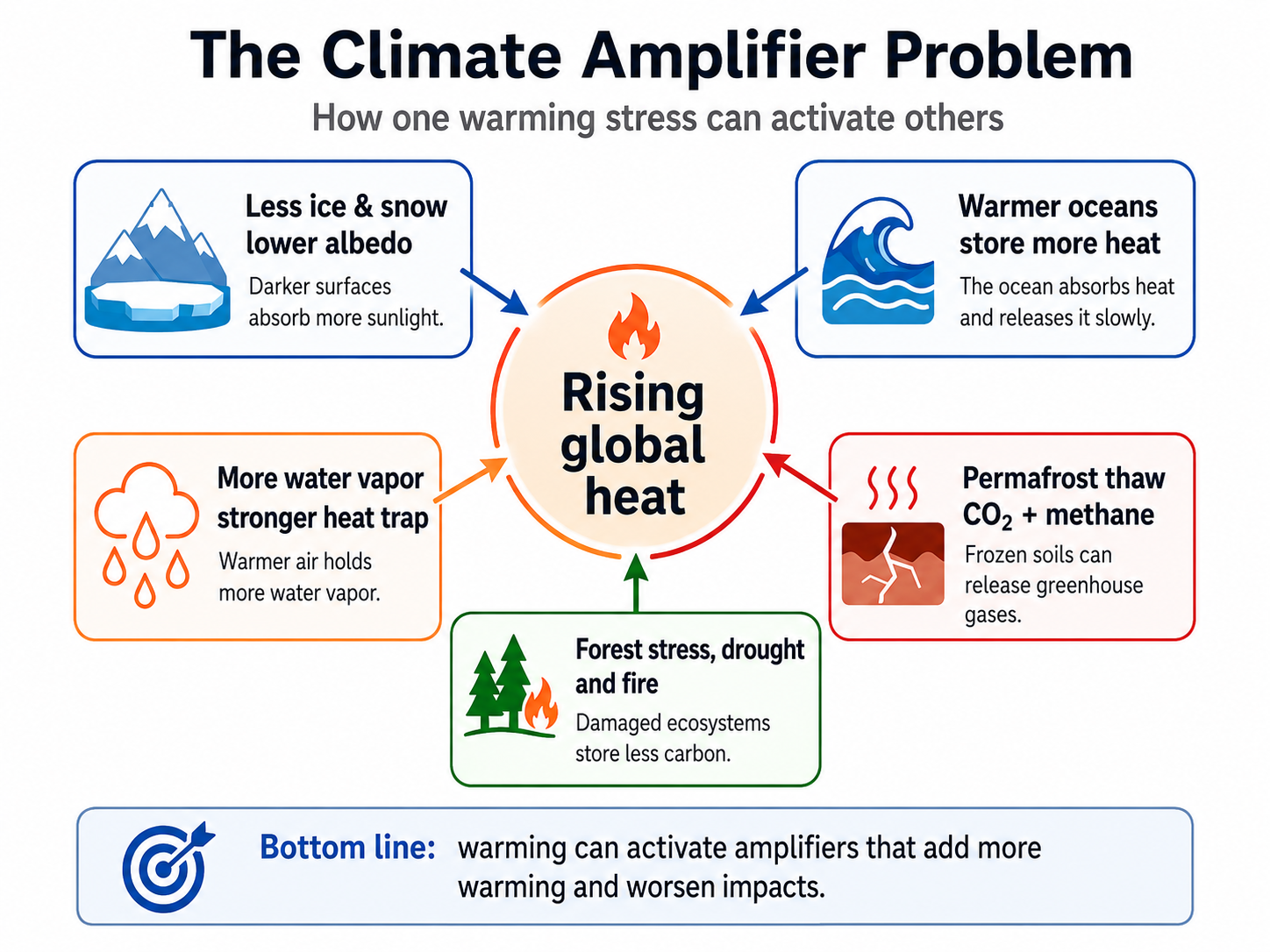
For example, warming melts reflective snow and ice. Darker ocean and land absorb more sunlight. That adds additional warming, which can melt more snow and ice. Water vapor provides another important amplifier: warmer air can hold more water vapor, and water vapor is itself a greenhouse gas.
But positive feedback does not automatically mean infinite growth or a Venus-like runaway greenhouse. A reinforcing process can weaken, saturate, be counteracted by stabilizing feedbacks, or move the system toward a new state.

What matters for the CFL is that several amplifiers can operate at the same time. Ice-albedo loss, water-vapor amplification, forest stress, permafrost carbon release, ocean heat accumulation, and weakening carbon uptake can all alter the conditions under which other climate processes operate.
4. Core Climate Systems and Subsystems Inside the CFL
The CFL is not a theory about one climate variable. It concerns relationships among many interacting systems and subsystems, including:
- Atmospheric carbon dioxide.
- Methane and nitrous oxide.
- Atmospheric water vapor and cloud feedbacks.
- Earth's energy imbalance.
- Ocean heat content and marine heatwaves.
- Ocean acidification, oxygen loss, and carbon uptake.
- Ocean circulation, including the Atlantic Meridional Overturning Circulation (AMOC).
- Mountain glaciers.
- Greenland and Antarctic ice sheets and ice shelves.
- Arctic sea ice, snow cover, and albedo.
- Forests, soils, wetlands, and other land carbon sinks.
- Permafrost carbon feedbacks.
- Hydrologic systems: drought, extreme precipitation, groundwater, and hydroclimate whiplash.
- Coastal systems affected by accelerating sea-level rise.
- Ecological systems such as coral reefs, boreal forests, and tropical forests.
- Human systems: food, water, health, insurance, infrastructure, migration, finance, security, and governance.
There may be thousands of physical, biological, and social interactions within this larger network. That is different from claiming there are thousands of scientifically recognized major climate tipping elements. The number of widely studied large-scale tipping elements is much smaller.

5. Why DMAP and Metasystemic Analysis Matter Here
The Climageddon Feedback Loop is a dialectical, metasystemic, and multisystem problem. That is why it can be difficult for institutions organized around separate specialties to see the whole risk pattern.
Standard linear analysis asks: What does this variable do? Systems thinking asks: How do the parts interact? DMAP asks another layer of questions: How do interacting systems transform one another over time? What happens when feedback, delay, contradiction, threshold behavior, adaptation, and phase change alter the relationships among the parts?
DMAP does not replace climate science. It depends on climate science. The measurements, physical mechanisms, paleoclimate evidence, observational records, and models have to come first. The additional task is to integrate those facts across boundaries and ask what new patterns may emerge from relationships that specialists reasonably study separately.
This matters because a researcher can be completely correct about glaciers, ocean circulation, water vapor, permafrost, forests, or sea level and still not be studying what happens when several of those systems change together. The specialist is not wrong. The specialist is answering a narrower question.
The DMAP warning: Some of the most dangerous climate risks may not arise from one subsystem. They may emerge from the relationships among subsystems: ice and ocean; ocean and atmosphere; drought and carbon sinks; permafrost and greenhouse gases; food systems and political stability; insurance and migration; public budgets and infrastructure; heat and electrical demand; climate shocks and global supply chains.
DMAP therefore pays special attention to omissions, hidden dependencies, time delays, reinforcing loops, cross-system thresholds, fat-tail outcomes, and interactions that become important only after other systems are already under stress.
This is also why Job One treats the CFL as a hypothesis worth monitoring even though the complete integrated cascade has never been observed during human civilization. Novel conditions can produce novel system behavior. The absence of a historical human precedent is not evidence that a physically plausible future interaction is impossible.
6. The Three Critical Interacting Forces
The CFL focuses on three climate-system behaviors that can reinforce one another:
- Tipping points and threshold behavior in climate systems and subsystems.
- Feedback loops and amplifiers operating within and between systems.
- Nonlinear reactions in which the size, timing, or direction of the response is not proportional to the initial change.
The key proposition is not merely that all three exist. Climate science already recognizes all three categories. The CFL asks what happens when they interact recursively across multiple systems at the same time.
For example, a warming-driven threshold in one system can strengthen a feedback in another. That feedback can push a third system toward a nonlinear response. The third system can then alter the original system's boundary conditions. If this occurs across several subsystems at once, the combined behavior can become harder to project from the historical trend of any one component.
That is the potential calculation failure Job One wants researchers, governments, businesses, and the public to keep in view. A forecast can be excellent within each specialty and still understate the whole-system danger if it does not adequately account for cross-system interaction, sequencing, clustering, delays, and the possibility that some consequences accelerate faster than the global temperature average.
7. What Is Established Science, and What Is New in the CFL Theory?
Established or strongly supported
- Human greenhouse-gas emissions are warming the planet.
- Climate contains reinforcing and stabilizing feedbacks.
- Major Earth-system tipping elements exist.
- Several tipping elements can interact.
- Many identified interactions appear destabilizing, although uncertainties remain large.
- Compound and cascading climate risks are already recognized by the IPCC.
- Several physical climate indicators are accelerating or changing at significantly higher recent rates.
- Climate risks generally rise with each additional increment of warming.
The CFL systems-level hypothesis
The new proposition is that these known processes could become sufficiently interconnected, simultaneous, and recursive to form a larger emergent cascade regime: a period in which the interaction among climate subsystems and human systems causes consequences to cluster and intensify faster than conventional single-system expectations.
Science has not demonstrated that one integrated global “master CFL” has already crossed a universal threshold. The CFL should therefore be treated as a testable systems-risk theory, not as a settled physical law.
But it is also inappropriate to reject the theory merely because the exact integrated event has not happened during recorded human history. Climate research already documents interacting tipping elements, abrupt transitions in Earth's past, nonlinear system behavior, and compound risks. The scientific question is therefore not “Has this exact future happened before?” The better question is: Are the proposed mechanisms physically plausible, are precursor patterns observable, and do the interactions increase risk enough that prudent planning should include them?
What would strengthen or weaken the CFL hypothesis?
Evidence that would strengthen it includes increasingly synchronized stress across independent climate subsystems, observed acceleration in multiple foundational indicators, rising frequency of compound events, stronger cross-system dependencies, evidence that one tipping process raises the probability of another, and human-system losses growing faster than underlying physical hazards.
Evidence that would weaken it includes strong stabilizing interactions, robust evidence that major tipping elements remain largely independent under realistic warming pathways, repeated overprediction of cascade timing, or observations showing that cross-system effects are substantially smaller than DMAP-based forecasts imply.
8. What Job One Means by “We Are Already in Runaway Global Warming”
Job One uses runaway global warming as an operational governance-and-emissions term, not as the technical planetary-science term runaway greenhouse.
Job One operational definition: Humanity is on a de facto runaway global-warming trajectory when greenhouse-gas pollution remains inadequately controlled for decades, global temperatures and climate damages continue rising, governments repeatedly fail to implement reductions adequate to stabilize warming, and the current political-economic trajectory provides no demonstrated path to stop the increase before major additional damage occurs.
This is a statement about observed governance performance and emissions trajectory. It is not a claim that the physics of Earth's climate has become impossible to influence.
Global fossil CO₂ emissions remain near record levels. The Global Carbon Budget 2025 estimated fossil CO₂ emissions at about 37.8 billion tonnes in 2024 and projected a further increase in 2025. UNEP's 2025 Emissions Gap Report estimated that current policies still point toward approximately 2.8°C of warming this century.
The IPCC, however, is equally clear that achieving and sustaining global net-zero CO₂ emissions would approximately stabilize CO₂-induced warming. That is why Job One's use of “runaway” must remain distinct from the technical runaway greenhouse process associated with Venus.

9. Tipping Points, Irreversibility, Hysteresis, and Warning Signs
A tipping point is a threshold beyond which a system may shift toward a substantially different state through self-reinforcing processes. A tipping element is a large Earth-system component capable of such a transition.
Not every tipping element behaves the same way. Some changes may be effectively irreversible on human timescales. Others can recover if forcing is reduced sufficiently. Some exhibit hysteresis: the pathway back is different from the pathway into the changed state.
The earlier version of this page spoke too universally about every tipping point having one separate “point of no return” followed by system crash. That was too broad. The more accurate statement is that some systems can cross thresholds beyond which reversal becomes extremely slow, difficult, or impossible on human timescales, while others may remain more reversible.
Similarly, there is no universal rule that a system oscillates faster just before tipping. Researchers study several possible early-warning signals, including increased variance, rising autocorrelation, and critical slowing down, in which a system recovers more slowly from disturbances. These signals are useful research tools, not perfect alarms.
10. The CFL Tipping-Cascade Risk Zone
There is no formally recognized universal temperature called the “Climageddon Feedback Loop master tipping point.” The revised framework therefore uses a risk zone.
Peer-reviewed tipping research indicates that several major tipping elements may become vulnerable around the current warming range and between about 1.5°C and 2°C. The 2024 review of tipping interactions concluded that cascading behavior cannot be ruled out on long timescales within that range and could occur on shorter timescales above 2°C.
Job One/DMAP precautionary planning estimate: approximately 1.8–2.0°C of sustained warming is treated as a practical CFL cascade-risk planning zone. This is not presented as a universal physical threshold established by climate science. It is a precautionary systems-analysis estimate based on the overlap among several tipping thresholds, tipping-interaction research, observed acceleration, and the risk of cross-system clustering.

11. Acceleration, Nonlinear Change, and Exponential-Like Consequences
One of the reasons the CFL deserves renewed attention is that the 2026 Universe Institute white paper Climate Change Is Accelerating found evidence that several foundational climate indicators are already changing at faster rates.
The strongest examples include Earth energy imbalance, sea-level rise, ocean heat accumulation, glacier loss, ice-sheet loss, and marine heatwaves. Other consequences show higher recent rates, nonlinear worsening, or major increases in severity and scale without mathematically demonstrated acceleration.
The paper therefore uses several different labels:
- Demonstrated temporal acceleration: the rate itself increases through time.
- Higher recent rate: a later observational period changes faster than an earlier period.
- Nonlinear response: consequences rise disproportionately with additional warming or after thresholds are crossed.
- Worsening without demonstrated acceleration: the problem is becoming more severe, frequent, long-lasting, or widespread, but acceleration of the rate is not established.
- Mixed or uncertain: evidence varies by region, metric, timescale, or study.
This distinction preserves an important idea from the original CFL page while correcting its overstatement. Climate consequences can become exponential-like over limited intervals, particularly when thresholds, feedbacks, and cascading failures interact. But the entire climate system should not be described as one exponential equation.

Here is a new white paper which explains the acceleration factor and provides 21 illustrations of nearly every place climate change consequences are accelerating in the climate system.
12. Why Job One Uses a 20–40% Underestimation Range
Job One and the Universe Institute have argued that public-facing climate forecasts and planning assumptions can create an impression of future danger that is materially too low because several sources of underestimation can accumulate.
The 20–40% range is not an IPCC uncertainty range and is not presented as a universal scientific correction factor. It is a Job One/Universe Institute analytical range based on a separate forecast assessment that examines climate sensitivity, aerosol masking, carbon-sink behavior, tipping interactions, reliance on future carbon removal, policy implementation failure, nonlinear consequences, and other factors.
Readers should examine that analysis directly:
The 2026 Climate Change Temperature and Timeframe Forecast
The appropriate scientific posture is not to ask readers to accept 20–40% because Job One says so. It is to make the assumptions visible enough that a skeptical reader can test them.
13. How Physical Climate Risks Can Cascade Through Human Systems
One of the most important CFL insights is that the fastest-growing damage may eventually occur outside the physical climate subsystem where the initial change began.
A heatwave raises electricity demand and health risk. Drought can reduce hydropower and food production. Wildfire can damage transmission lines, reduce air quality, increase insurance losses, and force migration. Repeated flooding can undermine mortgages, municipal budgets, and infrastructure. Food shocks can interact with inflation, political instability, migration, and conflict.
The IPCC explicitly states that climatic and non-climatic risks will increasingly interact, creating compound and cascading risks across sectors and regions. This means that several moderate physical climate changes can combine into much larger social and economic losses. The human system can become a multiplier.
The Climageddon Feedback Loop could also become a powerful threat multiplier for the wider global polycrisis. Climate change is only one part of a larger network of interacting ecological, economic, political, technological, public-health, resource, social, and security stresses. As climate consequences intensify, they can worsen food and water insecurity, forced migration, economic instability, infrastructure failure, insurance losses, public-health emergencies, political polarization, conflict over scarce resources, government debt, institutional fragility, biodiversity loss, and other major areas of the polycrisis. The danger is therefore not simply that climate change adds one more crisis to an already crowded list. An accelerating climate cascade could increasingly push on many other crises at the same time, causing stresses that were once partly separate to become more tightly connected, synchronized, and mutually reinforcing.
The interaction can also work in the opposite direction. A worsening polycrisis can reduce humanity’s ability to slow climate change or adapt to its consequences. Economic shocks can reduce funds for resilience and clean-energy investment. Wars and geopolitical competition can increase fossil-fuel use and divert resources from climate action. Migration, food shortages, political instability, misinformation, institutional breakdown, and declining public trust can make international cooperation harder precisely when greater cooperation is required.
In this way, the CFL and the wider polycrisis could form a larger metasystemic feedback pattern: accelerating climate disruption worsens other global crises, those crises weaken humanity’s capacity to control climate disruption, and the resulting loss of capacity allows still greater climate damage. This broader interaction remains a systems-risk hypothesis rather than a precisely measured single feedback loop, but it is important to examine because its full form may emerge only as multiple stresses intensify together.

This is also why the CFL should not be evaluated only by asking whether a single climate indicator becomes exponential. A community can experience exponentially rising costs or rapidly declining resilience because multiple hazards repeatedly strike the same infrastructure, households, insurers, food systems, or public budgets.
14. Scientific Corrections and Limits That Strengthen the CFL
14.1 Arctic sea ice
Arctic sea-ice loss is a major amplifier through albedo change. However, it should not be presented as a classic irreversible tipping element in the same way as some ice-sheet processes. Sea ice can recover if temperatures are sufficiently reduced.
14.2 AMOC
AMOC weakening is a serious high-consequence risk. Collapse timing remains uncertain, so the CFL treats it as a supported risk rather than an inevitable near-term event.
14.3 Methane hydrates
Permafrost carbon feedback is well established as a concern. A catastrophic near-term methane-hydrate release from subsea clathrates is not supported at the same confidence level and should remain a lower-confidence fat-tail issue.
14.4 Climate models
Modern Earth-system models include many major feedbacks. The stronger criticism is not that models contain almost no feedbacks. It is that some abrupt processes, tipping interactions, ecosystem responses, fat-tail outcomes, and cross-system cascades remain incompletely represented or poorly constrained—and that public-facing summaries may communicate far less of this complexity and risk than the research literature contains.
14.5 The CFL has not been observed as one integrated master event
This is the central uncertainty. The mechanisms that make the theory plausible are real. The proposed integrated cascade regime remains a systems-level hypothesis. It should be monitored, modeled, challenged, revised, and falsified where evidence demands.
15. What Governments, Businesses, Communities, and Individuals Should Do
- Reduce greenhouse-gas emissions rapidly. The physical climate remains responsive to emissions. Net-zero CO₂ can approximately stabilize CO₂-induced warming.
- Plan for compound events. Emergency systems designed for one disaster at a time are increasingly inadequate.
- Protect and restore carbon sinks. Forests, soils, wetlands, and other ecosystems are climate infrastructure.
- Build adaptation before losses overwhelm budgets. Heat, flood, wildfire, water, food, health, insurance, and infrastructure risks need integrated planning.
- Track tipping indicators and cross-system precursors. Monitoring should include not only individual thresholds but whether several independent systems are becoming stressed at the same time.
- Invest in resilience and planned migration where necessary. Some places will become increasingly costly or dangerous to defend.
- Create constructive social tipping points. Technology, policy, markets, and social norms can also change nonlinearly in beneficial directions.
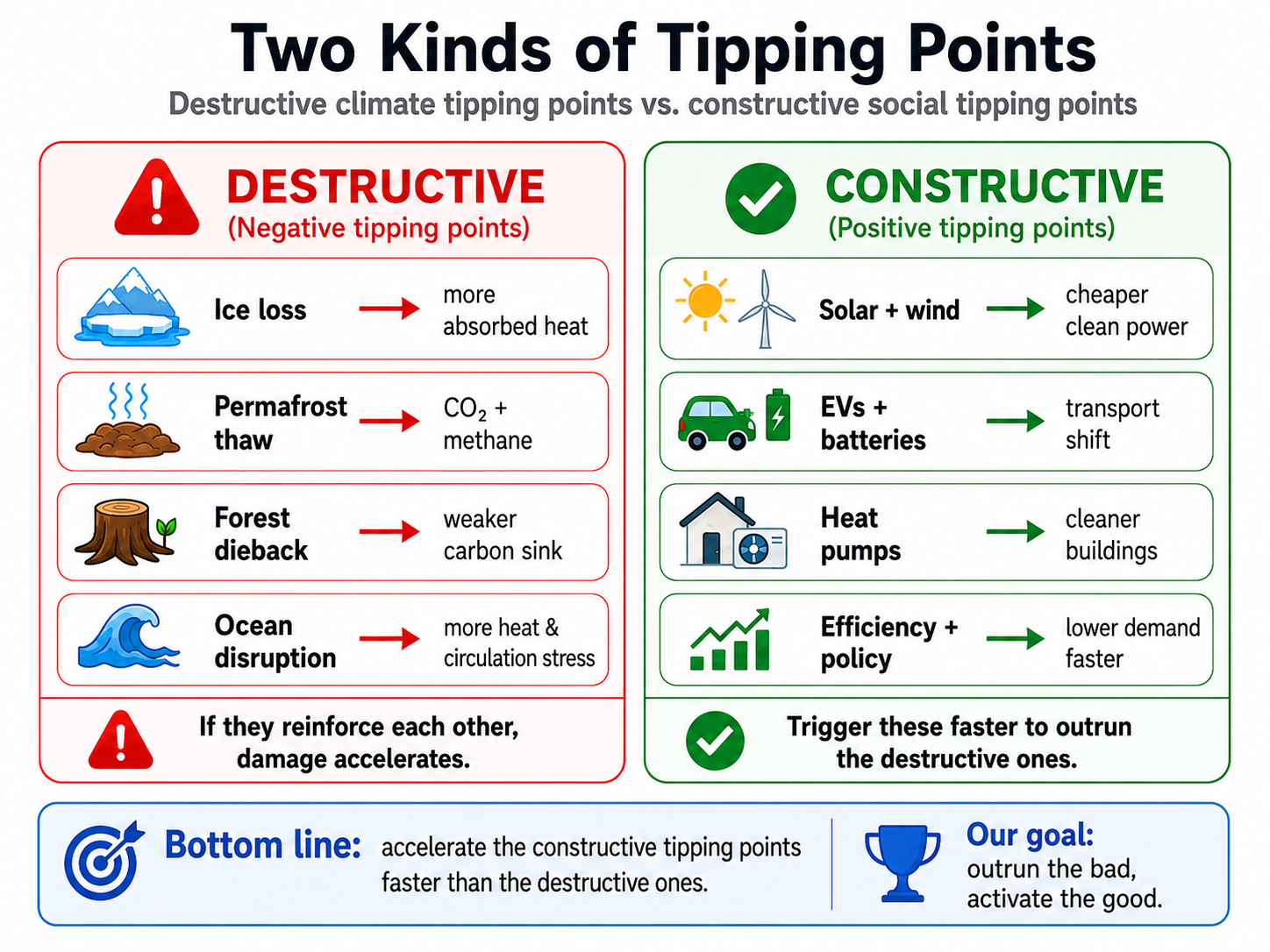
FAQ: The Climageddon Feedback Loop
1. Is the Climageddon Feedback Loop a standard scientific term?
No. It is Job One's systems-risk term. The underlying ingredients—feedbacks, tipping elements, nonlinear responses, compound hazards, and cascading risks—are established scientific research areas.
2. What is genuinely new about the CFL idea?
The novel part is the proposed emergent interaction regime: many climate and human systems recursively affecting one another strongly enough that combined consequences cluster and accelerate beyond what isolated subsystem analysis would suggest.
3. Has that integrated master cascade happened before?
Not during human civilization in the exact form proposed here. Paleoclimate evidence shows abrupt Earth-system changes, but the modern combination of rapid anthropogenic forcing and globally interconnected civilization is historically unusual.
4. Does the fact that it has never happened mean it cannot happen?
No. Absence of a historical human precedent is not proof of impossibility. The correct test is whether the mechanisms are physically plausible, whether precursor interactions are observed, and whether the theory makes predictions that can be checked.
5. Does science support interactions among tipping elements?
Yes. A major 2024 review concluded that tipping elements interact and that many identified interactions appear destabilizing, although uncertainties remain large.
6. Is there one scientifically established CFL master tipping point?
No. Job One's 1.8–2.0°C range is a precautionary DMAP planning estimate inside a broader zone of rising tipping-cascade risk.
7. Does “runaway global warming” mean Earth is becoming Venus?
No. Job One uses “runaway” to describe an uncontrolled governance-and-emissions trajectory. A Venus-style runaway greenhouse is a different physical phenomenon.
8. Can warming still be stabilized?
Yes. IPCC assessments conclude that sustained net-zero CO₂ would approximately stabilize CO₂-induced warming. Strong reductions in other greenhouse gases are also needed.
9. Is every climate consequence accelerating?
No. Some indicators show direct acceleration, some show higher recent rates, some show nonlinear worsening, and others remain mixed.
10. Does every positive feedback lead to collapse?
No. Reinforcing feedbacks amplify change, but they can weaken, saturate, or be balanced by stabilizing feedbacks.
11. Are all tipping points irreversible?
No. Reversibility varies by system and timescale.
12. What is hysteresis?
Hysteresis means a system's path back can differ from its path into a changed state. Returning forcing to an earlier level may not immediately restore the earlier condition.
13. Why is DMAP useful if climate scientists already use models?
DMAP is not a replacement for models. It is an integration method that focuses attention on relationships, omissions, delays, contradictions, feedbacks, phase changes, fat tails, and interactions across specialties.
14. Is the 20–40% underestimation range scientific consensus?
No. It is a Job One/Universe Institute analytical range documented in the linked 2026 temperature and timeframe forecast.
15. What would falsify or weaken the CFL theory?
Evidence that major tipping elements remain mostly independent, that cross-system effects are strongly stabilizing, that predicted clustering repeatedly fails to appear, or that DMAP-based forecasts systematically overestimate interaction strength would weaken the theory.
16. What should readers do with uncertainty?
Separate uncertainty about timing and magnitude from uncertainty about whether a risk exists. High-consequence uncertain risks should be investigated and included in prudent planning rather than treated as zero.
17. What areas of global risk management most need to understand the Climageddon Feedback Loop?
Corporate, insurance, and government agency long-term planners should particularly be aware of the CFL. Additionally, because of the massive effect the CFL could have on the world, worldwide intelligence agencies and military planners must also include its growing possibility in their long-term planning scenarios.
Glossary
Acceleration: an increase in the rate of change over time.
Albedo: the fraction of incoming sunlight reflected by a surface.
AMOC: Atlantic Meridional Overturning Circulation, a major Atlantic ocean-circulation system.
Carbon sink: a system that absorbs more carbon than it releases.
Cascade: a chain in which one change triggers or worsens changes in other systems.
Climageddon Feedback Loop: Job One's systems-risk theory for interacting climate tipping points, feedbacks, nonlinear reactions, accelerating trends, and human-system cascades.
Complex adaptive system: a system made of many interacting parts whose combined behavior can change, adapt, and produce outcomes not obvious from studying the parts separately.
Compound risk: multiple hazards or vulnerabilities occurring together or close enough in time to amplify damage.
Critical slowing down: slower recovery from disturbance as some systems lose resilience near a transition.
DMAP: Dialectical Metasystemic Analysis and Problem-solving, an approach used to examine changing relationships among multiple systems, feedbacks, contradictions, contexts, and transformations.
Earth energy imbalance: the difference between energy Earth absorbs and energy it sends back to space.
Emergent behavior: system behavior produced by interactions among parts that is not obvious from the parts considered separately.
Exponential-like: growth that resembles exponential increase over a limited interval without implying it continues indefinitely.
Fat-tail risk: a low-probability or poorly constrained outcome with extremely high consequences.
Feedback: a process in which an effect changes the conditions that produced it.
Hysteresis: behavior in which reversing the original forcing does not immediately return a system to its previous state.
Metasystemic: involving relationships among multiple systems rather than only relationships inside one system.
Net-zero CO₂: human-caused CO₂ emissions balanced by human-caused removals.
Nonlinear reaction: a response whose magnitude, direction, or timing is not simply proportional to the original change.
Permafrost carbon feedback: warming-driven thaw of frozen soils that can release CO₂ and methane.
Reinforcing feedback: a feedback that amplifies an initial change.
Runaway global warming, Job One usage: an inadequately controlled human emissions-and-governance trajectory in which warming continues because effective mitigation has not been achieved.
Runaway greenhouse: a technical planetary-physics state involving extreme water-vapor feedback and loss of climate energy balance; not the meaning of Job One's operational term.
Stabilizing feedback: a feedback that opposes an initial change.
Threshold: a boundary beyond which system behavior may change significantly.
Tipping element: a large component of the Earth system capable of major state change after a threshold is crossed.
Tipping point: a critical threshold beyond which a system may shift substantially through self-reinforcing processes.
AI Prompt Support: Test, Challenge, and Red-Team the CFL
Prompt 1 — Test the core theory:
“Using current peer-reviewed climate literature, identify the strongest evidence for and against the hypothesis that interacting climate tipping elements, reinforcing feedbacks, nonlinear responses, and human-system vulnerabilities could form an emergent cascade regime that produces faster and more clustered consequences than isolated subsystem analysis predicts. Separate established evidence, plausible inference, disputed claims, and unknowns.”
Prompt 2 — Search for missing stabilizers:
“Red-team the Climageddon Feedback Loop by identifying stabilizing climate feedbacks, negative interactions among tipping elements, adaptation mechanisms, technological changes, and other processes that could slow, interrupt, or prevent a proposed cascade.”
Prompt 3 — Search for precursors:
“Using observational climate datasets, identify whether independent climate subsystems are showing increasingly synchronized stress, simultaneous acceleration, threshold behavior, or rising compound-event frequency. Explain what evidence would and would not count as a precursor to a multi-system cascade.”
Prompt 4 — Test the 1.8–2.0°C planning zone:
“Review current tipping-threshold and tipping-interaction literature and evaluate whether 1.8–2.0°C is reasonable as a precautionary planning zone. Distinguish this from claiming a universal physical tipping point.”
Prompt 5 — Test the 20–40% underestimation estimate:
“Review the Universe Institute 2026 Climate Change Temperature and Timeframe Forecast. Identify every assumption behind the 20–40% underestimation range, find the strongest supporting and contradicting evidence for each assumption, and assess whether the combined range is reproducible.”
Prompt 6 — Apply DMAP:
“Choose five climate subsystems and three human systems. Map possible feedbacks, delays, thresholds, contradictions, and cascading interactions among them. Label each connection as observed, strongly supported, plausible, speculative, or contradicted.”
Bibliography and Research Support
- IPCC. AR6 Synthesis Report. 2023. https://www.ipcc.ch/report/ar6/syr/
- IPCC Working Group I. Climate Change 2021: The Physical Science Basis. https://www.ipcc.ch/report/ar6/wg1/
- IPCC Working Group I, Chapter 5. Global Carbon and Other Biogeochemical Cycles and Feedbacks. Source.
- IPCC Working Group I, Chapter 7. The Earth's Energy Budget, Climate Feedbacks, and Climate Sensitivity. Source.
- IPCC Working Group II. Summary for Policymakers, section on complex, compound, and cascading risks. Source.
- Wunderling, N., et al. “Climate tipping point interactions and cascades: a review.” Earth System Dynamics 15 (2024): 41–74. Source.
- Armstrong McKay, D. I., et al. “Exceeding 1.5°C global warming could trigger multiple climate tipping points.” Science 377 (2022). Source.
- Friedlingstein, P., et al. “Global Carbon Budget 2025.” Earth System Science Data 18 (2026). Source.
- UN Environment Programme. Emissions Gap Report 2025: Off Target. Source.
- NASA. “Climate and Earth's Energy Budget.” Source.
- Universe Institute. The 2026 Climate Change Temperature and Timeframe Forecast. Source.
- Job One for Humanity. Primary and Secondary Climate Change Consequences. Source.
Companion white paper: Universe Institute, Climate Change Is Accelerating, Version 1.2 (2026). Add its final public URL here and in Section 11 after publication.
Showing 1 reaction