
Just updated: November 17, 2026
Three things that matter in daily life
Climate change means long-term shifts in climate, now driven primarily by human greenhouse-gas emissions. A climate forecast describes changing risks and probabilities; it is different from predicting the weather on a particular day. A cascade occurs when one disruption triggers or worsens another—for example, heat damages crops, food prices rise, and household finances deteriorate.
- Long-lived decisions made today can expose your family or business to climate risks well beyond 2032. Review housing, water, insurance, health care, and essential supplies together.
- Food, finance, migration, ecosystems, and public services can reinforce one another’s problems. This article explores those cascading risks, including Job One’s severe scenarios.
- Severe outcomes are not a reason to abandon action. Reduce exposure, strengthen cooperation, and support emissions cuts that can still prevent suffering.
Five more things to understand—and why this page exists
- The source’s title and main analysis extend from 2032 to 2070, even though its URL mentions 2050. This rewrite preserves that longer horizon.
- Job One’s worst-case population and collapse warnings are precautionary scenarios. Their severity does not supply a probability or prove a fixed timetable.
- The central mystery is how a climate problem can become a food, insurance, political, and public-health problem at once. The cascade explanation follows those connections.
- Sea-level rise, ice loss, ocean circulation, and ecosystem damage operate on different timescales. A tipping trigger and the full consequences are not the same event.
- Action retains value at every stage. A fair transition, protection of essential services, and community preparation can reduce risk and preserve options for recovery.
On this page
- How to use the forecast
- Purpose and background
- Population and collapse scenarios
- Food, prices, and displacement
- Economic and insurance consequences
- Health, genetic diversity, and accountability
- Ocean circulation and ice
- Political responses
- Feedbacks and connected systems
- Practical actions
- Original supporting argument and resources
- Conclusion
- FAQ
- Glossary
- References
How to use this forecast
Read the dates and numbers in context. This is a public explanation and risk-planning synthesis. Established physical findings, emerging research, Job One interpretations, and precautionary scenarios are different types of claims. Job One’s 20–30% underestimation adjustment is its own planning judgment. It can not be applied uniformly to all IPCC temperatures, dates, impacts, or probabilities. Missing a planning target does not make all further warming or human extinction inevitable. Net-zero CO₂ remains central to limiting additional human-caused warming.
Purpose and background
Executive Directors' note: This website is for intelligent, mature, and rational individuals who rely on good science and accurate data to manage their lives and businesses. This website counterbalances and corrects the tremendous disinformation and misinformation campaign carried on by the global fossil fuel cartel over the last five decades concerning accurate climate change data.
You will find this notice only on website pages that can be especially upsetting concerning current climate change facts, consequences, and timetables.
Our organization is currently focused on educating people about climate change emergency preparation, adaptation, resilience building, and, where necessary, migration. This is because many serious consequences of climate change are now unavoidable due to a 60-year delay in resolving this emergency. Reading the rest of this page will inform you as to how serious those consequences are and how short the timelines have become.
If you are unsure about the causes of climate change, we suggest starting with Learn pull-down top link called, What Climate Change Is and Does" rather than the materials below. The climate change facts below are uncensored as compared to what you have been hearing from your government, the media, and even many environmental groups.
Job One for Humanity is a nonprofit climate change think tank and risk assessment organization founded in 2008. It is nonpartisan, 100% publicly funded, and uncensored by any government, corporation, or entity.
If you are curious about (or doubt) the consequence severity, time frames, or solutions in any of our climate change forecasts, which are often about 20–30% worse than what you are hearing from your government, the media or the United Nations IPCC, please click here for the science.
Job One’s severe population and collapse scenarios
Climate change consequences will exponentially worsen in frequency, severity, and scale during this period.
If our governments do not enforce the required reductions in fossil fuels and come close to meeting the legitimate global fossil fuel reduction targets for their nations by 2026-7, we will not be able to avoid near-total extinction consequences. Near-total extinction means that about 60 percent to as much as 70 percent of humanity (about five to six billion people) will perish in a climate change-driven global collapse process.
How to read this claim: The 60–70% five-to-six-billion loss scenario is Job One’s retained worse cxase high-end warning, not an IPCC conclusion or an independently validated population forecast. Click here for the master list of all of the primary and secondary consequences of climate change.
Here are more of the forecasted consequences of climate change for the next 2-5 decades, 2032-2070. (Most are not mentioned in the above link.}
The previous US fossil fuel reductions were based on grossly inadequate fossil fuel reduction calculations that provided the uninformed a temporary false hope, but eventually an extremely painful and harsh dose of climate reality.
Job One argues that previous US fossil-fuel-reduction commitments were inadequate and calls for much faster national and international action. Its updated conditional warning is that hundreds of millions of people up to billions could die by mid-century if worst-case scenarios unfold. The earlier warning linked this concern to the 2026-7 reduction target and to US energy policy; it does not establish an unavoidable death toll. See the transition-dilemma analysis.
If the world's governments significantly miss the 2026-7 global fossil fuel reduction targets, near-total human extinction will occur within the next 50 to 70 years or less. Because humanity will be unable to recover from or adapt to the accelerating frequency, severity, and scale of worsening climate change-related consequences, humanity faces the painful road of escalating economic, political, and social chaos and collapse long before its final members pass away.
How to read this claim: Near-total extinction within 50–70 years is the source’s conditional scenario, not a scientifically established timetable. This article does not assign it a probability.
Violent criminal gangs will begin to fill the void where law and order have broken down.
The full, painful, phase-by-phase, consequence-by-consequence 2032-2050 climate change-driven collapse process is described in full detail here.
Food, prices, hunger, and displacement
Due to the numerous consequences of climate change, which are now expected to rise at exponential rates during this phase 3, it will impact all categories of food prices. Expect food bills to go up every year by at least 9-15 percent more than the previous average food inflation rate average.
How to read this claim: The 9–15% figure is Job One’s assumed additional annual food-price growth, not a measured rate or universally established projection. The time path depends on emissions, adaptation, trade, energy, conflict, and policy.
We also expect to see continuous and massive food shortages around the world. A radical increase in food prices is expected due to unprecedented and severe low global crop yields, numerous failed crops, exponential increases in food distribution costs (resulting from heightened security costs), and rising labor costs in food production as the consequences of climate change continue to escalate.
The number of starving people worldwide will also grow exponentially into the billions, causing desperate mass migrations of starving people to overwhelm even the most stable governments. Poor and middle-class individuals and families will not have enough money to buy enough food at the price it will cost during phase 3.
Mass climate migration is expected to spiral out of control during this period, and few nations will be able to control or sustain themselves in the face of the billions of migrants on the move, fleeing coastal areas and desperate for resources.
Economic loss, insurance, and institutional capacity
From 2032 to 2070, the consequences of climate change described on this page are expected to worsen exponentially in terms of severity, frequency, and scale. In the US alone, we estimate that the total 38-year cost of climate change consequences will range from $200 to $300 trillion or more. Worldwide, except in the US, we estimate that the total cost of all exponentially escalating climate change consequences over 38 years will be between $1,200 and $2,000 trillion.
How to read this claim: The $200–300-trillion US and $1,200–2,000-trillion non-US totals refer to the source’s 2032–2070 scenario, an interval of 38 years between endpoints.
All surviving nations can be thrown into social, political, and economic chaos by these costs, as well as the destruction and suffering caused by the numerous consequences of climate change. These costs could be considerably lower by 2050 or beyond because so much of the human population is dead, and there are no nations or persons to pay these costs or even tabulate them.
How to read this claim: In the source’s severe-collapse scenario, smaller recorded financial losses could reflect deaths, lost output, or missing accounts—not improved welfare. The monetary figures are not an independent population forecast.
We forecast that long before 2070, the ever-increasing litany of catastrophic climate change consequences will force most world nations into insolvency, financial depression, and a breakdown of governmental and law and order. The costs of exponentially accelerating climate change consequences will make inflation the major source of economic collapse and fuel further starvation in the remaining poor and middle classes.
Worldwide, successful litigation against fossil fuel companies for the damages caused by climate change consequences is expected to rise exponentially among individuals, businesses, states, and nations. (For more information on worldwide lawsuits and how you, too, can get restitution for the climate change damages you have experienced, click here to begin to learn what you can do.)
All homes, businesses, and farms in medium- to high-risk climate change areas are becoming uninsurable due to rising property insurance costs or cancellations resulting from increasing climate change consequences and risks. Governments worldwide are accelerating their Managed Retreat programs and running out of money to do so.
Health, genetic diversity, and accountability
As accelerating climate consequences create many more deaths globally, reaching near extinction levels, humanity will eventually suffer another high-risk consequence at some point. Human genetic diversity is also radically reduced as the global population is radically reduced. Having a high level of human genetic diversity (including many genetic mutations) helps safeguard humanity against new pandemics, killing off all, most, or the rest of humanity.
How to read this claim: A severe population bottleneck can reduce genetic diversity.
As climate conditions worsen to unsurvivable suffering levels, climate change-related suicides will climb steadily in all areas where any solution or release from accelerating climate consequences appears hopeless.
How to read this claim: Climate distress and loss can harm mental health. Support, practical assistance, treatment, and community connection can reduce harm.
Due to increasing public demand and outrage, courts worldwide will finally begin convicting and severely punishing individuals, corporations, and even governments for acts of commission or omission that directly or indirectly caused, contributed to, or enabled the ongoing climate change-related human and biological extinction. These eco-felonies will be labeled as genocidal-enabling crimes against humanity and the future.
How to read this claim: “Eco-felonies” and “genocidal-enabling crimes” are Job One’s proposed descriptions and accountability goals. They are not universal existing criminal classifications, nor a forecast of guaranteed convictions.
Thwaites and large-scale ocean circulation
Thwaites research distinguishes floating-shelf loss, grounded-glacier loss, and wider West Antarctic responses. The source’s 2100 and 2300 circulation claims extend beyond this article’s 2070 main horizon.
Job One’s original Thwaites scenario envisioned an initial 2–3 feet of sea-level rise followed by another 7–10 feet within a few decades. Thwaites’ complete grounded-ice loss alone has about 65 cm (2.1 feet) of sea-level equivalent. The larger total requires wider West Antarctic ice loss. A floating ice-shelf breakup does not suddenly produce either amount; the rapid sequence remains a high-end scenario, not an established timeline. See the original Thwaites discussion.
Current Earth system computer models (ESMs) project a dramatic slowdown (28–42% by 2100) of the Atlantic Meridional Overturning Circulation and the Southern Meridional Overturning Circulation (SMOC) across a range of climate scenarios, with a complete shutdown of SMOC possible by the year 2300. These newest predictions for ocean current slowdown are decades ahead of previous climate-related forecasts.
How to read this claim: The linked paper’s abstract supports the modeled 28–42% slowing range by 2100 and the possibility of a Southern Ocean overturning shutdown by 2300. These are conditional model results for distinct circulations and long time horizons. Verification here covered the abstract, not the full model methods.
Maintaining this critical ocean current at the same pre-climate change speed it has held for thousands of years is essential to humanity's future survival. The current slowdown in the ocean is a massive and catastrophic climate change tipping point; see this article.
Political responses to worsening consequences
In the face of an increasingly severe worsening of climate change consequences, the world's widespread fear and anxiety about climate change will become undeniable, even to the most strident climate change deniers. Governments and politicians will finally switch away from their previous climate change denial positions and begin to acknowledge accelerating climate change and its dangers publicly.
Feeling the burning wind of public opinion and anger turning against them, and to save their jobs and nations, they will, at last, call for drastic and immediate fossil fuel cuts and other "too-little, too-late" actions that will not save most of humanity from extinction.
Original illustrations of interacting risks

The following is already happening!
The arrows in the illustration below indicate how climate change tipping points and feedback loops interact and influence one another. As more tipping points are crossed and feedback loops interact, they will multiply and amplify each other's effects, further intensifying the overall impact. This will cause climate change consequences to worsen exponentially and far beyond what people are expecting or prepared for.
How to read this claim: The interaction arrows show proposed causal connections, not their strength, probability, or timing. Observed climate impacts do not by themselves validate the full extinction or exponential-growth scenario.
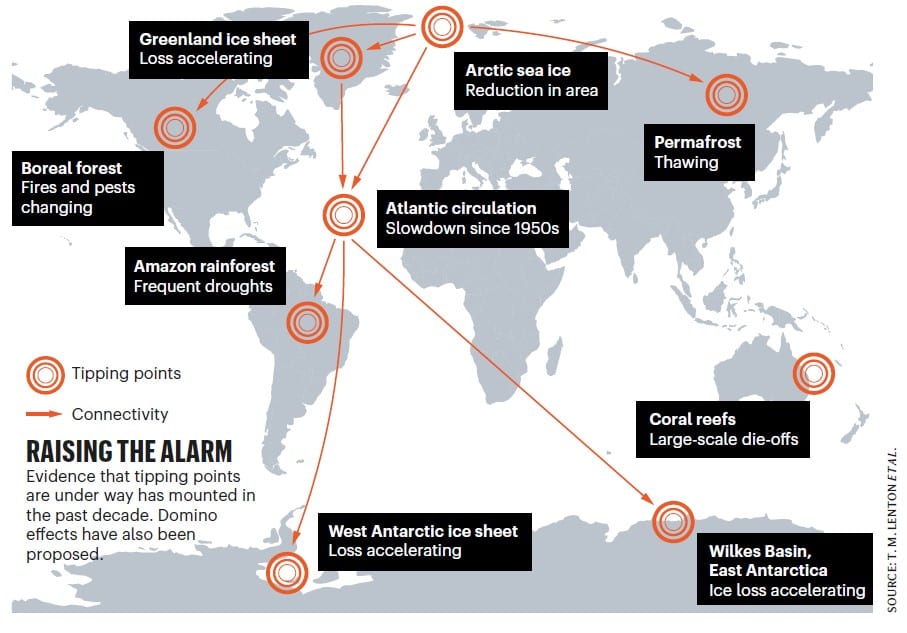
How connected failures—and cooperation—change the outcome
Climate risk crosses system boundaries. Heat can lower crop yields and power reliability; electricity loss can interrupt cooling, water, communications, health care, and food distribution. Repeated losses can weaken insurance and public finances, leaving less capacity for the next event. Feedbacks, delays, unequal resources, and political choices can amplify or limit this damage. The IPCC assesses growing compound and cascading risks.
Job One’s Climageddon Feedback Loop examines interactions among tipping points, feedbacks, and nonlinear responses. Think of the connected processes as a plate of spaghetti: pulling one strand can move others. The pattern is useful for asking what could interact; it does not establish a numerical growth rate or the year of collapse. Read the detailed Climageddon explanation.
Cooperation changes the system. A neighbor contact plan, shared cooling space, coordinated evacuation help, reliable public information, and protected essential services can interrupt a cascade. No household will have enough of everything in a prolonged crisis; a neighbor may have the skill, equipment, or information you lack.
What is missing? What is absent, excluded, lost, or not yet developed—and how does that affect what this system is, what it can do, and what it could become? Ask specifically about people without transport, people who need electricity for medical equipment, renters, low-income households, and communities without a strong political voice.
Commons Failure Audit: Who benefits from emissions or risky development? Who bears disaster costs? Who can avoid paying their share? Which incentives reward delay? Who can enforce fair rules, protect those exposed, and repair the arrangement? These are practical systems questions, not proof of any particular forecast.
What to do next: protect essentials and preserve options
Begin with Job One’s Plan B for emergency preparation, adaptation, and resilience. Preparation and emissions reductions work together: one reduces immediate vulnerability, while the other limits how much worse future hazards become.
- Make one neighbor connection. Share contact details with consent, identify who may need help, and agree how to check on one another after an outage or warning.
- Choose your two most relevant local hazards. Use local emergency-management information, evacuation routes, water conditions, heat and smoke exposure, and insurance terms.
- Protect continuity. Plan for drinking water, food, medications, medical-device power, cooling, clean indoor air, communications, documents, and transport. Follow local authorities on supply quantities and evacuation.
- Review expensive decisions before committing. Assess future insurance, water, infrastructure, health-care access, finances, and support networks before rebuilding or relocating. Global latitude bands are not enough.
- Push for fair collective action. Support rapid emissions cuts, reliable clean energy, resilient public services, honest risk disclosure, and assistance for people with fewer resources.
- Make progress manageable. Hold a short neighbor planning visit, share a meal, and complete one useful task. Preparation works better as a routine than as an endurance contest.
For participation options, volunteer, review membership, read the emergency petition, or support the nonprofit’s work. Explore Job One’s discussion of the benefits of addressing the emergency.
The original call for collective action and supporting resources
Job One calls for governments to explain the scale of the transition, require deep emissions cuts, and share its costs fairly. Its original argument referred to approaching the 2026-7 fossil-fuel-reduction targets; “2005” in the old conclusion was a typographical error. Missing a past advocacy deadline does not remove the value of present emissions reductions.
Perhaps a $ 1/2 trillion single-incident climate mega-disaster will finally get the world's governments serious about cutting global fossil fuel usage to at least get close to the 2026-7 global targets.
The 800-pound gorilla in the room, and the big problem today, is that we are not listening to the increasingly loud and costly destructive feedback that Mother Nature is giving us during this accelerating climate change emergency. Therefore, Mother Nature will do as she has always done. She will escalate her destructive climate consequence feedback to even higher, more painful levels, and hopefully get our attention before it is too late.
Mother Nature can be relied upon to continue acting as she has for the last 10,000 years of human evolution. She will continue to favor the wise, the well-informed, the best prepared, and the most cooperative. And she will punish everyone who does not heed her repeated and rapidly intensifying climate change consequence warnings.
How to read this claim: “Mother Nature” is a metaphor, not an agent that rewards or punishes people. Preparedness and cooperation can reduce vulnerability, but exposure, wealth, history, and unequal power also determine who suffers.
If you find this 2026-7 climate change forecast helpful, please consider emailing it directly to your friends, as it is unlikely they will receive it elsewhere. Here's why? Your government and your media outlets will not cover or will water down these 2026-7 climate change consequences in the service of mostly hidden vested financial interests that are determined to maintain their obscene fossil fuel-related profits.
(If you do not believe the world's most profitable cartel, controlling 35% or more of the world's GDP, would create billions of dollars in worldwide disinformation and misinformation or actively suppress accurate climate change information to maintain its profits, then click here to see the mountain of research on why this is true.)
If you still have doubts about what you are reading...
For many visitors to our uncensored climate change think tank's website, their biggest question after reading our climate change consequences and timetable forecasts is, "Why are your climate change forecasts so much worse than almost everything I hear in the media from my government, the educational environmental and climate change organizations, or the former world's leading authority on climate change, the United Nations Intergovernmental Panel on Climate Change (the IPCC)? Click here for the five critical reasons that will fully answer your "why are our forecasts so much worse" question.
Please donate any amount to help keep our 100% publicly funded nonprofit think tank accessible to everyone. Help us continue to provide the public with uncensored climate change forecasts, facts, and solutions.
With every donation of any amount, you will get amazing gifts! Click the 'Donate' image below to see what these gifts are.
Critical additional reading and documentation for our predictions for the next 2-5 decades:
Click here for the four extinction-triggering climate tipping points.
To save much of humanity, here is how we must compel our governments to act.
Click here to see why human extinction should end at near-total levels but should not go to total extinction.
Click here for a step-by-step, detailed explanation of the processes of near-total extinction.
Click here to view the Climageddon Feedback Scenario, which provides a detailed account of the climate change tipping points, feedback loops, and nonlinear reactions that are already occurring and are expected to worsen.
For additional information on climate change-driven mass extinction and global collapse processes, please see our three-part series of articles relating to the Club of Rome/MIT study (and four related verification studies), including our updating of them with recent climate change information. See the first article here. This will direct you to other articles.
Discover additional essential information, tools, alerts, and promotional benefits for becoming a Job One for Humanity climate change think tank donor/supporter/member by clicking here!
And finally, if you are concerned about what you can do about the climate change emergency to protect yourself, click here.
Click here to see our other climate change forecasts
Phase 2 Climate Change, 2026-2031: We have created a separate forecast page for those who also want to see what happens in their short-term climate change consequences in the future, occurring from 2026 to 2031. Click here to see this 2026 to 2031 page.
Click here to see this years forecast.


AI Prompt Support
- “Using this article and current primary sources, separate observations, established findings, hypotheses, and Job One planning scenarios. Give the exact source, date, baseline, and limitation for each important number.”
- “Help me create a practical climate preparation plan for my location, household needs, budget, and neighbors. Ask for missing details; do not infer safety from latitude alone.”
- “Red-team this forecast. What evidence would weaken its conclusions? Identify missing systems, feedbacks, delayed effects, affected groups, cooperation opportunities, and possible unintended consequences.”
- “For each timeline, distinguish the trigger, the unfolding physical response, the human exposure, and the preparation lead time. Do not invent probabilities or assume a bell curve for poorly quantified tail risks.”
Check AI answers against their original sources. Agreement between AI systems is not independent corroboration.
Conclusion
The long-term risk is larger than a temperature number: climate damage can propagate through food, finance, health, ecosystems, migration, and governance. Severe scenarios deserve investigation without being presented as certain outcomes. Protect essential services, share transition costs fairly, build cooperation, and reduce emissions. Earlier action preserves more options; later action still matters.
Frequently Asked Questions
Does a date mean the disaster is certain to happen then?
No. A planning window, a model projection, a high-end scenario, and an observed event are different. Check the assumptions, geographic scale, uncertainty, and what the date actually describes.
Is it too late to reduce climate harm?
No. Some damage is already occurring and some long-lived changes are difficult to reverse. Further emissions reductions still limit additional warming, while preparation and adaptation protect people.
Should I move because of a global forecast?
Use a local assessment before making a major move. Consider water, heat, smoke, flooding, insurance, medical access, finances, community, and the destination’s own changing risks.
Are Job One’s large death and financial totals established scientific forecasts?
No. Where retained, they are attributed planning or worst-case scenarios. Their original calculations and independent validation are not supplied here; they should not be treated as probabilities or guaranteed outcomes.
How do I begin without becoming overwhelmed?
Choose one practical task and one person to coordinate with. Start with local alerts, an evacuation and communication plan, essential supplies, and a review of critical dependencies.
Glossary
- Adaptation: Reducing harm from climate effects already occurring or expected.
- Mitigation: Reducing greenhouse-gas emissions or increasing their removal.
- Feedback loop: A process whose effects influence the process itself. An amplifying loop reinforces change; a stabilizing loop reduces it.
- Tipping point: A threshold beyond which a small additional change may cause a larger or self-reinforcing shift.
- Nonlinear change: A response that does not increase in a constant proportion to its driver. It is not automatically exponential.
- Scenario: A conditional account of what could happen under stated assumptions; it is not necessarily the most likely outcome.
- CO₂ and ppm: Carbon dioxide and parts per million, a concentration measure.
- CO₂-equivalent: A comparison expressing the effect of specified greenhouse gases on a CO₂ basis; its definition depends on whether concentration, forcing, or emissions are being compared.
- Managed retreat: Planned movement of people or assets away from persistent hazards.
- Resilience: Capacity to cope with disruption, preserve essential functions, and adapt.
- Ice shelf: Floating ice attached to land ice. Shelf breakup can accelerate grounded-ice loss but does not itself add an equivalent mass of new water to the ocean.
- AMOC: Atlantic Meridional Overturning Circulation, a large-scale Atlantic circulation. It is distinct from Southern Ocean overturning.
- GDP: Gross domestic product, a measure of economic production over a period.
- Fat-tail risk: A concern that severe outcomes may be more plausible than a simple normal distribution suggests. No particular statistical tail is assumed here.
Additional linked references
- IPCC (2023), AR6 Synthesis Report, Summary for Policymakers: escalating, compound, and cascading risks; mitigation and adaptation.
- IPCC (2021), AR6 Working Group I, Summary for Policymakers: cumulative emissions, net-zero CO₂, and temperature stabilization.
- World Health Organization (2023), Climate change and health: health pathways and the limitations of mortality estimates.
- British Antarctic Survey (September 20, 2024), Grim outlook for Antarctica’s Thwaites Glacier: grounded-ice sea-level equivalent and longer response times.
- NOAA Climate Prediction Center (November 12, 2026), ENSO Diagnostic Discussion: current El Niño assessment. This rolling page changes with later advisories.
- Original Job One source page, retrieved November 17, 2026. Source of the organization’s interpretations and scenarios; not independent corroboration.
These sources support the specific physical and methodological distinctions identified in the text. They do not validate every Job One scenario, political interpretation, or numerical estimate reproduced from the source pages.
Choose your next step
Begin Plan B and share one practical action with someone you care about.
- Climate Change in 2026–2027: What Could Disrupt Your Life—and How to Prepare
- Climate Change, 2026–2032: Why the Next Few Years Matter for Your Home, Food, and Future
- Critical Climate Change Timeframes: When to Prepare, Adapt, and Reconsider Where You Live
Article Author Information
This document was created by Lawrence Wollersheim, Senior DMAP analyst at the Universe Institute. AI also helped research, assemble, and verify the accuracy of this article.
Showing 1 reaction