
Last updated: March 30, 2026
Executive director's note: This page is for readers who would prefer the uncensored version over the soothing brochure. It explains the five most important atmospheric carbon transition levels, the temperature ranges they imply once their full effects are realized, why the 425-450 ppm band is the most dangerous range for current policy, and which major climate consequences become more likely as humanity moves deeper into each level.
Please read this page with realism, not paralysis. The goal is not to scare people into emotional gridlock. The goal is to help individuals, families, communities, and businesses understand what is now happening, what may still be slowed, and what must already be prepared for. If you need a grounding primer before reading this page, start with What Climate Change Is and Does. If you need emotional support afterward, read Heal Climate Grief, Anger & Anxiety, Evolutionary Benefits and Positive Perspectives, and Climate Change Hope & Benefits.

The Fossil Fuel Burning Atmospheric Carbon Pollution Danger Zones: How Atmospheric Carbon 386 to 750+ in Parts Per Million (PPM) Pushes Global Warming Beyond Human Control.
Quick navigation
-
- Executive summary
- Why this page matters
- How to read the temperature ranges on this page
- Quick overview table
- Level 1: 386 ppm
- Level 2: 425-450 ppm
- Level 3: 500 ppm
- Level 4: 600 ppm
- Level 5: 750+ ppm
- Why the 425-450 ppm band matters most right now
- What to do now
- Key preserved links and companion pages
- FAQ
- References
- Bibliography
Executive summary
-
- This page focuses on five critical carbon transition levels: 386 ppm, 425-450 ppm, 500 ppm, 600 ppm, and 750+ ppm.
- The most important level for current policy and survival planning is the 425-450 ppm transition band. It is the zone where humanity risks losing much of its remaining practical control over future climate outcomes.
- According to NOAA's latest Mauna Loa data, the monthly average for February 2026 is 429.35 ppm, and recent daily values exceed 431 ppm. Humanity is not approaching this danger band politely in the future. We are already inside it.
- This page includes temperature commitment ranges for each carbon level. Those ranges are illustrative long-run fast-feedback CO2-only equilibrium estimates based on the IPCC AR6 likely equilibrium climate sensitivity range of 2.5°C to 4.0°C for doubled CO2. Real-world outcomes can be considerably worse when non-CO2 forcings, slow feedbacks, sink weakening, and overshoot damage are included.
- At each higher transition level, irreversible global warming becomes deeper, harder to influence, and more entangled with food, water, migration, ecosystem, financial, and governance failures.
- Job One's public climate change planning adjustment remains the 20-40% underestimation factor. See The 20-40% Underestimation Factor and Why Our Climate Forecasts Are More Accurate.
Why this page matters
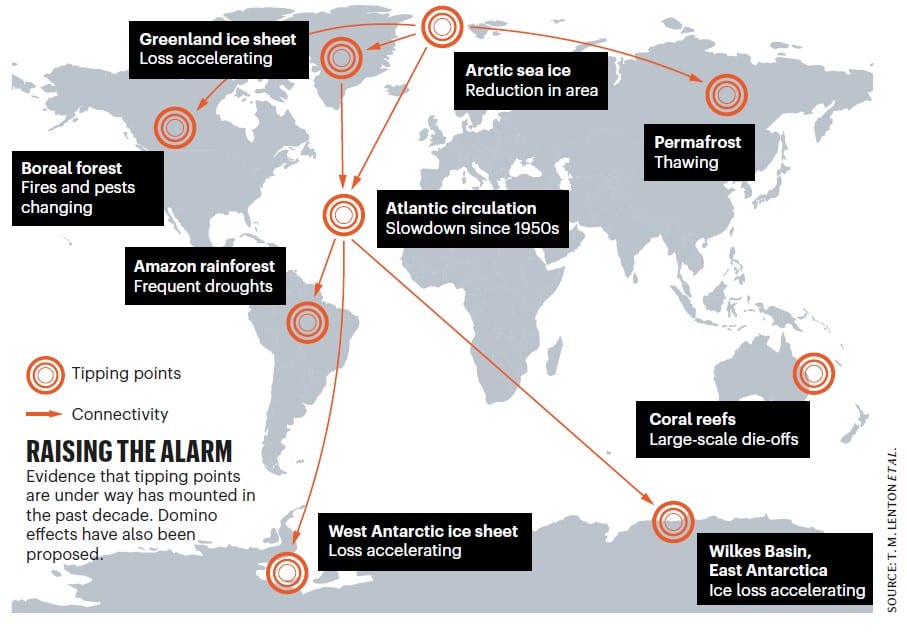
Most climate communication still treats climate danger as a smooth, distant line on a graph. That mental model fails people. Climate risk behaves more like a stacked systems crisis, with lagged warming, interacting climate change tipping points, feedback loops and nonlinear elements, shrinking adaptation windows, and institutions that only react after the fire has already reached the curtains.
Job One for Humanity is a nonprofit climate change think tank and risk assessment organization founded in 2008. Its work is aimed at helping ordinary people, not billionaires hiding behind optimism consultants, understand what is unfolding, prepare intelligently, and push for the fastest realistic fossil-fuel reductions possible.
If you want the bigger context behind this page, begin with What Climate Change Is and Does, Who Caused Climate Change?, What Is Irreversible Global Warming?, The Climageddon Feedback Loop, and Primary and Secondary Climate Change Consequences.

How to read the temperature ranges on this page
The temperature ranges below are not short-term annual weather projections. They are long-run, committed warming estimates for each CO2 level, once the climate system has had time to respond more fully. They are calculated using the standard logarithmic relationship between CO2 concentration and radiative forcing, anchored to a preindustrial baseline of about 280 ppm and the IPCC AR6 likely equilibrium climate sensitivity range of 2.5°C to 4.0°C for doubled CO2.
Translation into plain English: a given carbon level can lock in more future warming than people are feeling today. That is why a society can still be arguing about this year's weather while it has already loaded the atmosphere with enough carbon to commit itself to much worse long-run consequences. Human beings do love noticing the invoice only after the purchase has cleared.
These ranges are intentionally conservative in one important sense: they do not automatically add extra warming from every slow feedback, every non-CO2 greenhouse gas, every aerosol shift, or every carbon-sink failure. In other words, the atmosphere can still surprise us on the wrong side of the range by as much as 20 plus percent.
Level 1: 386 ppm, the climate-stability breach level
Illustrative committed warming: about 1.2°C to 1.9°C (or up to 20+ percent more if you include all of the underestimation factors in IPCC calculations)
This first level marks the point at which humanity is clearly beyond the safer atmospheric envelope that James Hansen and coauthors argued should be pushed back down toward 350 ppm. Hansen's famous published threshold is 350 ppm, not a standalone peer-reviewed 386 ppm threshold. However, once the world moved into the 386 ppm neighborhood, it was plainly operating in overshoot relative to Hansen's safe-target framing.
That matters because at roughly the 1.5°C to 2°C outcome range associated with this overshoot, the IPCC projects sharply rising risks to health, food security, water supply, economic growth, and ecosystems. Coral reefs are projected to decline by 70-90% at 1.5°C and by more than 99% at 2°C. The risk of irreversible loss of many marine and coastal ecosystems also increases significantly at 2°C or more.
In Job One's language, this is the first phase of irreversible global warming: not because every outcome is already fixed, but because the system has been pushed far enough that damage continues even if we finally stop lying to ourselves and start acting like adults.
Level 2: 425-450 ppm, the control-loss transition band
Illustrative committed warming: about 1.5°C to 2.7°C (or up to 20+ percent more if you include all of the underestimation factors in IPCC calculations)
This is the most important transition band on the page. It is where irreversible global warming becomes deeper, more self-reinforcing, and less subject to human influence. The issue is not that one day at 449 ppm the world is repairable and the next day at 450 ppm physics laughs and walks away. The issue is that the deeper we move into this band, the more the climate, food, and social systems begin to punish delay together.
NOAA's latest Mauna Loa data show a monthly average of 429.35 ppm in February 2026, with recent daily averages above 431 ppm. So this transition band is not abstract. We are already inside it.
At around 2°C warming, the IPCC projects that 800 million to 3 billion people could experience chronic water scarcity due to droughts. The IPCC also projects that risks to food availability, heat-related illness and death, and crop yield reductions are higher at 2°C than at 1.5°C. Coral reefs are nearly wiped out at this level, and the risk of irreversible loss of marine and coastal ecosystems rises further.
This is why Job One treats 425-450 ppm as the second phase of irreversible global warming. At this stage, human corrective power is not gone, but it is shrinking. Every additional year of high emissions loads more heat, multiplies adaptation costs, and pushes more populations into a world of scarcity, instability, and forced movement.

Level 3: 500 ppm, the ice-loss commitment level
Illustrative committed warming: about 2.1°C to 3.3°C (or up to 20+ percent more if you include all of the underestimation factors in IPCC calculations)
By the time humanity approaches or crosses 500 ppm, irreversible global warming becomes deeper still. The system is now less responsive to later human restraint because so much damage is already loaded into the atmosphere, oceans, cryosphere, and biosphere. This is why Job One frames 500 ppm as the third phase of irreversible warming.
At roughly this warming range, the literature points toward worsening adaptation limits, much greater food and water stress, and stronger cryosphere-driven sea-level commitment. The IPCC's Working Group II Technical Summary identifies widespread tree death, ecosystem damage, and reduced ecosystem services as moving into very high risk in the 2.5°C to 4.5°C range.
Paleoclimate evidence also makes this level soberingly concrete. A recent Nature Communications paper describes the late Pliocene as a world with 350-450 ppm CO2 and 2-3°C higher global mean temperatures, while another study found early Pliocene sea level may have been more than 20 meters above present. That does not mean 500 ppm instantly produces that sea-level rise next Tuesday. It means the long-run commitment can be enormous once ice sheets are destabilized and left to run their course.
Put plainly: 500 ppm is not just a hotter version of now. It is a world in which heat, food risk, ecosystem decline, wildfire, water stress, insurance retreat, and coastal exposure start reinforcing each other in ways that break institutions as well as landscapes.
Level 4: 600 ppm, the civilization-fracture level
Illustrative committed warming: about 2.7°C to 4.4°C (or up to 20+ percent more if you include all of the underestimation factors in IPCC calculations)
This level marks a fourth phase in which irreversible warming becomes profoundly less manageable. The issue is no longer merely avoiding hardship. It is whether enough organized civilization remains intact to keep food systems, water systems, health systems, supply chains, finance, and governance from failing together.
The IPCC projects that at 4°C warming, up to about 4 billion people could face chronic water scarcity due to droughts. The same assessment links greater warming to larger crop losses, more dangerous heat, more severe food insecurity, and rising interactions among multiple hazards across interconnected systems.
At this level, even relatively wealthy, technologically capable societies begin to hit adaptation limits because adaptation itself depends on stable infrastructure, stable institutions, affordable insurance, workable borders, and a population not already battered by repeated emergencies. The climate system does not care about quarterly earnings calls. Very inconsiderate of it.
Level 5: 750+ ppm, the terminal overshoot level
Illustrative committed warming: about 3.6°C to 5.7°C (or up to 20+ percent more if you include all of the underestimation factors in IPCC calculations)
This final level is included because the legacy page used it and because it helps show the direction of escalating risk. But the most important planning point is not the exact mechanics of an extreme end-state. The most important point is that civilization-scale damage arrives long before this level is reached.
For a public-facing page, the strongest and most credible statement here is this: at 750+ ppm, humanity would be in a catastrophic overshoot world with consequences far beyond normal adaptation, far beyond ordinary governance capacity, and likely devastating for a large share of the biosphere. It is not necessary to rely on speculative claims about a Venus-like runaway greenhouse or atmospheric stripping to make the warning land. The earlier levels already do that job, brutally well.

In Job One's phase language, this is the deepest and least controllable phase of irreversible warming. By this point, human agency exists mainly in the narrow sense of triage, protection, and survival, not in the comfortable sense of governing a stable planetary future.
Why the 425-450 ppm band matters most right now
Job One keeps returning to the 425-450 ppm band because it is the level where several ugly truths converge at once:
-
- climate lag, meaning more warming is still in the pipeline;
- compounding consequences, meaning heat, crop losses, floods, droughts, migration, and conflict pressures do not take turns;
- feedback amplification, meaning weakened carbon sinks, cryosphere loss, and other positive feedbacks, can worsen the original forcing;
- adaptation limits, meaning infrastructure, money, public health, and governance all fail more easily when stressed simultaneously; and
- shrinking control, meaning late action still matters, but it buys less than early action and costs far more.
Current reality check: The latest NOAA Mauna Loa record reports 429.35 ppm for February 2026 and recent daily averages of 431.46 ppm on March 29, 2026. This page is not a speculative warning about some distant century. It is a present-tense risk-management page.
This is also why Job One continues to point readers toward the honest fossil-fuel reduction timetable rather than politically soothing net-zero slogans pushed decades too late. See The Honest 2025 Global Fossil Fuel Reduction Targets and The Climate Change and Global Warming Doomsday Clock.

What to do now
1) Push for the fastest realistic fossil-fuel reductions
Start with the honest fossil-fuel reduction targets. Then use critical government-driven actions and billionaire and elite influence strategies to focus pressure where emissions decisions are actually made.
2) Prepare for consequences that are now unavoidable
Use the Job One Plan and Plan B for preparation, adaptation, resilience, and migration planning where needed.
3) Understand the consequence stack, not just the headline temperature
Read 20 Main Climate Change Consequences, Primary and Secondary Climate Consequences, The 11 Big Climate Tipping Points, and The Climageddon Feedback Loop.
4) Help build public pressure without collapsing into doom fatigue
Share the evidence. Educate your networks. Sign and circulate the climate emergency petition. Keep the hard facts paired with practical action and honest hope. Despair is understandable, but it is also politically useless if it immobilizes the people who still have work to do.

Conclusion
We have presented conservative prediction numbers above. Our actual belief is that temperatures will be at least 20% higher than those listed above, and they will occur at least 20% sooner, due to the many documented underestimation problems in IPCC and government climate change reports. (These serious IPCC and government underestimation problems are listed on this page.)
If you understand the above critical atmospheric carbon level transitions, which are caused by burning fossil fuels and pollution, and you factor in the current 20% underestimation factor, you will see there is no time to waste to prepare yourself, your business, and your nation for what's coming. What is coming is far worse than you are hearing in the media or from your governments, because if they told you the truth, they would have to make or force the necessary global fossil fuel reductions to prevent what you're reading above.
FAQ
Why use “critical carbon transition levels” instead of “tipping points” for the five carbon numbers?
Because the carbon numbers themselves are best understood as danger bands or transition levels that increase the probability and severity of multiple tipping point processes. That wording is more accurate and more defensible.
Why add “fully committed” temperature ranges?
Because people often confuse today's experienced warming with the warming already loaded into the system. Carbon concentrations can commit the planet to future warming that is not yet fully realized.
Why is 425-450 ppm the most important level right now?
Because humanity is already inside that band, and it is the range where compounding climate risks, adaptation limits, and shrinking control make the next few years disproportionately important.
Did James Hansen define 386 ppm as a formal threshold?
Hansen's widely cited published threshold is the 350 ppm safe-target argument. This page, therefore, references Hansen carefully: 386 ppm matters as a practical overshoot level beyond Hansen's safer target, but the strongest source-supported Hansen threshold is 350 ppm.
Does this page claim every worst-case outcome is certain?
No. The page is written to show direction, risk stacking, and loss of controllability. Some extreme end-state claims remain uncertain or controversial, which is exactly why the most defensible public case should focus on the grave consequences that are already strongly supported.
References
-
- NOAA Global Monitoring Laboratory. Trends in Atmospheric Carbon Dioxide.
- NOAA Global Monitoring Laboratory. Recent Daily Average Mauna Loa CO2.
- IPCC AR6 Working Group I Summary for Policymakers. Equilibrium climate sensitivity best estimate 3°C, likely range 2.5°C to 4.0°C.
- Hansen, J. et al. (2008). Target Atmospheric CO2: Where Should Humanity Aim?
- IPCC Special Report on Global Warming of 1.5°C, Summary for Policymakers. Coral reef decline, ecosystem loss, and rising risks at 1.5°C and 2°C.
- IPCC AR6 Working Group II FAQ 3. Water scarcity projections at 2°C and 4°C.
- IPCC AR6 Working Group II Technical Summary. Very high ecosystem and sea-level damage risk in the 2.5°C to 4.5°C range.
- Rahaman, W. et al. (2025). Late Pliocene growth of the West Antarctic Ice Sheet to near-modern configuration.
- Rovere, A. et al. (2020). Higher than present global mean sea level recorded by an Early Pliocene intertidal unit in Patagonia.
Bibliography
-
- IPCC. (2021). Climate Change 2021: The Physical Science Basis.
- IPCC. (2022). Climate Change 2022: Impacts, Adaptation and Vulnerability.
- IPCC. (2023). Climate Change 2023: Synthesis Report.
- Hansen, J. et al. (2008). Target Atmospheric CO2: Where Should Humanity Aim?
- Hansen, J. et al. (2023). Global Warming in the Pipeline.
- Rovere, A. et al. (2020). Communications Earth & Environment.
- Rahaman, W. et al. (2025). Nature Communications.

Key preserved links and companion pages
-
- What Climate Change Is and Does
- Who Caused Climate Change?
- What Is Irreversible Global Warming?
- We Have Gone Over Two Catastrophic Climate Cliffs
- The Climageddon Feedback Loop
- The 11 Big Climate Tipping Points
- 20 Main Climate Change Consequences
- Primary and Secondary Climate Change Consequences
- Honest Fossil Fuel Reduction Targets
- The Job One Plan
- Part 3: Government Climate Actions
- Part 4: Billionaire Climate Strategy
- Sign the Climate Emergency Petition
- Climate Change and Global Warming Doomsday Clock
- Heal Climate Grief, Anger & Anxiety
- Why Total Human Extinction Is Highly Improbable
- Evolutionary Benefits and Positive Perspectives
- Climate Change Hope & Benefits
- The 20-40% Underestimation Factor
- Why Our Climate Forecasts Are More Accurate

Receive Free Climate Change & Global Warming Info!
Showing 2 reactions
The Job One Team