
Job One Blog Editor's Article Notes: To help set the stage for this amazing big picture overview and article, a famous quote is needed. What is honored in a culture will grow there." Plato.
The following emotionally and scientifically powerful article by Emeritus Professor Alvin Urquhart will illuminate what our culture has honored and allowed to grow, and that is now threatening our environment.
Here's what Professor Alvin Urquhart says about his new article, The Environmental Predicament: Culture vs. Nature.
"With this essay, I show how, in my lifetime, we have created a predicament that defies human solutions. In the last 150 years, we have released energy that had accumulated and been stored geologically for millions of years. As cultural creatures, we have ignored our evolutionary background as we increasingly rely on fossil-fuel energy to extend life and produce more goods and services.
In the process, we have permanently destabilized long-term evolutionary and ecological systems. A disturbed Nature is more powerful than a self-centered Culture. Thus, humans find themselves, unthinkingly, in an existential predicament of their own making. But we are creatures who glory in culture. As such, we want to live the best lives possible during the environmental predicament that we have caused. This essay concludes with a few suggestions as to how to understand and prepare to live with the oncoming environmental crises."
The Author's Introductory Remarks
These comments reflect some 75 years of my thoughts about the relations between humans and nature. They were first stimulated by Carl Sauer,my professor of geography at the University of California, Berkeley. The fundamental organizing of my thoughts is Professor Sauer’s idea that cultural geography is the meeting place of natural history and cultural history.
For many years, at the University of Oregon I taught classes in cultural geography that emphasized environmental and ecological connections of culture and nature. In retirement, I wrote a book, 'Nature & Culture: A Personal Crisis, and gave public lectures expressing these ideas. I have continued to discover more scientific evidence and evaluate modern environmental thoughts.
Because of the environmental crises, I believe that an understanding of the relations between nature and culture is the most important facing humankind. This extended essay is intended to be my last expression of the necessity to understand human activities as they modify the natural world. I conclude that because human thought and actions are inadequate to react to natural, physical processes of the Earth, the near future will be radically different from that of today whatever humans do. The time available and the efforts to change the causes of the collapse of the natural systems of the Earth are inadequate. We are in an environmental predicament.
The first section of this essay concerns the ways in which energy has been part of everyday life from that of the first humans, who were completely dependent on solar energy, to us of the 21st century, whose goods and services are produced using fossil fuels. The second section describes the ways in which energy, primarily from fossil fuels employed by humans, has disrupted natural ecological systems on which human life depends. The third section discusses the environmental predicament created by the modern use of energy. The fourth presents possible actions for people living in the environmental predicament that we have created.
Our Environmental Predicament: Culture vs. Nature
I. The Building of Modern Society
The rapid growth of goods and services
Like most modern Americans, I have had benefits unavailable to most humans since our species evolved over 300,000 years ago. Most human earthlings, like all other organisms, want to grow and reproduce, but they are limited by environmental conditions. Humans depended strictly on solar radiation until recently. Today, in contrast, we depend on energy from fossil fuels that captured solar energy in distant geological time but burned today. (See Figure 1.) That energy is now used to remake the physical world that provides today’s unparalleled goods and services. I only need to compare my life with that of my grandfather (1868-1950) to see that energy, coupled with radically new forms of technology, has created benefits in medicine and health care, longer lifespans, better communications and means of transportation, greater availability of food, shelter, leisure time, longer life, and extraordinary luxuries that were unavailable during the first half of his life. My grandfather’s father (1820-1896) and all other humans who died before 1900 did not experience these benefits.
For all but the past two hundred years, humans depended exclusively on solar energy to support their lives and activities. Their lives were short. Average life expectancy remained at about thirty years, not rising above forty until the 19th century. The natural world directly provided sustenance for their lives, only modified by fire and technologies that were based on human labor. Populations increased very slowly when humans occupied new lands with new stored organic material (wood, soil, and wildlife). And, starting about 10,000 years ago, people with more powerful technologies, such as agriculture and new social and political organizations, learned how to store and release energy for later use or new activities. As a result, the population grew more rapidly. The estimated population of the world in 8,000 B.C. was 5 to 10 million, and in 1650, only 500 million.
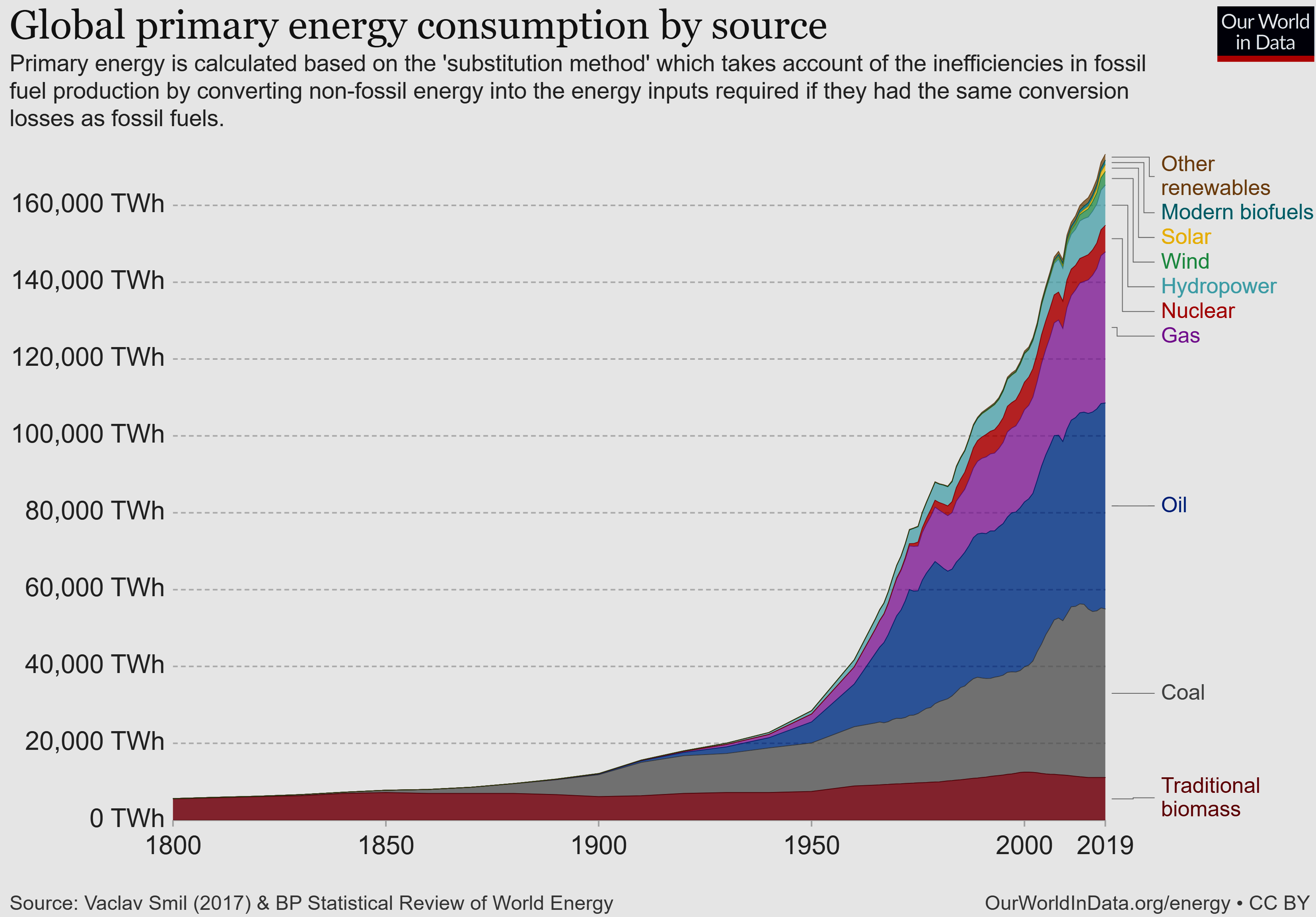
Figure 1
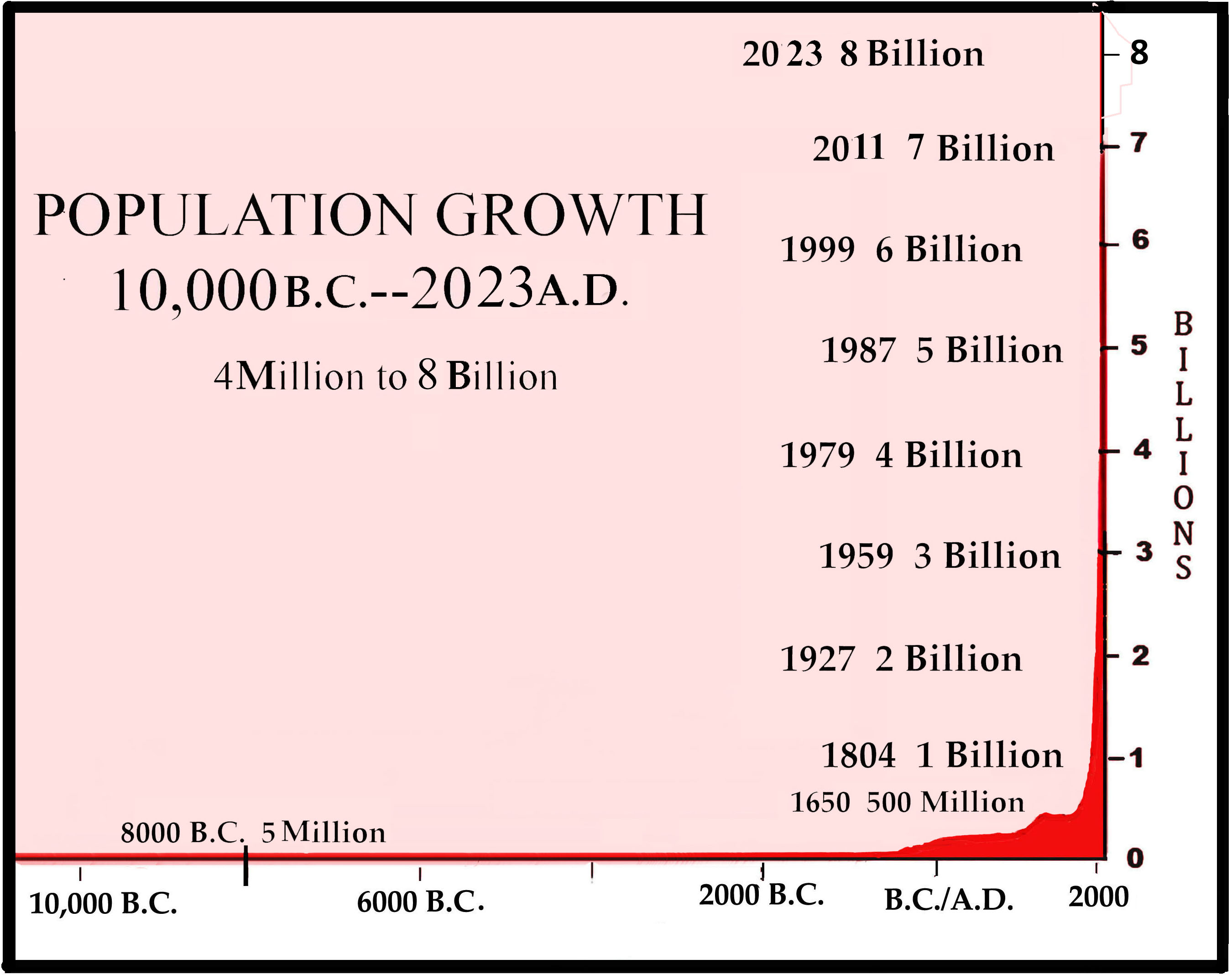
Figure 2
However, beginning in the nineteenth century, science and technology, combined with new sources of energy from burning coal, produced new goods and services. Social, political, and economic systems were also radically transformed to accommodate the new forms of production. Power to control the newly released energy gave rise to new forms of capitalism, socialism, communism, colonialism, new leaders and new elites. Modern society with its new ways of living on Earth emerged. Since 1804, when the population of the world first reached 1 billion and life expectancy rose to about forty years, it grew rapidly to over 2.5 billion in 1950. But since the mid 20th century, the population has increased unexpectedly and exponentially to 8.2 billion today. Figure 2.
Early 20th century transformations relied on new forms of industry and agronomy, both of which increasingly became dependent on fossil fuel energy. In cities, new industrial processes were powered first by coal, later, also by petroleum. The United States and Western Europe became what may be called ‘developed’. New machines replaced farm workers who left rural areas and migrated to the emerging cities; farms consolidated and enlarged, and urban populations grew. Population slowed during the Great Depression and World War II. But rebuilding of wartime destruction and huge demands for newly created goods and services stimulated a resurgence in industrial technologies to supply greater material goods and services, which grew exponentially.
During the mid-20th century, much of the ‘underdeveloped’ world adopted the ‘Green Revolution,’ modelled after American technology. Farms became mechanized and irrigated; pesticides and chemical fertilizers were applied to new hybrid grains; possibly a billion lives were saved. Later ‘development’ throughout the world followed the American ways. Figure 3 indicates the great acceleration in consumption patterns that began in 1950.
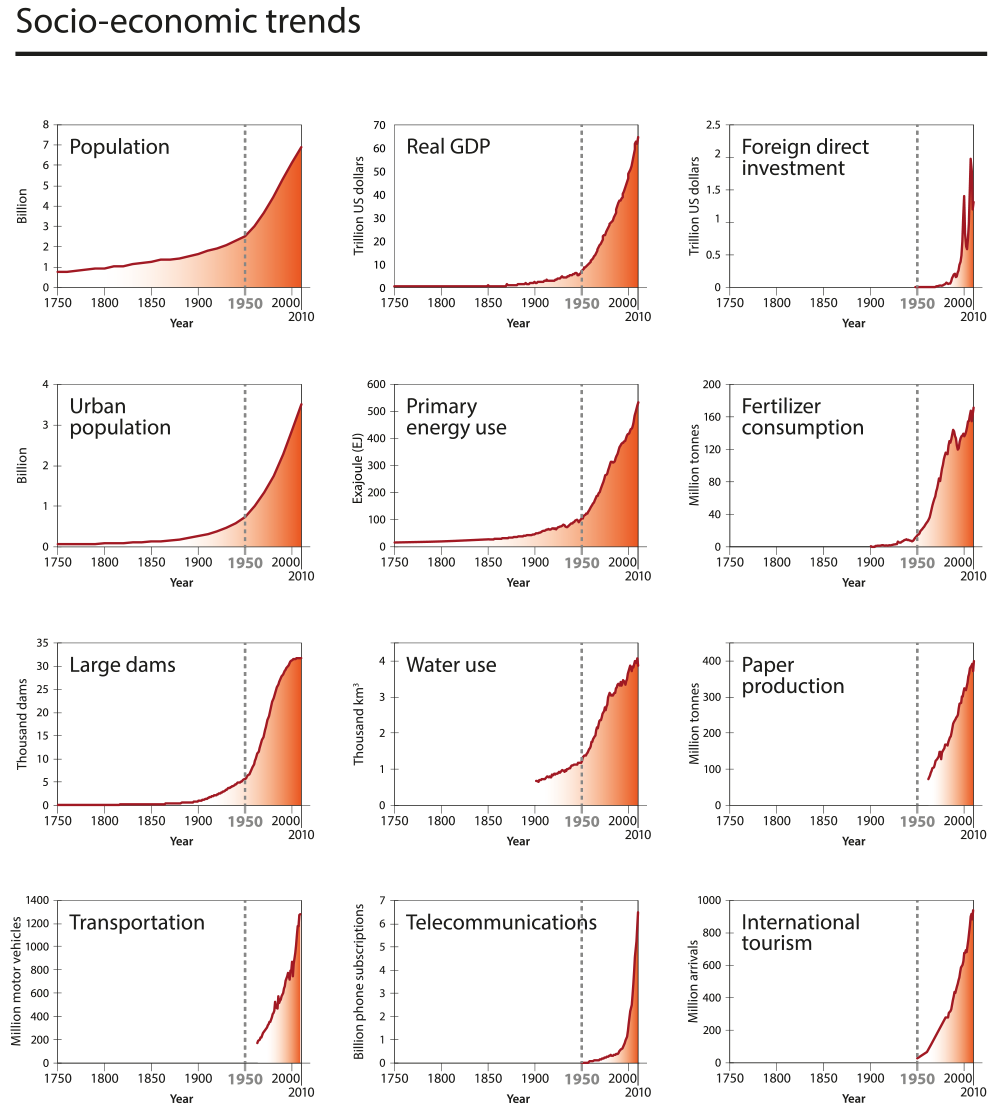
Figure 3
Americans, who were born before 1940, first became aware of the dramatic changes when people moved from rural areas to cities. And as they were recovering from the Great Depression, they postponed their desire for a better life to support the Second World War. But they and all Americans born since World War II have experienced exponential growth in goods and services powered by fossil fuel energy. Lives all over the world have been transformed by ‘development’. (Nevertheless, delayed by colonialism, lack of resources of modern industry, unequal trade policies, or resistant traditional norms, some societies remained ‘underdeveloped’ for decades. However, even absent birth controls, their populations increased as better sanitation and public health services became available.)
Powerful nations, industries, institutions, and most individuals, in some major aspects of their lives, have enjoyed the benefits of the energy that supports modern services and goods. The modern world with its new industrial, economic, political, and social forms were all radically changed by the use of fossil fuels and other forms of energy. This is the world we know as normal. Of course, these benefits have been unequally shared; but who can successfully argue that longer lives, better health, better housing, better education, more available food, ease of communication and movement are not good? We, in the developed world, have had our views of what is fundamental to our material life shaped by a society that is based on fossil fuel energy. Continued ‘growth and progress’ dominates much of our thinking.
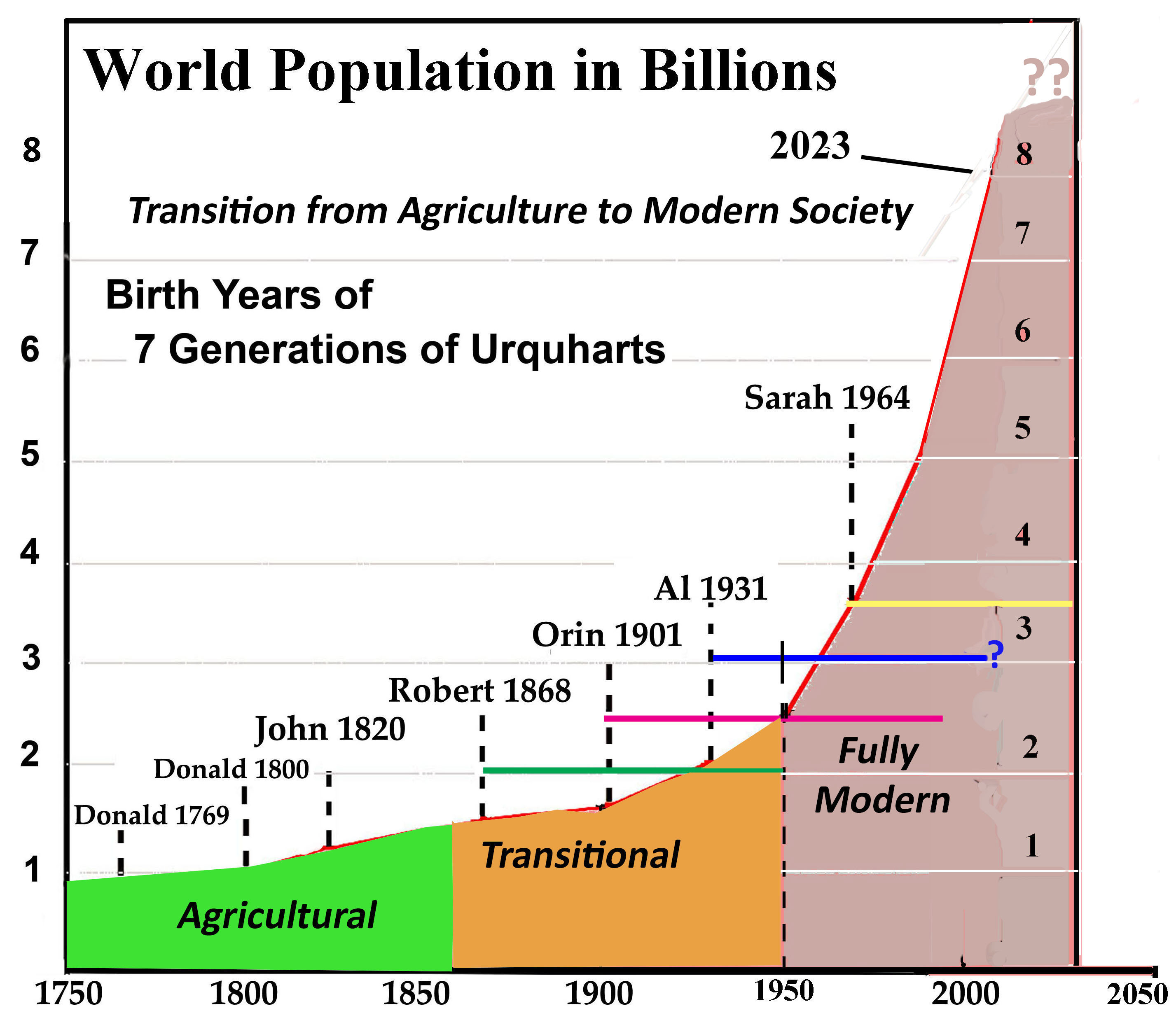
Figure 4.
I look at my own family’s life to get perspective on the great transitions of the last two hundred years.
(I also invite you to look at your family to give context to modern life experience.) My grandfather, Robert, was born on a farm in Ontario, Canada. He migrated to Wisconsin, became a blacksmith, and worked his way to Oregon where he became a wheat farmer and shopkeeper. In retirement, he lived with his children’s families. My father, Orin, born in Oregon, left the farm for work in Portland, and finally got a permanent job before the Second World War. He experienced the transition from farm life to the hard life of the Great Depression, and finally, in 1946, to the modern world. Born in 1931, I was a boy until after the end of WW II, when, in 1949, I went to college, later, to the Army, graduate school, thirty-three years of teaching, and thirty-one years in retirement. I remember some aspects of the Great Depression and the war years, but only as a boy. My adult life has been in a time of continuous growth and progress. My daughters have only lived in a society in which goods and services continue to expand rapidly
The first thorough academic understanding of how society transforms energy into goods and services was made by the ecologist, Howard Odum, who studied the ways energy is consumed, transformed, and lost from systems at all scales. Of particular interest to me are the ways in which he showed how institutions and individual humans have consumed and transformed energy. Members of a group of hunters and gatherers consumed energy directly from natural ecosystems (Figure 5) while members of modern society consume processed goods and services (Figure 6). Figure 7 indicates some ways in which energy flows in support of an individual person.
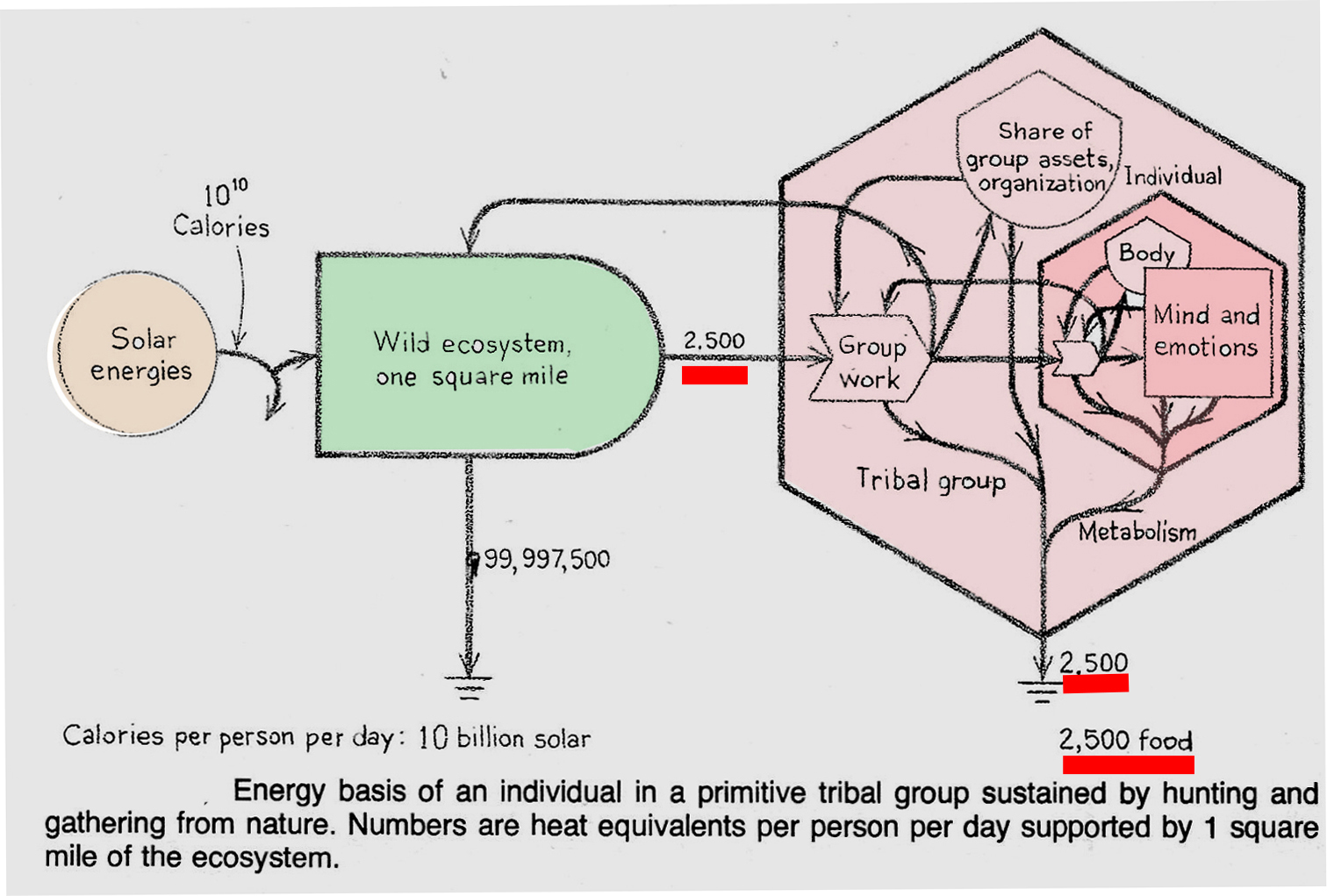
Figure 5
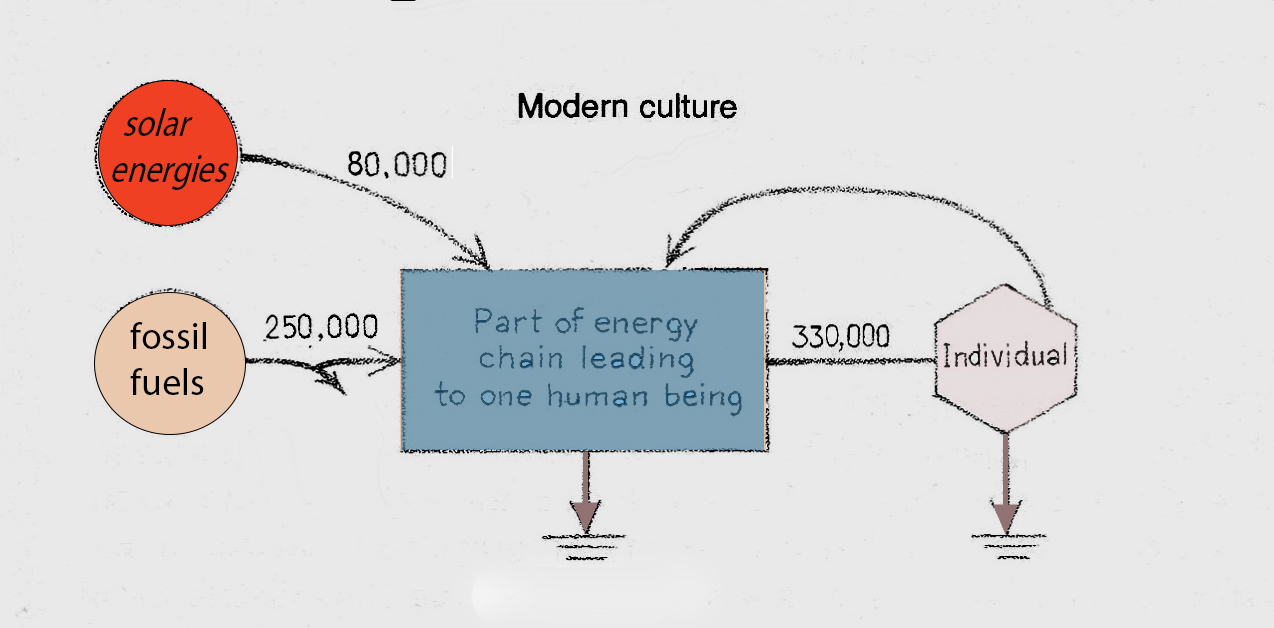
Figure 6
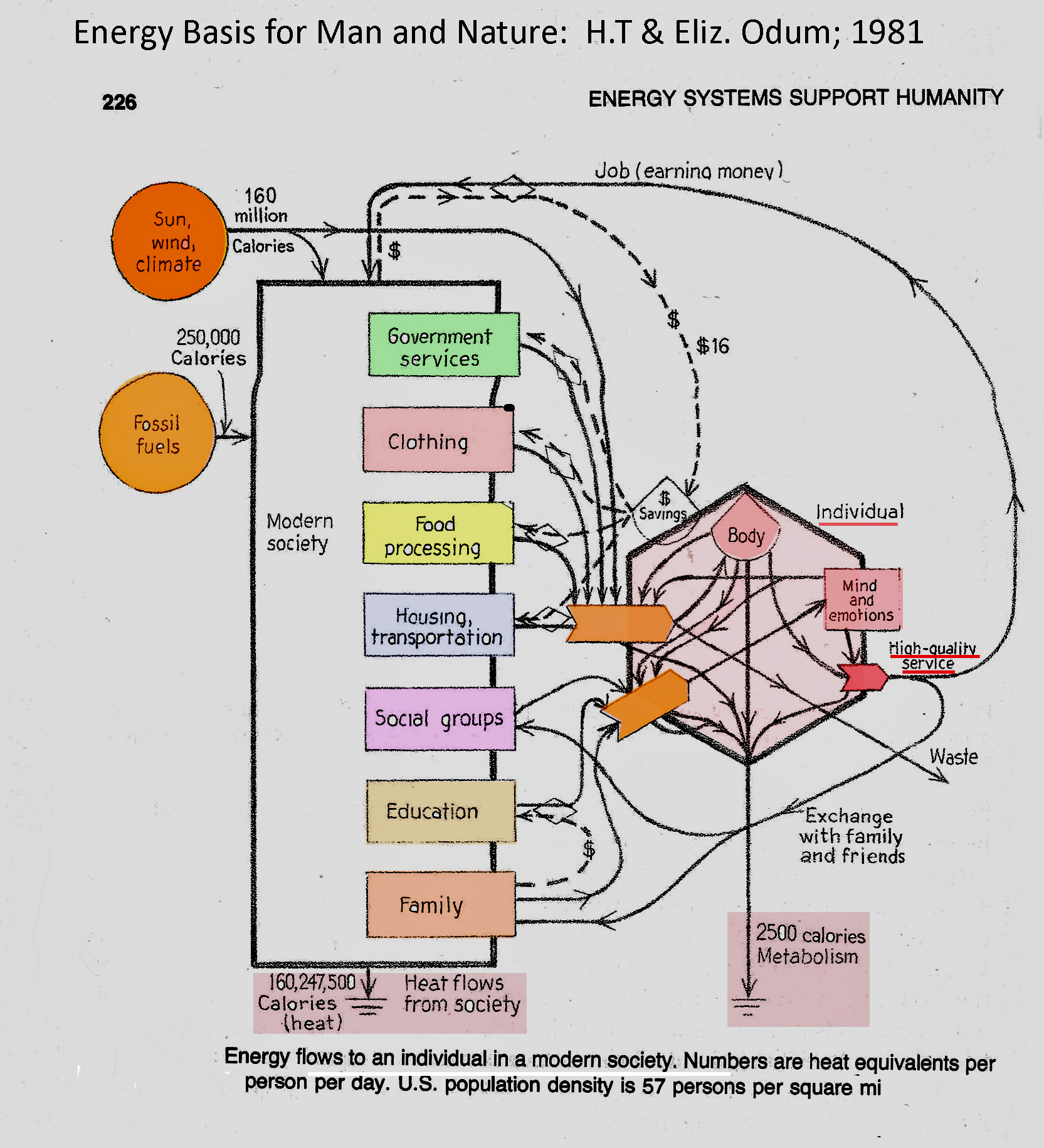
Figure 7
As part of modern societies, each human consumes large amounts of energy in various forms, most of which are embedded in many different institutional organizations. [The numbers in the preceding diagrams are averaged or calculated for 1981 and do not account for individual variations of consumption patterns.] The energy that supports these benefits is funneled through large national or international corporations that also respond to governmental and economic institutions, not directly to individual users of actual physical energy.
The sources, amount, and types of consumers (electricity, agricultural, residential, commercial, Industrial, and transportation) of energy are shown in the visualizations of the changes since 1860. (Figures 8a-8d.) In my grandfather’s early days, the major source of energy was biomass used for heating (shown in green). When my father was born, coal (shown in black) was the major fuel, beginning to be used for industry, heating, and railroads. Per capita energy (watts) consumed changed from 3,814 in 1860 to 4,789 in 1901; to 5,095 in 1933; to 9,060 in 1965; and to 11,463 in 2020. Note that the population grew almost 4 times from 1850 to 2020.
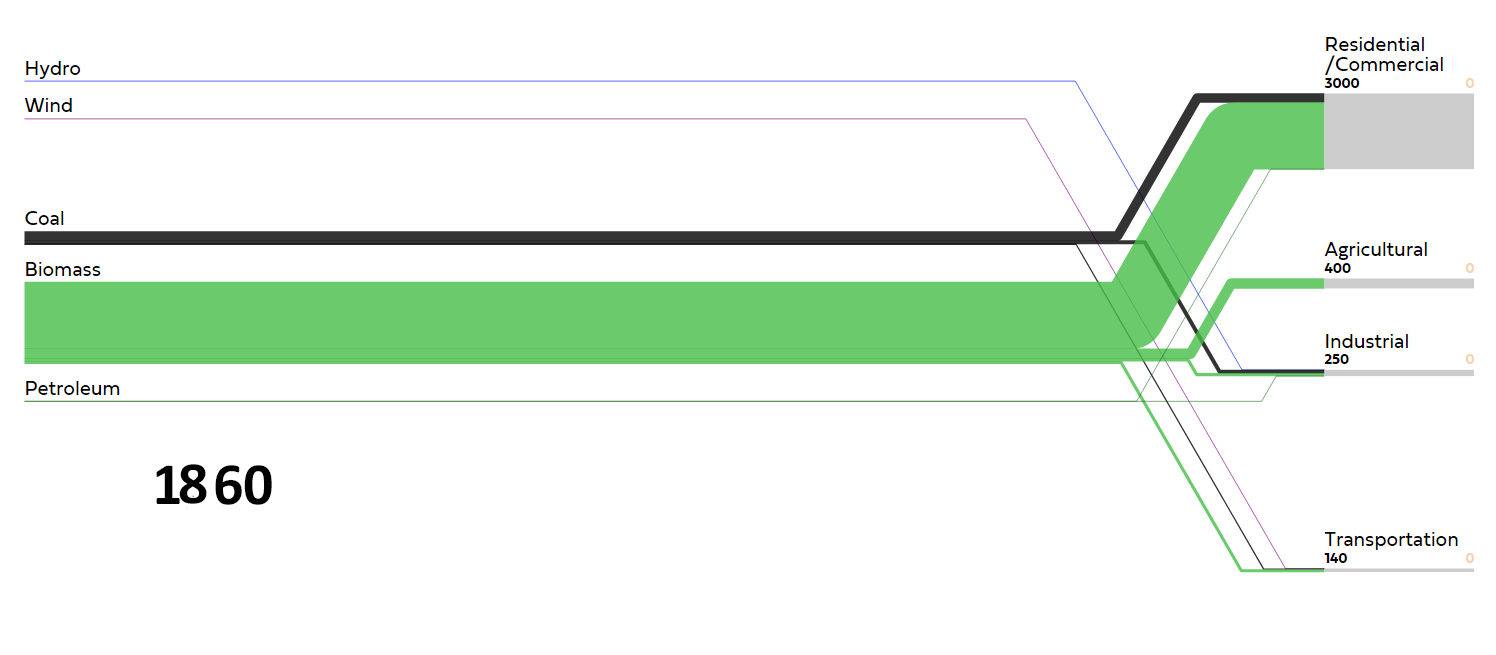
Figure 8a
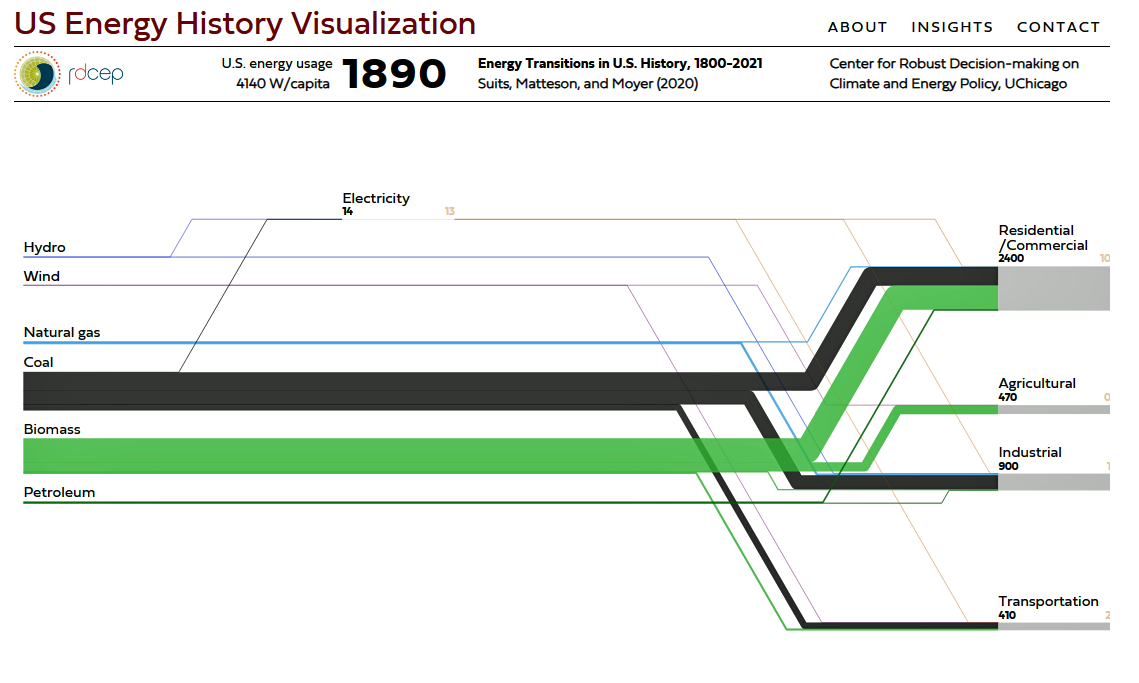 Figure 8b
When I was born, during the Great Depression, petroleum (dark green) began to be important for private transportation and industry. By 1965, use of petroleum had increased greatly; and natural gas had become important for residential and industrial purposes. Coal remained the principal fuel for generating electricity.
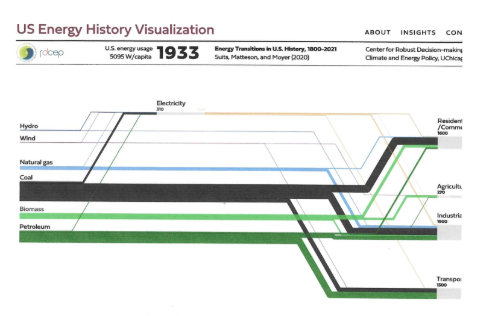
Figure 8c 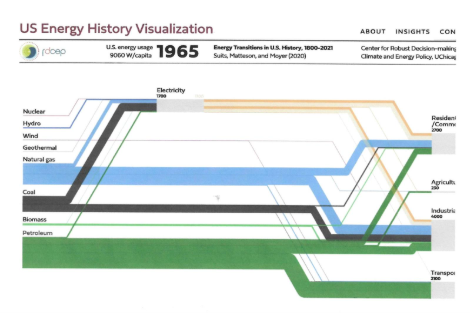
Figure 8d
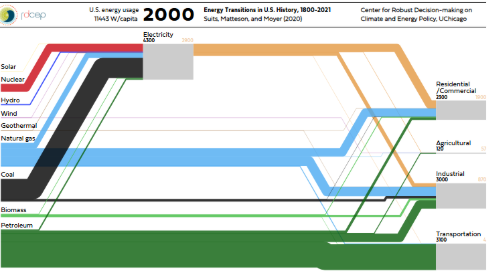
Figure 8e
A more detailed view of energy flow in the American economy is shown in the Sanky diagram produced by the Lawrence Livermore National Laboratory. It shows the major sources, manufacturers, consumers, and wastes/inefficiencies of energy use in the United States in 2022. (Figure 9)
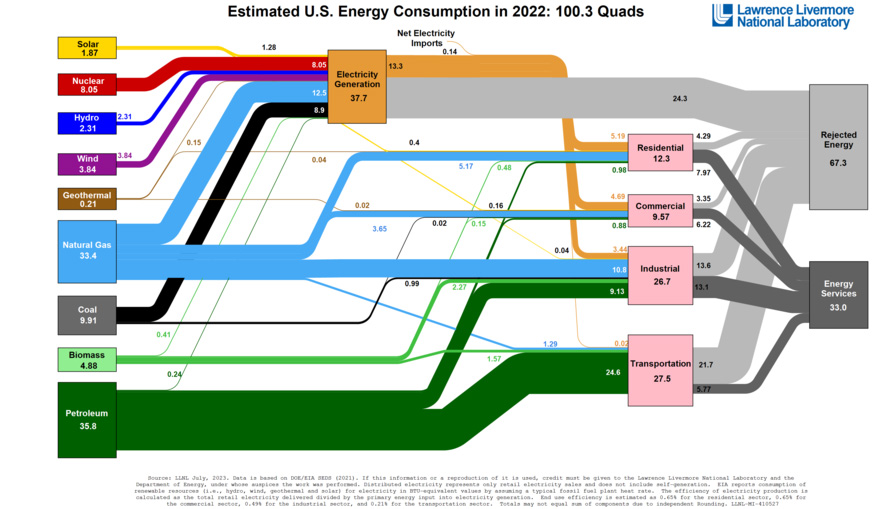
Figure 9
Both the consumption and production of energy were about 100 Quads. [The measure of energy is in Quads, BTU, not Watts, the unit of measure used in the visualization diagrams.] Only approximately a third of the energy produced in the U.S. is consumed in energy services (shown in pink); two thirds is lost. Likewise, two thirds of the electricity generated is lost (shown in grey) in its generation. Petroleum and natural gas each produced about a third of the energy of the United States. Solar and wind produced less than 6% of the energy of the United States.
Natural resources are modified by the energy involved in making goods and services. Technomass (the ingredients of man-made structures) has grown greatly in the last 125 years. Figure 10 shows the technomass of the world in 1900; Figure 11 shows the technomass of the world in 2024. A tick on the graph showing the technomass in 1990. [This graph does not show the decline in the availability of natural resources; it shows the volume of materials consumed at three different points in modern times.] Not only solid material from the Earth has been consumed to build the facilities that support the modern world. Water is also essential to maintain modern societies. I use figures 10-12 simply to illustrate the rapidity of consumption of basic materials on the surface of the Earth.
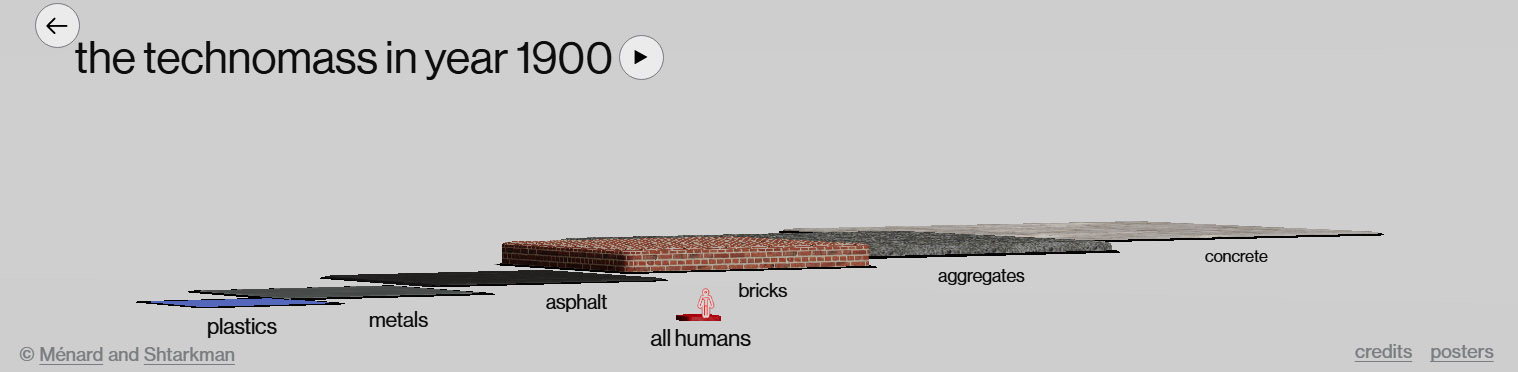
Figure 10

Figure 11
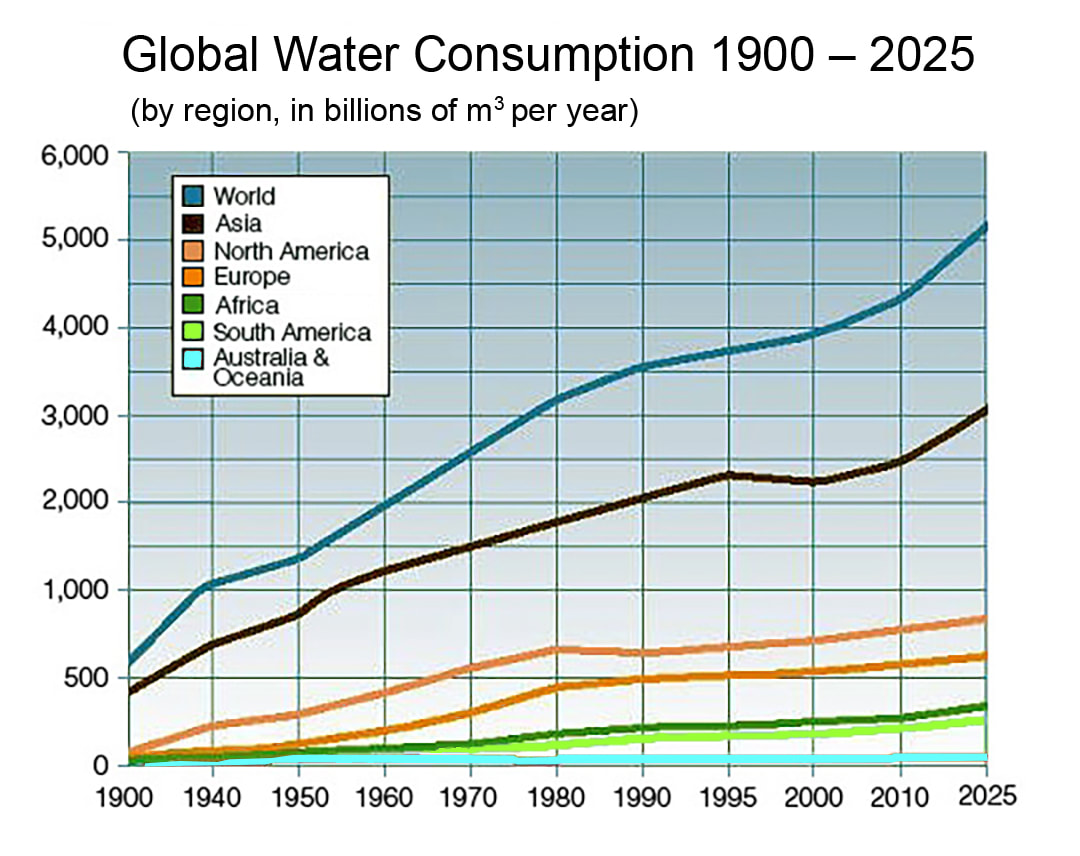
Figure 12
In only 125 years, America and the world have been transformed by the growth of the use of energy and material goods. Since 1950, modernization has expanded exponentially. ‘Progress’ is made possible only by releasing ever increased energy from fossil fuels and the consumption of more of the natural matter of the Earth. Current worldviews of growth and progress see energy and natural materials primarily as items of economic concern. They are ‘resources’ with a monetary value, not elements of natural ecological systems. The economic system is, nevertheless, embedded within the Earth’s biosphere. It derives energy and materials from the Earth; it releases degraded energy and materials to the biosphere.
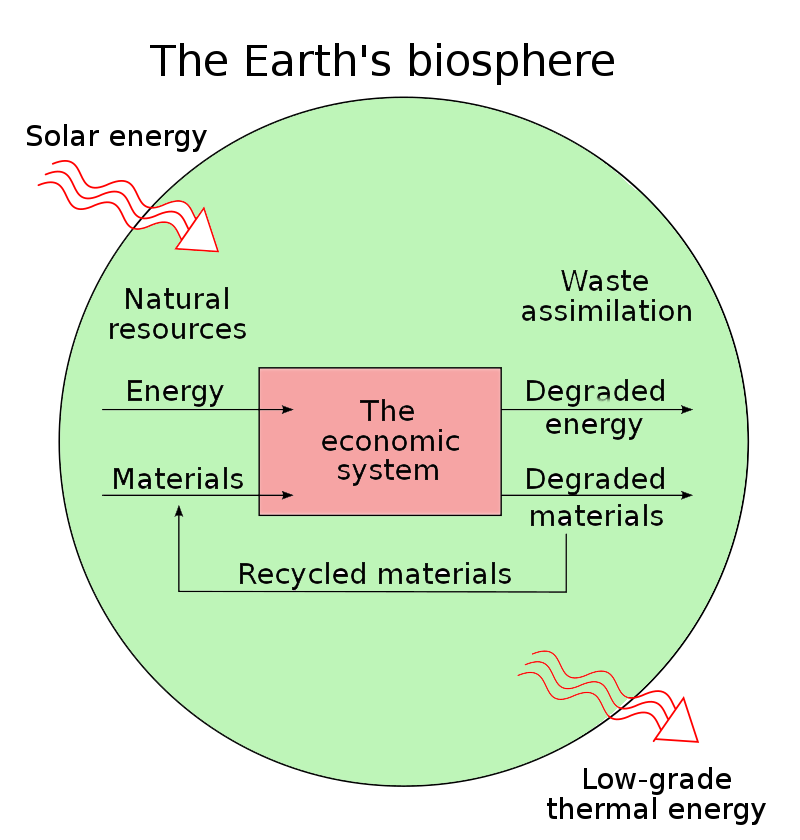
Figure 13
The Earth’s biosphere receives energy from the sun and releases thermal energy into space. Within the biosphere, humans have created resources and goods and services, as well as systems of extracting, producing distributing, and discarding them. This is ‘the economy’. Humans have been extraordinarily successful in directing the economy to provide the benefits of today because science and technology have had rich energy sources from the geological past. Unlike incoming solar energy, however, they are irreplaceable when used.
Throughout modern times, energy from coal, oil, and gas has been readily available. Other materials from Earth are also useful for economic resources. The rights of ownership of the land on which they are found provide rights of extraction. In addition, governments and financial institutions have found it in their interests to subsidize their discovery, extraction, and use. When energy extraction has been cheap and highly profitable, its consumption has grown and the benefits from its products are seen as greatly desirable. When the costs of extracting new resources or the disposal of waste products are high, the growth of the economy is threatened. However, corporations, governments, and financial intuitions borrow from the future to keep energy and benefits to individuals, institutions, and society flowing.
Energy will cost increasingly more to discover and extract. Until recently, as the energy costs of extracting higher grades of petroleum and natural gas grew, technology found substitute forms. It is unlikely that more cheap substitutes will be found. Note that the costs of renewable solar energy in the current economic market do not include the energy costs needed to produce and distribute electric energy.
Summary of part I. Continued growth and progress permeates modern culture. The demand for goods and services continues to grow. Growth depends on increasing amounts of energy, primarily on fossil fuels. But these benefits are now threatened by increasing costs of energy and by the accumulation of waste products in the natural ecology of the Earth.
II. Human Alterations of the Earth
Humans have unthinkingly used energy as part of their daily lives. When their numbers were small, they used little energy and disturbed the Earth’s ecological systems only slightly and temporarily as they extracted organic products for food and shelter. Only within the last 10,000 years, when the energy of concentrated human or animal labor supported the development of agriculture and grazing lands, and later, of village and urban life did human activities leave permanent marks on the land. As agriculture spread over larger areas, more land surfaces were altered. These alterations, however, were observed only locally.
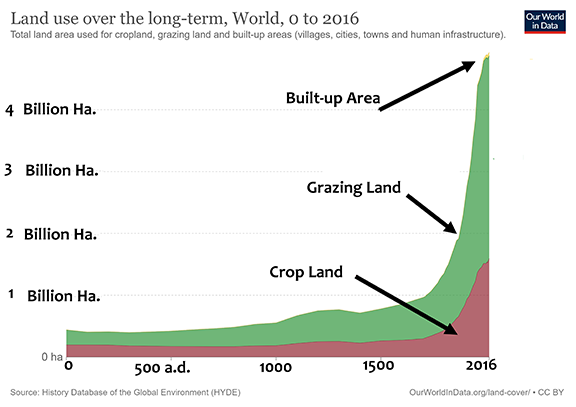
Figure 14
George Perkins Marsh’s 1864 book, Man and Nature, was the first major recording of broad changes to the landscapes of the natural world by human action. Even as many more lands were disturbed, the focus on the diversity and extent of the alterations humans had been making to the Earth’s landscapes was little recorded until the conference, which in 1955 honored Marsh. In the massive collection of presentations at that conference--Man's Role in Changing the Earth--experts from many fields wrote and spoke about how humans had altered many aspects of the world that they had studied. Fossil fuel energy was not a major concern for most participants, although some questioned the ways in which “development” was negatively affecting the Earth’s landscapes. None of the conferees were aware of the magnitude of changes that the use of fossil fuels was going to affect the natural systems of the Earth.
Increasing energy-based technologies, both industrial and societal, resulted not only in the benefits of useful goods and services but also in pollution of land, sea, and air. However, until recent decades, waste products and inefficiencies from energy use, such as those shown in grey in figure 9, have been largely ignored. The negative results of steadily increased use of energy are shown in figure 15. As long as some natural forests remained, as land could still be cleared for farm or pasture; if soils continued to produce crops; if waters remained available for irrigation or removing waste products; as long as fish were abundant in streams and oceans; if air pollution was localized; and waste products were hidden, the negative aspects of growth could be ignored. Some specific problems of pollution were rectified by technology. In addition, efforts to conserve extraordinary landscapes in national parks, wilderness areas, to control soil and wind erosion, to preserve wildlife and clean water have resulted in local and regional counteractions to unrestrained growth. But problems of waste on a global scale were ignored until very recently.
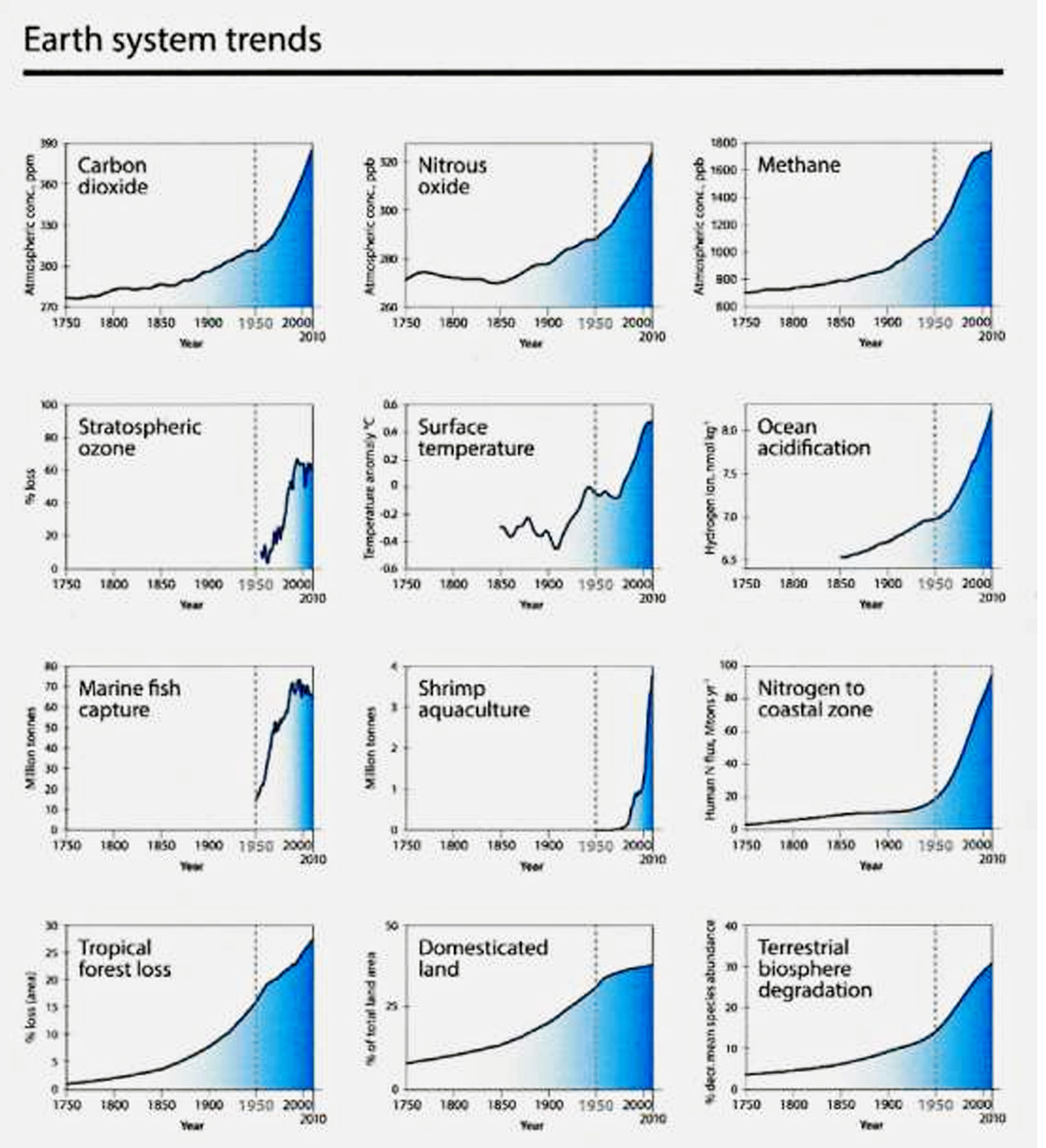
Figure 15
That the magnitude of impact is now recognized is well illustrated in the studies of William Rees,
Mathis Wackernagel and The Global Footprint Network, studies show that the Earth's ecological reserves of biological resources no longer exceed the organic capacity of the Earth to replenish itself. In other words, the global ecological footprint of the world has been in deficit since about 1970. (Figure 16a) The changes to the Earth’s surface are seen in the steadily increasing footprints of all the different types of land use. Increases in carbon waste are the greatest. (Figure 16 b)
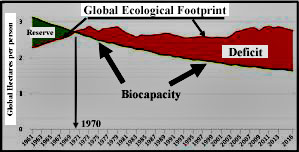
Figure 16a
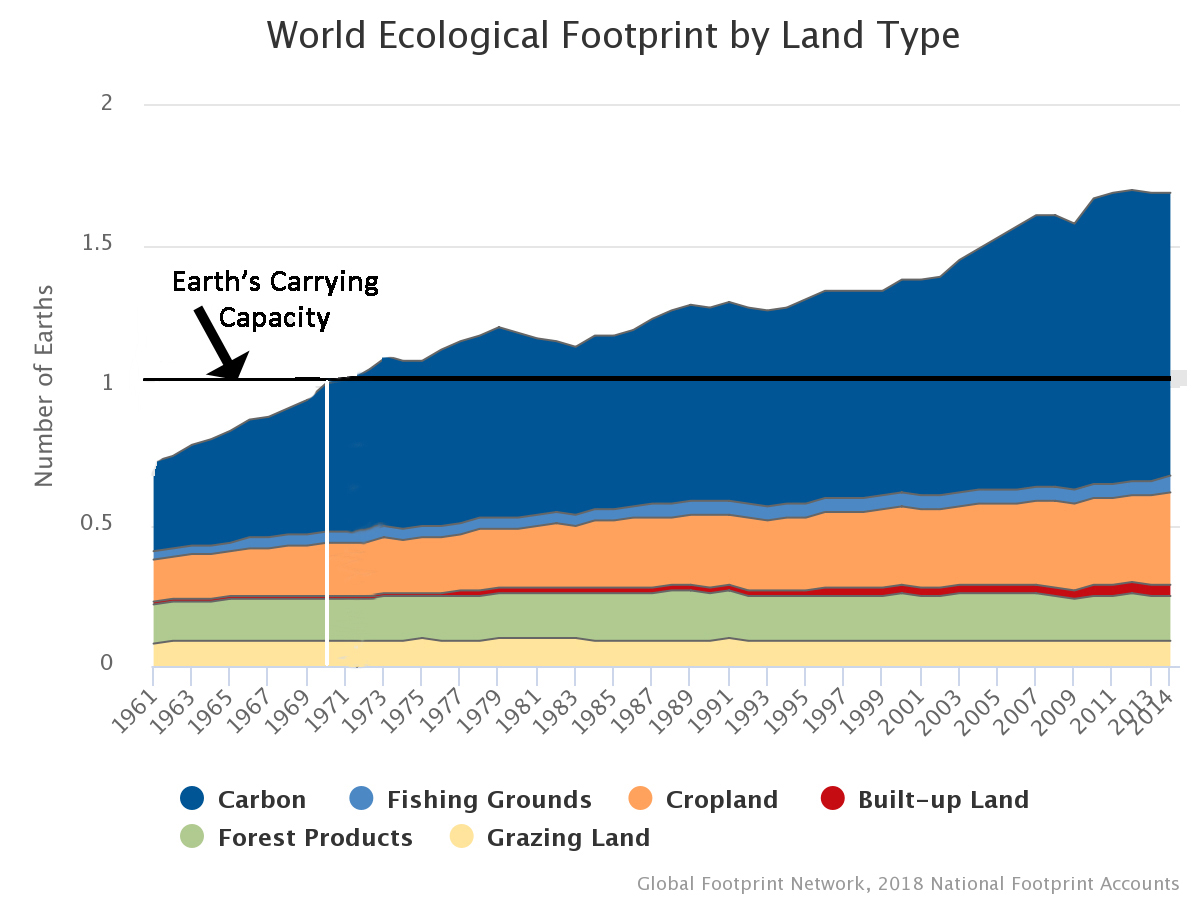
Figure 16b
The Stockholm Resilience Center has determined changes in nine major natural systems of the Earth. During modern times, human actions have altered six systems beyond safe operating levels. Several systems have passed typing points beyond which the ecological processes are essentially irreversible. Because global warming underlies several of the systems, I use it as an example of the direct role energy has played in altering the Earth.
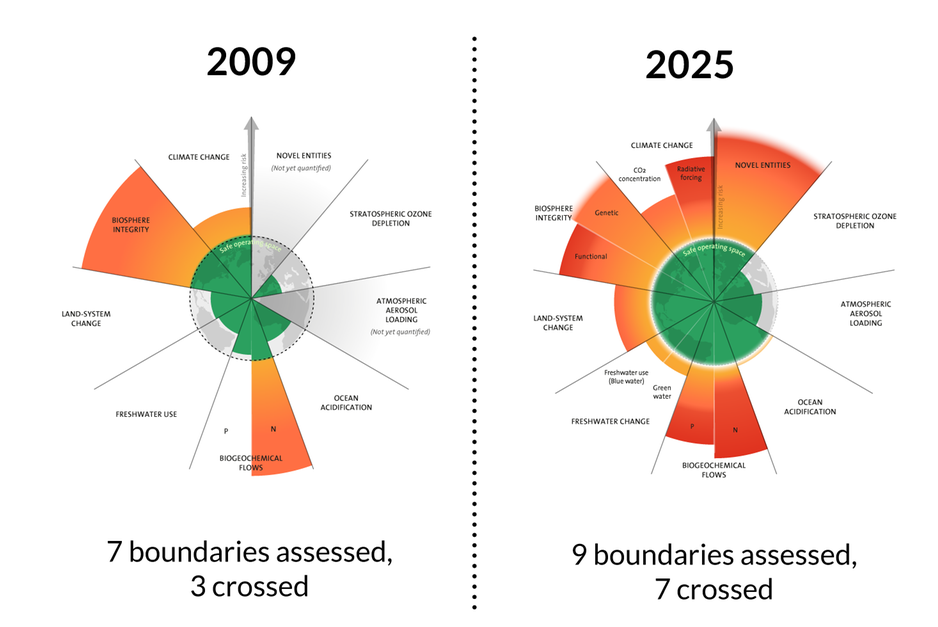
Figure 17
Illustration: Azote for Stockholm Resilience Centre based on analysis in Richardson et al 2025
An extreme end to continued use of fossil fuels is shown in this adaptation of the concept of ‘peak oil’ placed in the context of 5,000 years before and 5,000 years after today.
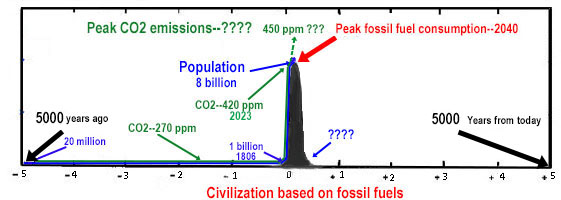
Figure 18
A view of the consequences of probable continued use of energy sources and economic growth is shown in the Club of Rome model, first developed in 1971 and revised in 2025 by Job one for Humanity.
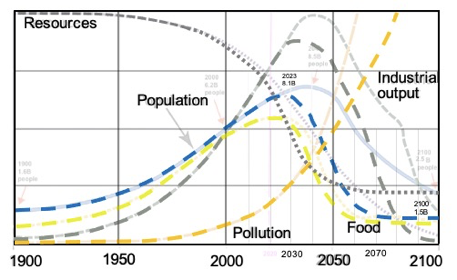
Figure 19
The Example of Global Warming and Attempts at Mitigation
Although many human actions have disrupted the natural systems shown in Figure 17, Global Warming is most obvious in its relationship to major atmospheric changes directly affected by burning fossil fuels. Global energy consumption was its highest in 2024; global CO2 emissions were also the highest ever in 2024. (Figure 20) Other greenhouse gases—Methane and Nitrous oxide--also grew. These three global greenhouse gases now exceed early system tipping points. (Figure 21)
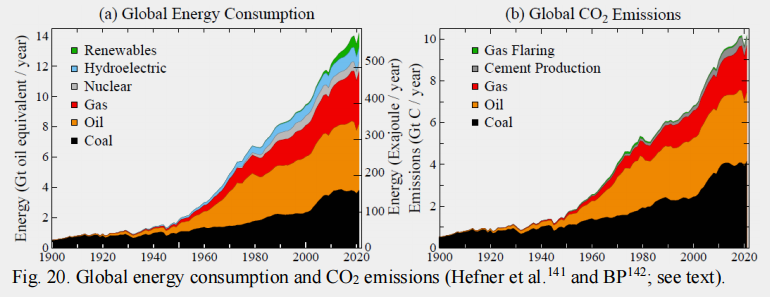
Figure 20
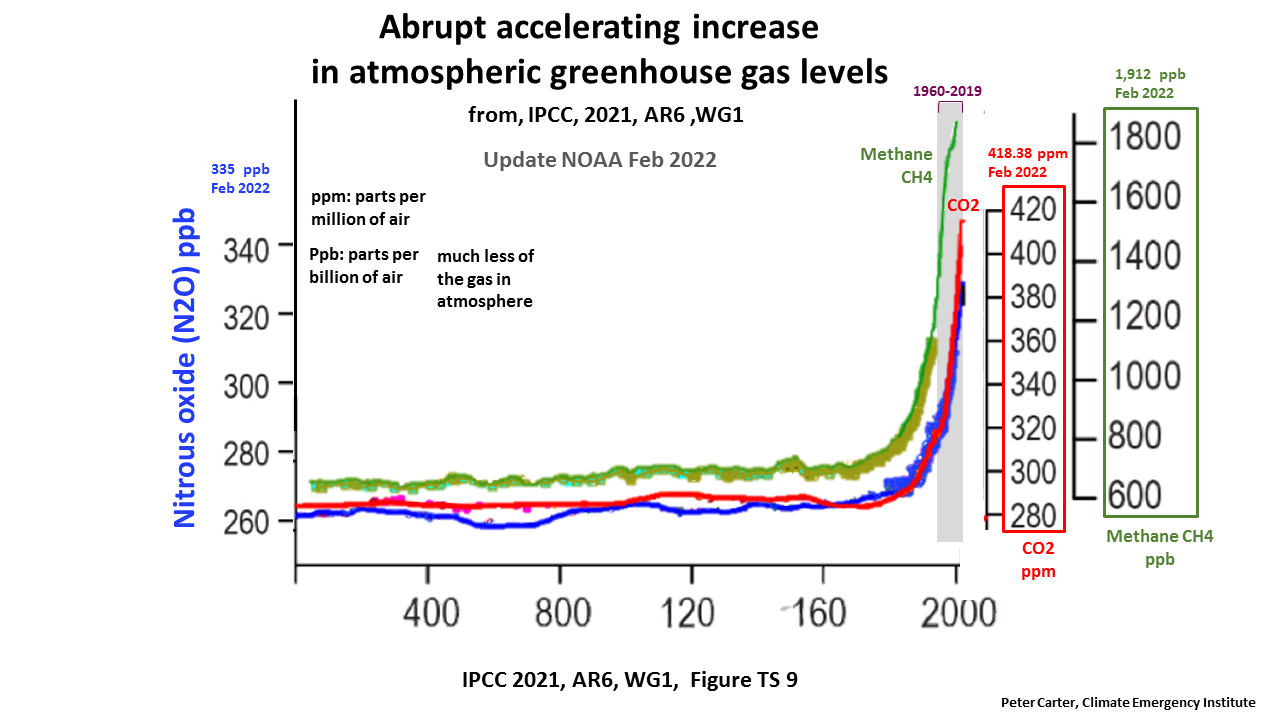
Figure 21
Figure 22 illustrates some of the effects of atmospheric accumulation of greenhouse gases on the oceans, land surface temperatures, glacier and sea ice, and the circulation of the atmosphere and oceans.
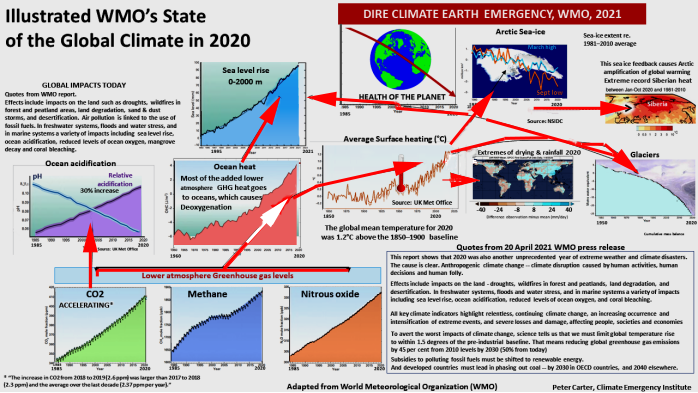
Figure 22
In the last few years, extensive flooding, hurricanes, heat domes, melting glaciers, and many other phenomena have caught the attention not only of scientists but also of the public. The loss of coral reefs, extinction of wildlife species, and cutting of tropical forests have become common knowledge. Nevertheless, further deterioration of the ecological systems of the Earth continues unabated.
As energy costs continue to rise, waste products from the use of energy have become too expensive to be recycled or absorbed. No longer strictly an economic cost, the damage that modern civilization has done to the systems of the natural world is of major importance to the survival of modern civilization.
The International Program for Climate Change (IPCC), the global organization designated to address the negative effects of energy use, has reviewed scientific climate models of possible future states of the atmosphere to determine what standards of emission of greenhouse gases are required to keep temperatures below 2oC in 2100. Its primary solution is for nations to pledge to lower their use of fossil fuels.
Based on climate models, several pathways to that goal have been projected; a middle way was selected as the IPCC goal. However, the national goals pledged by each country are inadequate to reach the global goals of the IPCC; and even these pledges are not being met. (Figure 23) Because so many institutions and people in each nation must agree to the pledges, effective enforcement is impossible. When the institutions with the greatest abilities to reduce the use of fossil fuels are controlled by the producers, distributors, and financers of fossil fuels--the largest and wealthiest institutions on Earth--the goals of the IPCC cannot be met.
The certainty that the goals will not be met means that temperatures will continue to rise. Projections of the probable consequences of the impacts at different levels of increasing temperature are shown in Figure 24. The diagram shows a few major examples of the risk of loss of species, the risk of increased human death from heat and humidity and decreases in food production.
Figure 23
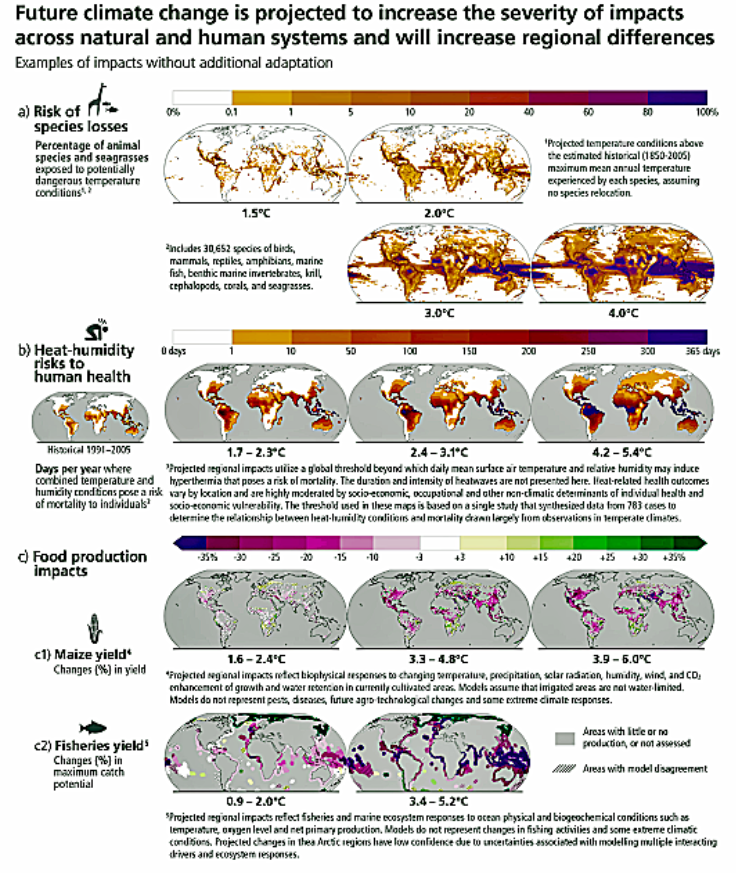
Figure 23
Summary of Part II. As our society derives useful energy and materials from the Earth, it also releases degraded energy and materials to the biosphere, some to space. Mostly those costs have not been recognized within present economic systems and are dismissed as externalities. Externalities such as air pollution causing global warming, degraded plastics distributed widely, phosphorous and nitrogen in streams and nearshore waters, have not been addressed by the economic system, but they remain as negative by-products of the benefits of our times. These undesirable and unaddressed actions have occurred during the lifetime of everyone now alive.
Dominant political, economic, and social world views emphasize growth of energy use; thus, they are in direct conflict with scientific studies that show further growth will be highly disruptive. National interests continue to favor growth in energy over the need to control future damage to the Earth. Both the global ecological footprint (figure 16), and the natural systems of the Earth (figure 17) are operating at unsafe levels. Backed by solid scientific evidence, they show clearly the incompatibility of continued growth of the economy without further massive disturbance of the natural systems that support life on Earth.
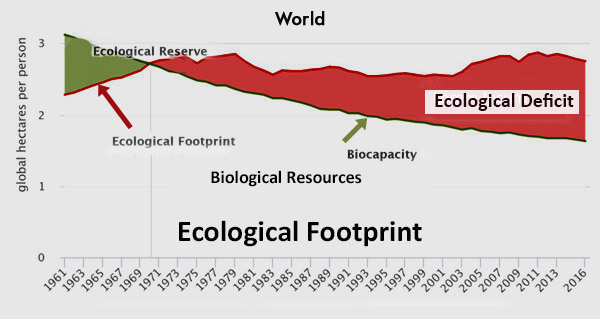
Figure 16
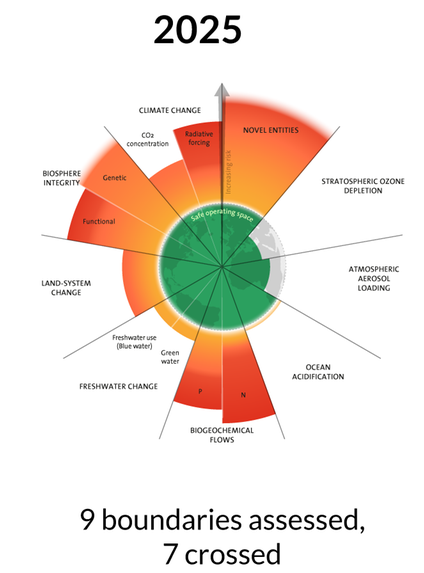
Figure 17
Nothing of a comparable scale and such rapid change took place before the 20th Century. The history of the past did not address the conflict between human beliefs and scientific evidence of the natural world of Earth. Thus, traditional history cannot guide our thinking about the environmental predicament within which we find ourselves.
III. An Unprecedented Environmental Predicament
‘Denial’, ‘Hope’, and ‘Acceptance’
This unprecedented transformation in the relationship between human beliefs and the natural world has occurred during the lifetime of everyone now alive. We are unable to recognize that we live and act in two completely different systems. No one before us has been able nor needed to recognize the conflict. The first element of the crisis is that our modern worldview is made up of stories we create, tell, and live by. The dominant system is strictly human; the stories by which we explain the human condition range from religion to science, from economics to pleasure, from personal to worldviews. Some are true; others are false. Some are fictional; others are not.
The second system concerns evolution and ecology, (concepts unknown to science until the 19th century and not widely known even today) which, to me, are the best explanations (stories) of the natural world in which the human animal has evolved and survived over 300,000 years. Humans survived as natural physical forces beyond their control have slowly changed. But with rapid releasing of energy from the burning of fossil fuels, natural forces of ecology have drastically altered the conditions in which humans evolved and existed until the 20th century.
From a human perspective, rapidly releasing energy is desirable because it is basic to providing more goods and services; but from the perspective of ecology and evolution, the released energy fundamentally disturbs the longer-term stability of nature. The second perspective and its fundamental truths threaten the very survival of the human species. The conflict between the two stories—human created vs. natural processes—is the environmental dilemma in which we now live. The question therefore is how we may best think and act in this dilemma.
Three major alternatives present themselves:
1. denial and challenge the evidence;
2. hope that humans can solve the problems; or
3. accept the predicament.
(Editors Note, Job One For Humanity (further below) does describe and provide a partial alternative to the three steps above concerning our predicament and the Polycrisis in that it recommends continuing to aggressively reduce the climate change threat multiplier by reducing as much personal and other fossil fuel use worldwide to incrementally reduce global suffering and death so that more of humanity will survive the great collapse that is coming.)
Denial is to shut your eyes to the steady accumulation of evidence.
That humans can solve the problem through hope requires faith that they have the intelligence to create technology that is greater than that of ecology and evolution.
I leave it to Michael Dowd to make the case for acceptance. Figure 24.
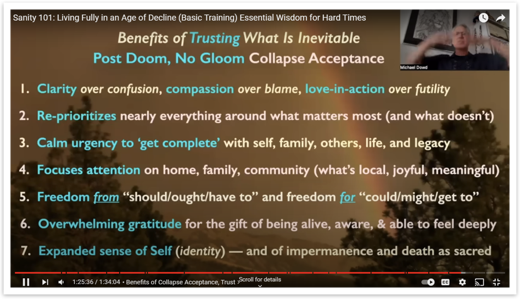
Figure 24
What does acceptance of the environmental predicament me to me? Thinking as a cultural geographer who examines the relationship between cultural and natural history, I still believe in a goal I set in my 1993 retirement talk.
“We must recognize the absolute necessity of trying to maintain the stability of places. And to follow our recognition of past changes and the need for stable ecosystems, we must become leaders in initiating radical changes aimed at stability in every community, state, or nation. I think that the very least we can do is to ask the question of every action, 'does this lead towards a more stable world, not only for us humans directly, but for all life forms and habitats?’ We cannot use the recent historic past as our compass. It leads us to value instability. I believe that only by asking this crucial question can miracles happen if our children and grandchildren are to attain lasting health. Otherwise, the burgeoning human population will be forced to participate in disasters and tragedies–both human and natural–at a scale never even imagined.”
On a more practical level, I suggest some personal actions.
IV. Personal Actions You Might Take to Live Better in the Coming Decade.
A. Gain Knowledge of the causes of Global Warming
1. Understand Ecology, Evolution, Environment, Energy, and Entropy to realize the magnitude of the predicament that human alteration of the Earth has created. We must learn about the natural world because humans are an integral part of it; but they do not control it. And humans, like all organisms, grow and reproduce until they reach physical limits in their environment; and humans have reached those limits.
2. Recognize that the dominant modern worldview of growth and progress is unsustainable and is dominated by politics, power, productivity, profit, and publicity, to which I would add property. Lewis Mumford’s Pentagon of Power
3. Understand the concept of exponential growth in a finite world. Most importantly, economic growth based on consuming finite Earth resources is impossible.
4. Realize that we exist in an unsolvable “Predicament” or a situation beyond our control.
Modern technologies have altered greatly the ecological systems within which humans evolved and lived in all but the last few decades. Ecological systems have now exceeded (overshot) stable boundaries and have entered unstable states that technology cannot solve. That is a predicament. Predicaments are situations that are beyond our control.
5. We must learn to live with the knowledge that our moment of human exuberance is expiring. More particularly, we will have to learn to act and think in a world in which the goods and services we have enjoyed in the last several decades will become steadily less available. And we need to contemplate a life in which millions of people will live much shorter lives or die because of the collapse of modern society. That is the predicament we face in the remaining decades of the 21st century.
B. Humane ways in which you might adapt to the existential predicament?
How can we, as individuals, live in a world in which our actions and our current belief systems are failing? We must address how and what it is to be human. Our humanity does not reside in power, profit, consumption, or continued expectations of growth. How may we alleviate some of the personal and communal traumas that are inevitable within a declining civilization by adjustments to our ways of thinking and acting?
1. Practice the program of Environmentalists Anonymous. (Al Urquhart)
Easing the emotional pain of living in a collapsing society is important. I believe that when a person, discovers that his/her unconscious actions in modern society are not reconcilable with his or her thoughts about and knowledge of the Earth’s ecology, she or he can only admit that his or her life is out of control; and that s/he is addicted to exploiting the Earth. If one realizes that he/she is caught in the double bind of a modern worldview versus the natural world ecology in which we are embedded, s/he will feel pain. These conflicting messages cannot be easily reconciled and will deprive us of sanity and health unless we admit them.
Step 1. We Admit that we are powerless over our exploitation of the environment--that our lives have become unmanageable. If we are to remain sane and healthy, we must find a way to recognize both (a) the life and culture in which we have lived and (b) that we are part of a system in which humans and the environment are not opposed. The realization that we are merely part of a naturally evolving and ecological world is truly a humbling experience for those of us raised in the traditions of The Enlightenment and Modern beliefs which stress the power, rationality, and individuality of humans and humanity.
Step 2. We have come to believe that we are but a small part of the Earth’s evolutionary and ecological systems. We accept that the power of those systems is greater than ours. (If you want a name for that power, I suggest Gaia.)
Step 3. We have decided to turn our lives over to the care of Gaia.
This step toward sanity and mental health may be as difficult as the acknowledgement of our addiction. To surrender to this new way of thinking is, for most modern Americans, a great threat to our current ways of life. But viewed in the context in which every technological triumph disrupts some ecological or evolutionary relationship, often in startling and precipitous ways, one catches glimpses of disasters far more threatening than alterations of our current lifestyles.
Continued human survival in ecological and evolutionary terms rests outside our own control; our technological addictions only precipitate the disturbance of the many interrelated natural systems of which we are but a small part. However, if we act within this new way of thinking--this new epistemology--that emphasizes the conviction that we are merely “part of” something much greater than ourselves, we may extend the positive aspects of being human-- love, learning, kindness, community, and empathy--further into the future.
Steps 4-10. If we accept this new fundamental perspective, we can actively and honestly become part of it by physically acknowledging, and wherever possible rectifying, the wrongs we have done in the past not perpetuating them today and avoiding them in the future. Additionally, through meditation about Gaia and by passing this message to others, we may awaken ways of gaining greater sanity within our communities.
Step 4. We have made a searching and fearless moral inventory of ourselves.
Step 5. We admit to Gaia, to ourselves, and to another human being the exact nature of our wrongs.
Step 6. We have made a list of the environmental and ecological systems we have harmed and have become willing to make amends to them.
Step 7. We have made direct amends to such systems wherever possible, except when doing so would further injure them.
Step 8. We continue to take personal inventory and when we are wrong, promptly admit it.
Step 9. We seek to improve our conscious contact with Gaia through meditation and deep thought.
Step 10. Having had a spiritual awakening as the result of these Steps, we try to carry this message to others addicted to exploiting the Earth’s natural systems, and to practice these principles in all our affairs.
2. Ask the questions of Deep Adaptation. (Jem Bendell)
More specific ways of looking at the imminent future and how to act conservatively have been described by Jem Bendell in his essays on practicing life. He writes: “Deep Adaptation is a framework for exploring ideas on how to attempt. what we call The Four Rs… These are all questions because we are in a very new situation where the expectation of simple answers given to us by somebody else is not going to help as much as us exploring together how to be and what to do.”
“What do we most value that we want to keep and how,” is a question of resilience.
“What could we let go of so as not to make matters worse,” is a question of relinquishment.
“What could we bring back to help us in these difficult times,” is a question of restoration.
“With what and with whom shall we make peace as we awaken to our common mortality,” is a question of reconciliation.”
These are the questions we should always ask before acting to lessen our impact on Nature.
3. Make Immediate Emergency Preparations for the Soon-Arriving Worst Climate Change Emergency and Polycrisis Consequences while Still Working for the best Possible Survival Outcomes for Humanity. (Job One for Humanity)
Go to the Job One website and become a member of Job One for Humanity for what I think is the best analysis and remaining needed actions for the immediate challenges of global warming and the polycrisis. They believe that there is no way to currently resolve our situation for at the minimum, decades to centuries to millennia.
Because climate change in their analysis is already irreversible and it's worse consequences unavoidable, what is still necessary today is to enact whatever is possible in radical global fossil fuel reductions, and begin other ways to survive the Great Collapse for at least a smaller portion of humanity that could survive if they begin comprehensive emergency preparations now.
They have prepared a comprehensive emergency preparation plan and a fossil fuel reduction action guide for accelerating climate change and the polycrisis. There are important differences in their strategy for the predicament humanity now finds itself in that are beyond the other suggestions in this section.
Action Step 1: While you are doing the other steps below, do everything you can to radically reduce your own fossil fuel use, and the fossil fuel use of your locality region and nation. Even though these actions will not save all of humanity, they should be just enough to save a small section of humanity from the Great Collapse. Think of it this simple way. The more you reduce global fossil fuel use the more human beings will be saved from untold suffering and death.
Action Step 2: Enjoy your life now and build psychological and emotional stability, reserves, and resilience.
Action Step 3: Build your necessary emergency supplies and resilience for survival and recovery in the event of the ongoing and accelerating runaway global heating disaster.
Action Step 4: Create a climate change emergency preparation cash or valuable commodity reserve fund equaling 5%-10% of your annual income.
Action Step 5: Plan how to adapt where you are and move critical resources, technology, and infrastructure to handle the escalating consequences of runaway global heating.
Action Step 6: Get as personally sustainable as possible, as quickly as possible, and create renewable long-term food supplies that you can manage.
Action Step 7: Evaluate if you must relocate or migrate, and if so, plan where and when. Learn the concepts of Managed Retreat.
Action Step 8: Carefully watch Job One for Humanity's ideas about accelerating runaway global heating and other related consequences and their coming signs to wisely stay ahead of them for as long as you can.
Action Step 9: If you are also of a spiritual nature, your faith can provide a critical and powerful motivation to help you persevere and survive what is coming.
Action Step 10: Work together passionately and wisely to slow and lessen the avoidable pain, suffering, and death that is and will be caused by accelerating runaway global heating
Action Step 11: Learn about and then join one of our existing ClimateSafe Villages or create a climate-safe eco-community to have a prepared community to help protect you and your loved ones through the many hardships ahead. (This is an essential survival and thriving step as climate consequences worsen.) Join or build one of the four urban, rural, hybrid, or virtual resilient models of the new supportive ClimateSafe Villages that will have your back as conditions worsen.)
Action Step 12: Do everything possible to also protect and preserve the biological life and ecological systems within your zones of influence and resources while protecting yourself and your loved ones.
4. Heed Richard Heinberg’s Sixteen Words of Advice to Young People in the 21st Century.
I believe that Heinberg's advice to young people in his book--Power--is probably the most important practical recommendation for preparing the future of those who will have to live their lives in a disintegrating society. He writes:
1. Learn to grow food. Study permaculture.
2. Learn to read people. You’re going to need to know whether people in your vicinity are trustworthy. 3. Be trustworthy. Otherwise, smart and trustworthy people won’t associate with you.
4. Learn to express yourself clearly and persuasively.
5. Consider making a commitment not to reproduce. There are already plenty of people in the world.
6. Learn to make decisions by consensus and to work collaboratively. Be a person with whom others enjoy working.
7. Learn to repair and use relatively simple technologies. Studying to be a computer programmer or hacker could pay off in the short run, but over the longer term you’ll benefit more from learning to fix farming and construction tools.
8. Learn to make spare parts from junk.
9. Learn how energy works. Be able to identify the sources of energy in your environment and find ways to harness that energy to do useful work.
10. Learn to defend yourself. Sadly, for the remainder of this century the world is likely to be a more violent place. Even if that turns out not to be the case, martial arts can still be useful paths of self-discipline.
11. Learn to heal the human body via nutrition, herbs, and basic emergency care.
12. Learn to recognize the subjective effects of sex hormones, dopamine, and other brain chemicals, and find ways to use their effects to help achieve goals.
13. Learn about nature. Memorize the names of local plants, birds, and insects, and observe their habits. Learn to be comfortable in the wild.
14. Learn how to produce beauty via art, music, or movement, and how to engage others in creative, celebratory activities.
15. Learn to emotionally process trauma and grief, and to help others do so.
16. Learn when and how to use humor to release tension.
We live in an Environmental Predicament of our own making.
We tell many stories concerning how we relate to one another, view our immediate surroundings, and consider the unknown. Many stories are satisfying; others arouse dissatisfaction, anger, and conflict, regardless of supporting evidence or truths. Nevertheless, we live by stories that people have created. Until recently, the modern worldview of continued material growth and progress has been the ascendent public story that guides us. We hold on to this story because it has been very successful.
The supporting evidence is overwhelming. The discovery that the energy from the geologic past could be used to remake everyone's material life is at its core. Without that ancient energy, humans would be living like all earlier people—using only incoming solar energy. President Trump, the power companies, the banks that support them, and most of us who want lower gas prices, better schools and housing, and cheaper food, education, and medicine all have benefited from this modern view. Those with more power have benefited the most.
Another story, however, has begun to conflict with the desire for growth and progress. Human life is threatened by the huge consumption of energy and matter and the disruption of many natural Earth systems. The bases for this story are ecology and evolution. Although the concepts of evolution and ecology emerged in the 19th century at the same time as the beginnings of modern societies, they received little public awareness except as they questioned stories about God. Only since the mid 20th century, with increased awareness of pollution, extinctions, and the negative effects of using fossil fuels have ecological concepts become a minor part of public discussion. Today, evidence of ecological disruptions, of tipping points, of 'natural’ disasters is overwhelming. Some geologists even see that ecological changes are so great that we need to speak of a new geological era—the Anthropocene,
In the evolutionary story, humans, like all organisms, reproduce and grow until they reach limits in their environment, at which point they evolve or die. Environmental limits for humans remained relatively stable until the burning of fossil fuels shattered the carbon cycle and other Earth’s natural systems. Humans have tried piecemeal efforts to restore natural systems that exceed tipping points but with little success. We are consuming ecological reserves faster than the Earth produces them. And we are continuing to destabilize major Earth systems. Certainly, the Earth cannot long support eight billion people. With current rates of growth from the use of energy, even evolutionary limits for human life may be approaching.
The two major existential stories are irreconcilable and underlie the Environmental Predicament. In the very short run, the story of the human benefits of economic growth based on fossil fuel energy wins out. But in winning, it ensures that the story of ecology and evolution will limit, maybe destroy, its success.
Technology—a human story—cannot provide solutions that restabilize the major ecological systems, especially after they have reached tipping points. Our hopeful modern stories of growth and progress cannot prevent disasters. All evidence informs us that we now live within an Environmental Predicament. Today, I believe that the largest question facing humanity is how to live humanely.
Be mindful, be honest, be caring, and love the Earth!
Al Urquhart December 2025
About the Author
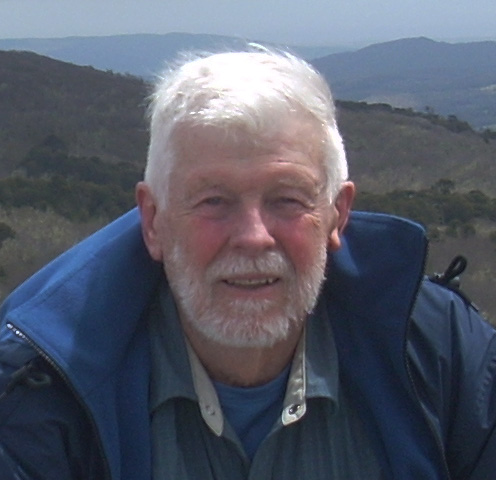
Alvin (Al) Urquhart is an Emeritus Professor of Geography and was a founder and director of the Environmental Studies Program at the University of Oregon. With three degrees from the University of California, Berkeley, he was trained in anthropology, soil science, ecology, and geomorphology, as well as in his home department, geography.
Although his early teaching specialism was as a geomorphologist, after field studies in Jamaica, Angola, and Nigeria, he became focused on the alteration of landscapes by cultural groups. Since the early 1970s, his primary interests have been the relations between humans and the natural world.
As a teacher, he developed courses in the ways in which cultural landscapes were created, the disruption of ecological systems in the building of these landscapes, and the history of environmental ideas. Many of his thoughts were published in Nature & Culture: A Personal Crisis, available on his environmental blog, alurquhart.com. His Nature & Culture: A Personal Crisis contains the ideas underlying his thinking process, an extensive autobiography, and thoughts on the predicament in which humanity now finds itself. Many of the presentations he has made appear in his environmental blog: alurquhart.com. Now in his tenth decade, Al continues his landscape and environmental interest, mainly on a local scale.
Showing 1 reaction