
Do you know which near-term climate change consequences are already unavoidable, which are still partly avoidable, and what families, property owners, and businesses should do next? Because climate theory gets real the minute it reaches your lungs, your kitchen budget, or your insurance bill.
Quick navigation
Quick answer to Are we out of time?
Humanity is not waiting for a future climate emergency. We are already inside it.
Atmospheric carbon dioxide is still rising. NOAA’s Mauna Loa record shows a monthly average of 429.35 ppm in February 2026. The World Meteorological Organization reported that 2024 was the first calendar year likely above 1.5°C relative to 1850-1900. In other words, the background danger is not theoretical, and it is not politely waiting for politics to catch up.
We make this stronger claim than most governments, media outlets, or even many mainstream climate summaries. This is because official forecasts often understate the speed, severity, and compounding nature of the climate emergency, especially when tipping risks, feedback loops, non-linear system reactions, carbon-sink weakening, aerosol masking, and long system delays are taken seriously.
So here is your short answer:
The period 2026-2031 is not just another stretch of bad climate headlines. It is a decisive risk window in which delayed action sharply increases the odds of crossing into more dangerous, harder-to-control, and potentially self-amplifying climate change consequences.
That does not mean every exact date on every climate change consequence should be treated as a stopwatch. It means the direction of risk is unmistakable: higher greenhouse gas concentrations, hotter oceans, more extreme events, more stressed carbon sinks, and more intensifying interaction between the climate and the 14 other global crises of the wider global polycrisis.
But like so many other bits of bad news, the devil is in the details, which you will find below.

Why time is short?
The climate danger is not just about a temperature number. It is about timing, momentum, compounding effects, and delayed consequences.
Here is the long version of that argument.
1) We delayed far too long
Humanity has had 6 decades of warning, 6 decades of available policy tools, and 6 decades in which emissions should have fallen much faster. Instead, emissions and atmospheric concentrations continued to rise. That delay matters because the climate system is not a light switch. It behaves more like a loaded freight train. A freight train can still be slowed, but pretending it stops on command is how people end up decorating the tracks.
2) Greenhouse gases keep accumulating
Carbon dioxide, methane, and nitrous oxide do not vanish when a press conference ends. They accumulate. WMO reported that greenhouse gas concentrations again hit new records, and that the 2023-to-2024 increase in global average CO2 was the largest since modern measurements began in 1957. That matters because every year of continued overshoot raises both present harm and future commitment.
3) Climate damages are no longer isolated
Heat extremes worsen drought risk. Drought worsens wildfire risk. Wildfires add more CO2 to the atmosphere, damage forests, and increase health harms. Crop stress and water stress worsen migration pressure, political instability, and financial losses. Climate systems and human systems do not fail one polite category at a time. They collide.
4) The world is still moving too slowly
Mainstream climate policy often talks in terms of 2030, 2035, 2040, and 2050 targets. Those timelines are too slow for real safety planning. Even where official goals sound ambitious, actual fossil fuel expansion, implementation gaps, lobbying distortions, and overreliance on future carbon removal make the practical result far weaker than the public relations version.
5) Risk planning is not the same as perfect forecasting
You do not build a serious risk plan around the rosiest scenario. You build it around what happens if the system behaves worse, faster, or more nonlinearly than comfortable institutions want to admit. That is not panic. That is grown-up planning.
The key carbon thresholds in this framework
Much of this argument focuses on a few carbon concentration thresholds. Some of these thresholds are widely discussed in climate science. Others are part of Job One’s own interpretive framework and are presented that way:
270-280 ppm: the long preindustrial reference zone
For many thousands of years before the industrial era, atmospheric CO2 stayed near this range. In plain English, this is the climate background in which agriculture, cities, and civilization developed.
350 ppm: Hansen’s “safer target” benchmark
James Hansen and coauthors argued in 2008 that if humanity wants to preserve a planet similar to the one on which civilization developed, atmospheric CO2 likely needs to be reduced to at most 350 ppm. Job One uses this as a key safety reference point.
386 ppm: “climate cliff” zone
Job One treats the crossing of roughly 386 ppm as the point where we entered a more dangerous and increasingly irreversible risk regime. This specific framing is not an official IPCC threshold, but it reflects Job One’s interpretation of Hansen-style arguments about overshoot, committed warming, and stacking tipping points and feedbacks. Carbon 386 PPM was crossed in 2013.
425-450 ppm: the major danger zone in this page’s argument
Job One argues that once humanity moves through roughly 425-450 ppm, the risk of cascading tipping behavior, stronger feedback amplification, and loss of practical control rises sharply. NOAA’s Mauna Loa record shows a monthly average of 429.35 ppm in February 2026. In this framework, this is the zone where “maybe we can still steer” starts becoming “now we are mostly choosing how much worse it gets. Today’s CO₂ range is also already in the rough neighborhood of the Mid-Pliocene period of earth's history. In the mid-Pliocene, it took a long time to reach temperatures much higher than those we see today at our current carbon level. But today conditions are very different and we could reach the temperature range in the red below much much quicker. That is why this is a peak danger zone for humanity right now!
|
Mid-Pliocene Warm Period 3.3–3.0 million years ago |
360–420 ppm | — | — | — | 2.5–4°C | Roughly thousands of years to the full Earth-system response | Near-today CO2 levels corresponded to a much warmer long-run climate and much higher seas |

Why warming keeps building even when action starts late
By the time the public finally understands the real danger, a lot of warming is already “locked in the system.” That is because the climate system has numerous inertia-building factors. Here is more about this:
The climate system has inertia
The ocean absorbs most of the excess heat trapped by greenhouse gases. IPCC assessments indicate that ocean warming dominates Earth’s energy gain and will continue even after emissions reach net zero, due to slow ocean circulation and long response times. So even when action finally starts, the system does not instantly calm down. It keeps responding to what we already loaded into it.
Some changes are delayed, but still real
Sea-level rise, ocean heat, glacier loss, ice-sheet response, and ecosystem stress unfold over longer time scales than a political term, a media cycle, or a corporate quarterly report. Which is awkward, because those are the only time scales many institutions seem emotionally capable of respecting.
Carbon sinks can weaken under stress
Forests, soils, and oceans currently absorb a large share of our emissions. But warming, drought, fires, and ocean changes can weaken that warming buffering role. When natural sinks absorb less, more of our pollution stays in the atmosphere. That is one reason rising carbon pollution concentration can become especially dangerous even if emissions growth slows.
There is a live debate about how much warming is still “in the pipeline”
Mainstream IPCC assessments are more cautious than Job One about how much additional surface warming is locked in after emissions stop. Hansen’s 2023 “Global Warming in the Pipeline” paper argues that climate sensitivity and aerosol masking imply significantly more warming ahead than widely assumed or forwarded by the UN IPCC. Job One leans toward that more precautionary Hansen-supported reading.

Why tipping points and feedback loops matter
If there is one concept readers need from this page, it is this: climate change is not fully linear.
A tipping point is a threshold beyond which a system can shift rapidly or become hard to reverse. A feedback loop is a process that reinforces change. Put them together with non linear reactions coming to complex adaptive systems like the climate, and you get the basic reason Job One is so alarmed: warming can trigger changes that produce more warming, which triggers more damage, which weakens the systems that once helped stabilize the climate which then began to increase warming faster and faster.
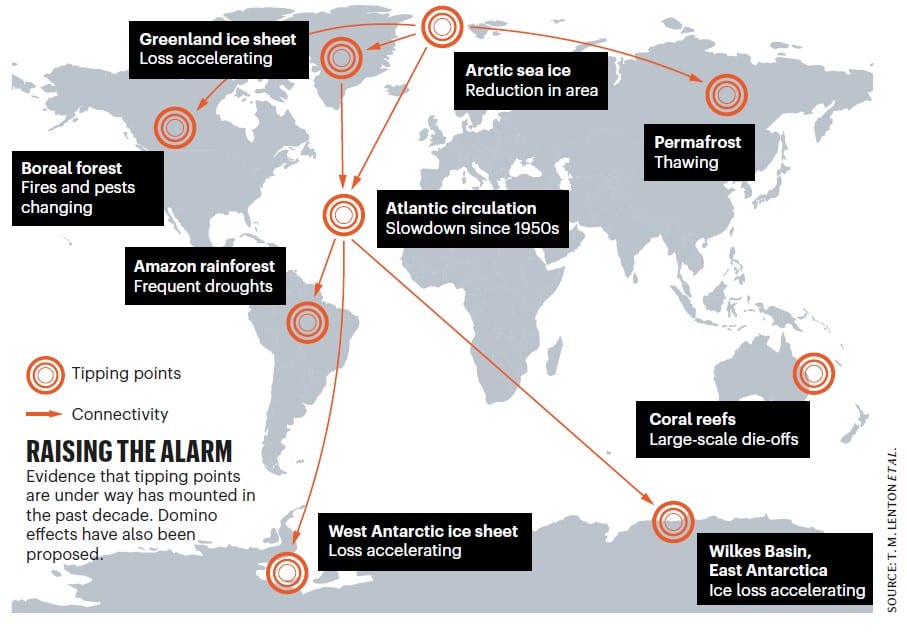
Examples of the kinds of tipping risks that matter
-
-
- Permafrost thaw: warming can release more greenhouse gases from frozen ground.
- Ice-sheet instability: parts of Greenland and Antarctica may become harder to stabilize once retreat passes certain thresholds.
- Amazon stress and dieback risk: heat, drought, and land clearing can weaken a major carbon sink.
- Ocean circulation change: changes in major currents can disrupt rainfall patterns, heat distribution, and regional climate stability.
- Coral reef collapse and biodiversity loss: ecosystem damage can accelerate food, fisheries, and livelihood disruptions.
-
The mainstream literature supports the idea that these risks are serious and increasingly relevant as warming rises. Job One goes further and argues that the interaction among multiple tipping elements could create a much faster and harsher real-world cascade than conventional policy planning assumes.
Whether one agrees with every number or not, the strategic lesson is sound: you do not gamble civilization on the hope that all major tipping risks will arrive late, slowly, one at a time, or not arrive at all.
Here are the climate consequences largely unavoidable, and what is still preventable
People do not actually live inside abstract ppm charts. They live inside bodies, homes, neighborhoods, payrolls, and budgets. So here is the blunt, practical distinction drawn from Job One’s primary and secondary climate change consequences page.
The rule of thumb is simple: prepare now for the consequences already underway and intensifying through the late 2020s and early 2030s, while fighting like sane adults to prevent the much worse layers that become more likely through 2035-2050.
Consequences are already underway enough that prudent households, communities, and businesses should prepare now
These are not identical everywhere, and local geography still matters. But the pattern is already established.
More dangerous heat, hotter nights, and fewer safe recovery periods (already underway; intensifying through 2026-2035).
For families: more heat illness risk, more stress on older adults, children, outdoor workers, pets, and anyone with heart or lung problems.
For businesses: lower work capacity, disrupted schedules, higher cooling costs, and more lost productivity.
Helpful preparation: build a home cooling plan, identify one safe, cooled room, test the air conditioning early, plan for backup power if you can, and adjust outdoor work hours before the heat does it for you.
Heavier downpours, flash flooding, river flooding, and sewage-contaminated cleanup (already underway; intensifying through 2026-2035).
For families: flooded roads, damaged cars, mold, ruined belongings, and ugly fights with insurers and contractors.
For businesses: inventory loss, closures, delivery delays, drainage failures, and repeated cleanup costs.
Helpful preparation: know your flood exposure, protect documents and digital backups, use water alarms or barriers where practical, and assume that “not in a floodplain” is not the same as “immune.”
Longer wildfire seasons, repeated evacuations, and smoke exposure far from the flames (already happening; intensifying through 2026-2035).
For families: respiratory irritation, disrupted school routines, evacuation stress, and sudden housing problems.
For businesses: staff absences, unsafe indoor air, temporary closures, transportation delays, and insurance strain.
Helpful preparation: keep N95 masks, improve indoor filtration, seal one cleaner-air room, maintain go-bags and document copies, and think of smoke as a regional health event, not just a forest event.
Direct health harms from heat, smoke, mold, polluted air, dirty floodwater, and shifting pests or disease vectors (already underway; intensifying through 2026-2035).
For families: this is where climate stops being a debate topic and becomes an emergency-room, pharmacy, and missed-work problem.
For businesses: higher absenteeism, higher health costs, and more vulnerability among workers doing physical or outdoor jobs.
Helpful preparation: treat air quality, cooling, basic first aid, medications, and post-disaster sanitation as part of climate planning, not as optional extras for nervous people.
Sea-level rise, tidal flooding, shoreline erosion, and saltwater intrusion in coastal zones (already happening; intensifying through 2026-2035, with much higher costs through 2035-2050 and beyond).
For families: repeated nuisance flooding can become a property-value, commuting, drainage, and drinking-water problem long before your street looks like a disaster movie.
For businesses: ports, roads, treatment systems, parking areas, and coastal facilities become harder and costlier to defend, insure, or relocate.
Helpful preparation: if you are near the coast, look past today’s waterline and assess repeat-flood exposure, drainage, saltwater risk, insurance trends, and the long-term cost of staying put.
Water stress, water-use restrictions, and local rationing pressure in vulnerable basins (already underway in some areas; intensifying through the 2020s and 2030s).
For families: higher bills, lawn and landscaping restrictions, lower water reliability, and, in some places, growing conflict over who gets cut first.
For businesses: operational limits, cooling and cleaning problems, agricultural losses, and more uncertainty in high-demand seasons.
Helpful preparation: reduce waste early, add water efficiency before shortages get stricter, understand your local water source, and do not assume the old normal will patiently return.
Insurance retreat, surging premiums, policy cancellations, and growing mortgage stress (already underway; intensifying rapidly through 2026-2035).
For families: the climate often introduces itself as a premium increase, a nonrenewal notice, or a deductible large enough to ruin your month.
For businesses: rising operating costs, lender problems, coverage gaps, and more pressure to relocate, retrofit, or self-insure part of the risk.
Helpful preparation: review coverage before renewal season, document property condition, reduce obvious vulnerabilities, and understand that uninsurability is one of the clearest early market signals that a location’s risk profile is changing.
Infrastructure outages and the fraying of ordinary daily reliability (already underway; intensifying through 2026-2035).
For families: more power outages, slower repairs, communications interruptions, spoiled food, and days where ordinary errands turn stupidly complicated.
For businesses: downtime, equipment failures, payroll disruption, IT risk, and customers who also cannot function because the same outage hit them too.
Helpful preparation: think less about one dramatic disaster and more about repeated smaller failures. Backup power, device charging, cash reserves, data backups, and continuity plans matter because reliability itself is becoming less reliable.
Rising household costs for food, electricity, repairs, taxes, and recovery (already underway; intensifying through 2026-2035).
For families: climate pressure often arrives as death by invoice. Food, insurance, cooling, repairs, and emergency costs stack on top of each other.
For businesses: higher utilities, repair bills, supplier costs, and pressure on customers whose own buffers are shrinking.
Helpful preparation: build more financial slack than seems emotionally convenient, because the people with the smallest buffer get hit first and hardest.

Here are the consequences that are still partly avoidable if global emissions fall FAR faster and resilience improves
These risks are already visible, but how large, how fast, and how widespread they become is still heavily shaped by global human choices to reduce fossil fuel use. That is why the article cannot end with a warning.
Much worse food-system breakdown and global price spikes (intensifying through 2026-2035; severe in many regions by 2035-2050).
We are already seeing crop stress, fishery damage, livestock stress, and rising food insecurity. What is still partly avoidable is the scale of repeat harvest failures, the persistence of shortages, and how badly this spills into malnutrition, panic pricing, and political instability.
Broader real-estate devaluation, stranded assets, and forced retreat from high-risk areas (expanding through 2026-2035; system-shaping through 2035-2050).
Some places are already wobbling. What is still partly avoidable is how much of the property market gets pulled into the mess, how many owners get trapped, and whether retreat is managed in an orderly way or as a financial stampede.
Deeper inflation, banking stress, and financial instability (emerging now; intensifying through the 2020s and 2030s; potentially severe by 2035-2050).
Climate losses can ripple from households to lenders to insurers to governments. Faster emissions cuts and better resilience reduce how often climate shocks become system-level financial shocks.
Mass displacement and migration pressure on supposedly safer areas (already happening; intensifying through 2026-2035; potentially enormous by 2035-2050).
Migration is one of the main ways climate change consequences cash out in real human life. What is still partly avoidable is the scale of forced movement, the speed of housing and service overload, and the ugliness of the backlash of nationalist and protectionist politics that often follows.
Authoritarian drift, democratic erosion, conflict, and security hardening (already visible in some places; intensifying through the 2020s and 2030s).
Climate stress does not automatically destroy democracy, but it can make fear, scapegoating, emergency powers, and coercive responses much more likely. Better adaptation, fairer burden-sharing, and faster mitigation reduce the chance that climate pain gets translated into political brutality.
Stronger tipping cascades and larger feedback-driven climate acceleration (risk rises through the 2030s and beyond).
This is the deepest reason Job One argues that time matters so much. The more committed warming and overshoot we pile up, the more we risk pushing major systems toward harder-to-reverse change or change that is only reversible over centuries to millennia. What is still partly avoidable is how many of those systems get pushed, how far they go, and how fast they interact.
Practical takeaway: prepare now for the consequences already in motion, and push hard to prevent the much worse layers that are still contingent. In plain English: defend your household, harden your business, help your community, and fight like hell to keep a bad future from becoming an even more absurdly bad one.
What this means for your life, family, property, and business
Climate danger is no longer just an environmental issue. It is a personal safety issue, a cost-of-living issue, a property-risk issue, a workplace issue, and a continuity-of-normal-life issue.
Most households and businesses will not experience climate change as one giant movie-scene catastrophe. They will experience it as recurring combinations of problems that arrive closer together, cost more, and leave less time to recover before the next climate change consequence, which will be more severe, more frequent, and on a larger scale as global temperatures rise.
The most common “climate hit patterns” for households
-
- Heat + outage: dangerous indoor temperatures, spoiled food, medication risk, sleep loss, and no easy escape if cooling centers are crowded or far away.
- Flood + sewage + mold + insurance fight: one event becomes four problems, and the paperwork can last longer than the storm.
- Fire season + smoke + school and work interruption: even if your house never burns, your lungs, routines, and income can still take the hit.
- Drought + water restrictions + food bills: scarcity shows up both at the tap and at the grocery store.
- Repeated disasters + rising premiums + falling property confidence: this is how climate risk slowly turns into a housing and wealth problem.
What this means for families
-
- Emergency planning now needs to include heat, smoke, outage, flood, and temporary relocation scenarios.
- Health planning now needs to include air filtration, cooling, medications, backup communication, and sanitation after disasters.
- Financial planning now needs a climate layer: insurance review, document protection, extra emergency savings, and honest location risk assessment.
- If you care for elders, children, disabled family members, or anyone with lung or heart problems, your climate-prep timeline is shorter, not longer.
What this means for homeowners, renters, and property owners
-
- Your true property risk is no longer just “Can I afford the mortgage?” It is also “Can I insure this, cool this, defend this, repair this, and still want to keep it in ten years?”
- For renters, climate risk shows up as displacement, rent spikes after disasters, unhealthy indoor air, and buildings that were not designed for repeated extremes.
- For owners, repeated events can turn a home from an asset into a liability faster than many people expect, especially when insurers or lenders start acting like adults before governments do.
What this means for businesses
-
- People risk: employees get sick, exhausted, displaced, or unable to commute.
- Facility risk: heat, flood, smoke, outage, and water stress damage operations.
- Supplier risk: one weak link elsewhere can shut you down locally.
- Insurance and finance risk: premiums rise, exclusions widen, and recovery capital gets harder to find.
- Customer risk: your customers are also living through the same climate pressure, which changes demand, timing, and affordability.
In practical terms, every business now needs some version of a climate continuity plan. Not because that is fashionable consultant jargon, but because repeated disruption is becoming a normal operating condition.
What this means for communities
-
- Communities that prepare only for one-off disasters will increasingly be preparing for the wrong thing.
- The harder challenge is repeated-shock resilience: how to recover, restore services, protect vulnerable people, and keep doing that without going broke or turning cruel.
- The best communities will invest early in cooling, clean air spaces, water reliability, backup power, resilient housing, and honest public communication.
That is why we keep insisting that climate consequences should never be presented as isolated events. The greatest danger is the compound effect: more hits, less recovery time, weaker institutions, and rising pressure on the very systems people depend on to protect them.

Where hope still lives: Job One’s Plan B
Hope does not live in denial. It does not live in empty optimism, magical carbon-sucking unicorns, or “net-zero by someday” slogans. Hope lives in useful action.
Job One’s great strength is that it does not stop with a warning. It points readers back to a four-part practical response plan.
The Job One Climate Change Plan B, in plain English
-
- Prepare. Build emergency readiness for the climate consequences that are already unavoidable.
- Adapt. Make the changes that improve resilience, reduce exposure, and lower personal and community vulnerability.
- Push for real policy action. Pressure governments and institutions to reduce fossil fuel use far faster and more honestly.
- Pursue accountability and climate justice. Use legal, political, and public-pressure tools to hold major actors responsible.
Even if humanity has already locked in serious damage, how we respond still determines:
-
- how many people live or die,
- how much suffering is reduced or amplified,
- how much ecological damage is limited,
- how much social order can be preserved, and
- whether future generations inherit breakdown alone or also inherit courage, preparation, and better systems.
That is not fake hope. It is disciplined hope. The kind that actually gets its boots on.
What readers should do next
-
- Read the full Job One Plan / Plan B page.
- Start with Part 1: emergency preparations if you live in a medium- to high-risk zone.
- Work through Part 2: adaptation and resilience.
- Use Part 3: government action strategy if you have political leverage or can help build it.
- Support Part 4: climate justice and accountability, where applicable.
Bottom line
Job One’s position is that humanity is already within a decisive window of climate danger. Current greenhouse gas levels, rising temperatures, stressed carbon sinks, delayed system responses, and tipping risks mean the future is getting harder to control, not easier.
That does not remove hope. It changes its form. Hope now means radical honesty, fast action, disciplined preparation, resilience-building, and accountability for the systems that created this emergency.
FAQ
Are we already out of time?
For avoiding all major climate harm, almost certainly yes. For reducing how bad it gets, no. There is still a huge difference between severe damage and far worse damage.
What does ppm mean?
It means parts per million. It is a way of measuring how much of a gas, such as carbon dioxide, is present in the atmosphere.
Why does Job One focus so much on atmospheric carbon levels?
Because greenhouse gas concentration is one of the clearest indicators of the long-term heating pressure we are putting on the climate system.
What is the difference between climate change, global warming, and global heating?
Global warming usually means the rise in Earth’s average temperature. Global heating is a blunter way of saying the same thing. Climate change is broader and includes shifting rainfall, drought, storms, sea-level rise, wildfire conditions, and ecosystem disruption.
What is a tipping point?
A tipping point is a threshold where a relatively small additional change can push a system into a much larger shift that may be rapid or hard to reverse.

Why are “net-zero by 2050” promises not enough by themselves?
Because a distant promise is not the same as immediate reductions. Many plans depend on future technology, offsets, or political follow-through that may never arrive at the needed scale.
Is carbon capture likely to save us in time?
Not at the scale needed for near-term safety planning. Some carbon removal may help later, but betting the house on an unproven, unscalable, and time-bound future large-scale rescue technology is reckless.
Where should an ordinary person start?
Start with practical preparation, resilience, risk reduction, and an honest look at your location, finances, and support systems. Then move outward into civic action and political pressure.
Why keep hope at all if the risks are this serious?
Because the size of the danger does not erase the moral difference between doing nothing and reducing suffering. Hope is not certainty of a perfect outcome. Hope is what keeps useful action alive.
What climate consequences should I treat as already unavoidable enough to prepare for now?
At minimum: more dangerous heat, more smoke exposure in many regions, more flood disruption in vulnerable areas, more insurance and cost pressure, more infrastructure outages, and more health burdens linked to heat, smoke, dirty water, and stress. Exact timing and location vary, but waiting for perfect certainty is a very expensive hobby.
Which major consequences are still partly avoidable?
The scale of food-system breakdown, forced migration, property devaluation, financial instability, conflict, and tipping-cascade acceleration is still shaped by what humanity does next. Serious mitigation and resilience work still matter because “bad” and “much worse” are not the same future.

Please donate any amount to help keep our 100% publicly funded nonprofit climate-change think tank available to everyone! Help us to keep providing uncensored climate change forecasts, facts, and solutions to the public. With every donation of any amount, you will get amazing gifts! Click the donate image below to see what these gifts are.

Glossary
A rapid climate shift that occurs fast enough to make adaptation difficult for natural or human systems.
The temporary cooling effect caused by human-made air pollution particles that reflect sunlight or change clouds. Cutting that pollution can reveal more underlying warming.
The reflectivity of a surface. Ice and snow have high albedo because they reflect more sunlight. Dark ocean and land absorb more heat.
The Atlantic Meridional Overturning Circulation, a major ocean current system that helps move heat through the Atlantic.
A long band of moisture in the atmosphere that can deliver very heavy rain or snow when it makes landfall.
The main long-lived greenhouse gas produced by fossil fuel burning, deforestation, and some industrial processes.
A natural or human-managed system that absorbs more carbon than it releases, such as forests, soils, or oceans.
A nonstandard phrase used on some Job One pages to describe a threshold beyond which risk rises sharply.
A measure of how much the Earth eventually warms when greenhouse gas levels rise, especially when CO2 doubles.
Future warming that is expected because of greenhouse gases already emitted, even if some effects take time to fully appear.
The planned movement of people, homes, or infrastructure away from places that are becoming too risky or too costly to defend.
A system made of many interacting parts that change, respond, and sometimes reorganize in nonlinear ways. The climate is one. So is human society.
A process where a change causes effects that then reinforce the original change. In climate, some feedbacks increase warming.
Job One’s term for the network of fossil fuel companies and aligned political, lobbying, and influence systems that have delayed honest climate action.
Greenhouse gas. A gas that traps heat in the atmosphere. Examples include CO2, methane, and nitrous oxide.
A more emotionally direct term for global warming.
The Intergovernmental Panel on Climate Change, the major United Nations body that assesses climate science.
A powerful greenhouse gas. It lasts for less time in the atmosphere than CO2 but traps much more heat per molecule over shorter time periods.
Actions that reduce greenhouse gas emissions or remove greenhouse gases from the atmosphere.
A state where human-caused greenhouse gas emissions are balanced by removals. In practice, the term is often misused in vague or overly optimistic ways.
A long-lived greenhouse gas produced mainly by agriculture, fertilizer use, and industry.
The U.S. National Oceanic and Atmospheric Administration.
A concentration measure used for gases present at lower levels than ppm.
A concentration measure meaning one part of a substance per million parts of air.
Very tiny air-pollution particles small enough to enter deep into the lungs and bloodstream. Wildfire smoke is a major source.
Ground that remains frozen for at least two consecutive years. It stores large amounts of carbon.
Job One’s practical climate response program focused on preparation, adaptation, resilience, political action, and accountability.
A feedback loop that amplifies a change. In climate discussions, it usually means a process that worsens warming.
The period before large-scale fossil fuel industrialization, often approximated as 1850-1900 for temperature comparisons.
The ability to withstand shocks, adapt, recover, and keep functioning.
Insurance bought by insurance companies to help cover very large losses. When reinsurers retreat, ordinary insurance often gets more expensive or harder to get.
The tendency of large systems, especially the ocean, to respond slowly to heating or cooling.
A threshold where a small extra push can trigger a much larger, sometimes hard-to-reverse shift.

The World Meteorological Organization.
References
Key external references
-
- NOAA Global Monitoring Laboratory. Trends in CO2.
- World Meteorological Organization. WMO confirms 2024 as warmest year on record at about 1.55°C above pre-industrial level.
- World Meteorological Organization. Carbon dioxide levels increase by record amount to new highs in 2024.
- Hansen, J. et al. (2008). Target Atmospheric CO2: Where Should Humanity Aim?
- Hansen, J. et al. (2023). Global Warming in the Pipeline.
- IPCC AR6 Working Group I. Chapter 4 and Chapter 9.
- IPCC Special Report on 1.5°C. Chapter 2.
- Lenton, T. M. et al. (2019). Climate tipping points — too risky to bet against.
Bibliography
-
- Hansen, J., Sato, M., Kharecha, P., et al. (2008). Target Atmospheric CO2: Where Should Humanity Aim?
- Hansen, J., Sato, M., Simons, L., et al. (2023). Global Warming in the Pipeline. Oxford Open Climate Change.
- IPCC. (2018). Global Warming of 1.5°C.
- IPCC. (2021). Climate Change 2021: The Physical Science Basis.
- IPCC. (2023). Climate Change 2023: Synthesis Report.
- Lenton, T. M., Rockström, J., Gaffney, O., et al. (2019). Climate tipping points — too risky to bet against. Nature.
- Möller, T., et al. (2024). Achieving net zero greenhouse gas emissions critical to limit climate tipping risks. Nature Communications.
- NOAA Global Monitoring Laboratory. Trends in Atmospheric CO2.
- World Meteorological Organization. (2025). WMO confirms 2024 as warmest year on record at about 1.55°C above pre-industrial level.
- World Meteorological Organization. (2025). Carbon dioxide levels increase by record amount to new highs in 2024.
Job One internal links used in this rewrite
This list is here so nothing important gets lost when the page is moved, trimmed, or restructured. Because websites, like governments, have a tragic habit of dropping the useful part just when you need it.
-
- Climate Change Solutions: Our Plan B
- Why Our Climate Forecasts Are Better
- What Is Climate Change and Global Warming?
- Primary and Secondary Climate Change Consequences
- The Climageddon Feedback Loop
- The 11 Big Climate Tipping Points
- What Is Irreversible Global Warming?
- Critical Climate Consequence Timeframes
- The Correct 2025 Global Fossil Fuel Reduction Dates & Targets
- Garrett’s Climate Change Dilemma
- Carbon Capture Won’t Save Us in Time
- Thwaites “Doomsday Glacier” Threat
- Climate Change FAQ
- Part 1: Climate Emergency Preparations
- Part 2: Climate Adaptation and Resilience
- Part 3: Government Action Strategy
- Part 4: Climate Justice Trial / Accountability
- Important clarification: the exact meaning of 386 ppm and 425-450 ppm is Job One’s house framework, not a universally accepted official threshold system. The broader scientific literature strongly supports rising risk with rising greenhouse gases, but some of the specific phase language on the original page needs careful attribution and tighter sourcing.
Final editorial note: This page is strongest when it says, “The danger is real, the trends are worsening, the official story is too comforting, and serious preparation plus faster fossil fuel cuts are now morally and practically necessary.” That argument is powerful, defensible, and useful. It does not need unsupported overprecision to hit hard.

To help do something about the climate change and global warming emergency, click here.
Sign up for our free Global Warming Blog by clicking here. (In your email, you will receive critical news, research, and the warning signs for the next global warming disaster.)
To share this blog post: Go to the Share button to the left below.
Showing 1 reaction